
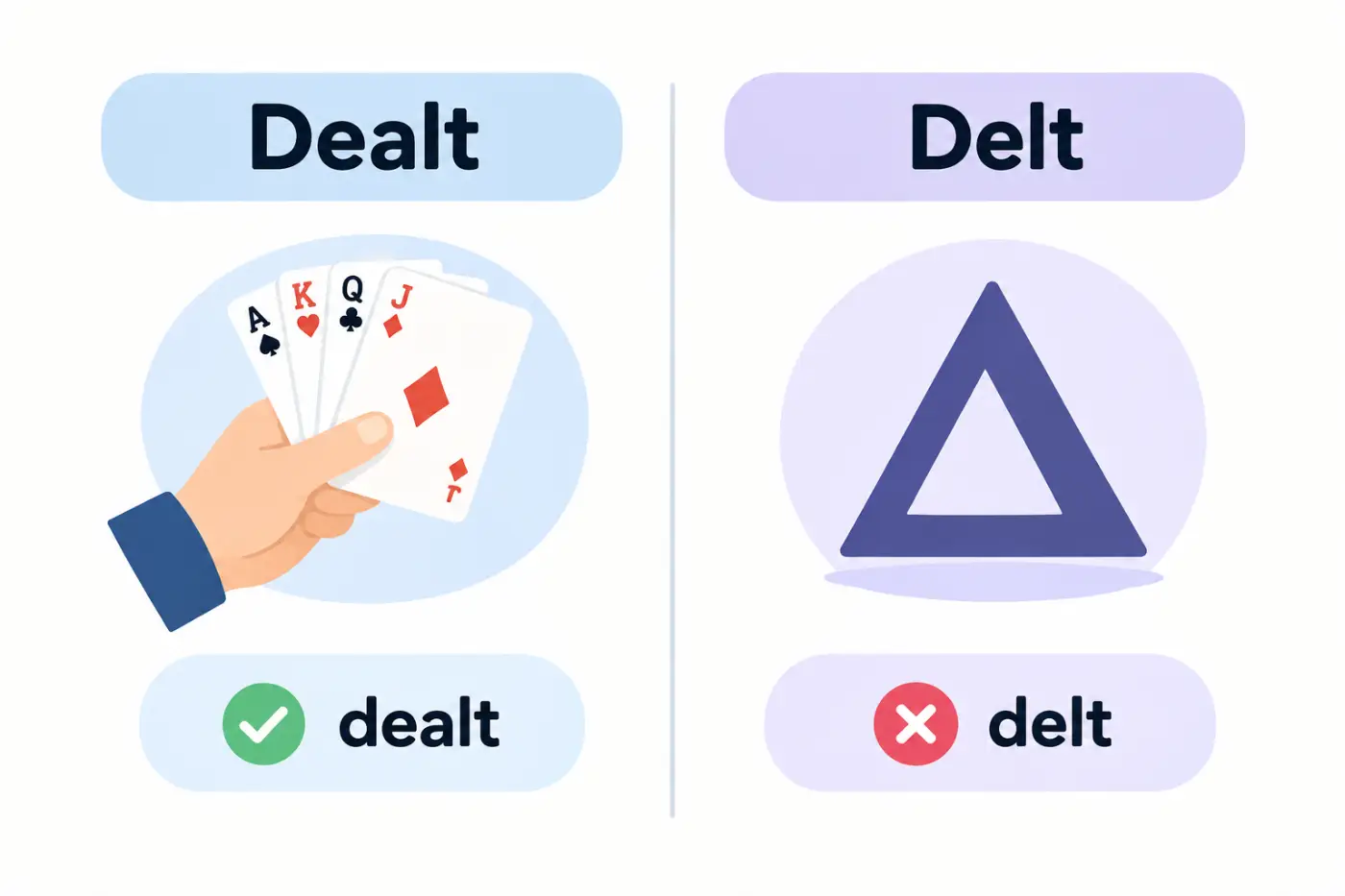
If you’re confused by dealt vs delt you only need to remember one thing at first. Dealt is the correct spelling when you mean the past tense or past participle of deal. Delt is not the standard spelling of that verb.
The confusion makes sense because dealt doesn’t look like a regular past tense. You don’t simply add ed to deal. Instead the word changes from deal to dealt. That small spelling change can make the correct form easy to forget.
You’ll see this word in phrases such as dealt with a problem, dealt the cards, and dealt with a difficult situation. It can describe handling something or giving out cards in a card game. It can also appear in expressions about business, treatment, and personal situations.
This guide explains the difference in plain English. You’ll learn what dealt means, why delt is incorrect, how to use the word in real sentences, and how to remember the spelling without second guessing yourself.
Quick Definition
Dealt is the past tense and past participle of deal. It can mean handled something, took action about a situation, or gave cards to players in a card game. Delt is not the standard English spelling of this word.
Direct Answer
Dealt is correct. Delt is incorrect when you mean the past tense of deal.
Comparison Table
| Word | Meaning | Example Sentence | When to Use It |
|---|---|---|---|
| Dealt | Past tense and past participle of deal. | She dealt with the problem quickly. | Use it when talking about something you handled or distributed in the past. |
| Delt | Not the standard spelling of the past tense of deal. | Delt is incorrect in standard English. | Do not use it as the past tense of deal. |

What Does Dealt Mean
The word dealt has several related meanings because the verb deal can describe more than one action. The most common meaning is to handle or take care of something.
For example, you might say that a manager dealt with a customer complaint. This means the manager handled the complaint and took steps to solve it. You could also say that a person dealt with a difficult situation. In that case, the person faced the situation and managed it in some way.
The word also has a second common meaning connected to card games. When someone gives cards to players, we say that person deals the cards. The past form is dealt.
For example, you might say, “The dealer dealt five cards to each player.” The word means the cards were distributed to the players.
There is also a third use connected to buying and selling. Someone can deal in a particular product or trade. For example, a company may deal in used cars. The past form can describe that activity too.
These meanings may look different at first. They all connect to the basic idea of handling, distributing, or taking part in something.
Why Dealt Is Spelled That Way
The main reason this word causes trouble is that deal does not form its past tense by simply adding ed. Instead, it is an irregular verb.
Regular verbs usually form the past tense in a predictable way. For example, walk becomes walked and clean becomes cleaned. Deal follows a different pattern.
The present form is deal. The past form is dealt. The past participle is also dealt.
You can see the pattern clearly in these examples.
- I deal with customer questions every day.
- I dealt with three customer questions yesterday.
- I have dealt with similar problems before.
The vowel changes from ea in deal to ea in dealt while the word gains a final t. That makes it different from regular verbs that simply take an ed ending.
Deal In The Present Tense
Use deal when the action happens now or happens regularly.
- I deal with customer complaints at work.
- She deals with difficult situations calmly.
- They deal with suppliers from several states.
The form changes depending on the subject. With he, she, or it, use deals.
Dealt In The Past Tense
Use dealt when the action happened in the past.
- I dealt with the issue yesterday.
- She dealt with the customer politely.
- They dealt with the problem before the meeting.
The same past form works with every subject. You don’t say de alt for one person and a different form for another.
For example, all of these are correct.
- I dealt with it.
- You dealt with it.
- He dealt with it.
- We dealt with it.
- They dealt with it.
Dealt As A Past Participle
Dealt also works as a past participle. You usually see it with helping verbs such as have, has, or had.
- I have dealt with this issue before.
- She has dealt with several difficult clients.
- We had dealt with the problem before the meeting started.
This form talks about a completed action while connecting it to another point in time.
Dealt With Meaning
One of the most common phrases you’ll see is dealt with. It means handled, managed, or took action about something.
For example, if you say, “The teacher dealt with the issue quickly,” you’re saying the teacher handled the issue.
The phrase works with many different situations.
- The doctor dealt with the patient’s concerns.
- Our team dealt with the technical problem.
- She dealt with the complaint professionally.
- He dealt with the stress by taking a short break.
The noun after with can describe a problem, person, situation, concern, or task. The exact meaning depends on the sentence.
Dealt With A Problem
This is one of the most common uses.
- We dealt with the problem before it became serious.
- The manager dealt with the complaint this morning.
In both sentences, the person or group took action instead of ignoring the situation.
Dealt With A Person
The phrase can also describe how someone handled another person.
- She dealt with the angry customer calmly.
- The coach dealt with the players fairly.
Here the focus is on the way someone managed an interaction.
Dealt With A Situation
You can also use the phrase for a difficult event or circumstance.
- He dealt with the situation better than I expected.
- They dealt with the emergency quickly.
This use often suggests that someone faced a challenge and managed it.
Dealt In Card Games
Another common meaning appears in card games. To deal cards means to give cards to the players.
The present tense uses deal.
- I deal the cards before every round.
- She deals five cards to each player.
The past tense uses dealt.
- I dealt the cards before the game started.
- She dealt five cards to each player.
This is one of the easiest ways to see why the spelling matters. Delt does not work as the past form.
You may also hear the phrase the cards were dealt. This uses the passive voice and means someone distributed the cards.
For example, you could write, “Once the cards were dealt, everyone looked at their hands.”
The word can also appear in figurative expressions. The phrase deal with the hand you’re dealt means you have to handle the situation you have been given. It comes from card games but people often use it when talking about life or difficult circumstances.
Common Sentences With Dealt
The best way to become comfortable with an irregular verb is to see it in natural sentences. These examples show several common uses.
- She dealt with the problem before lunch.
- We dealt with a similar issue last year.
- He dealt with the customer in a calm way.
- The teacher dealt with the situation fairly.
- They dealt the cards and started the game.
- I have dealt with this kind of request before.
- The company dealt with the complaint quickly.
- The players waited until the cards were dealt.
- She had already dealt with the problem when I arrived.
- He dealt fairly with everyone involved.
Notice that the word does not always mean exactly the same thing. Context tells you which meaning applies.
In one sentence, dealt can mean handled a problem. In another, it can mean distributed playing cards. The spelling stays the same in both cases.
Common Mistakes With Dealt
The most common mistake is changing deal into delt because the shorter form may seem natural when you’re speaking quickly. English pronunciation can make some words sound shorter than they look when written. That can lead people to leave out the a when they type the past form.
The correct spelling keeps the ea from the original word. Think of the pair as deal and dealt. The final t changes the tense while the main vowel pattern stays in place.
For example, these sentences use the correct form.
- I dealt with the issue yesterday.
- She dealt with the complaint professionally.
- We dealt with the problem before it got worse.
These sentences are incorrect if you use delt as the past form.
- I delt with the issue yesterday.
- She delt with the complaint professionally.
- We delt with the problem before it got worse.
A quick visual check can help. If you’re writing the past tense of deal, look for the ea before the final t.
Deal Dealt And Dealt In Different Tenses
Understanding the three main forms makes this verb much easier to use. The base form is deal. The simple past form is dealt. The past participle is also dealt.
You can see the pattern in this group of sentences.
- I deal with emails every morning.
- I dealt with the emails yesterday.
- I have dealt with those emails already.
The first sentence describes a regular or current action. The second describes an action that happened in the past. The third uses the past participle with have.
Simple Present
Use deal when something happens now or happens regularly.
- I deal with customer questions every day.
- She deals with billing issues.
- They deal with several suppliers.
When the subject is he, she, or it, add s to the base form.
- He deals with difficult cases.
- She deals with complaints.
- The department deals with refunds.
Simple Past
Use dealt when the action happened in the past.
- I dealt with the issue yesterday.
- She dealt with the customer last week.
- They dealt with the complaint before the meeting.
The form stays the same for every subject. You don’t add another ending for different people.
- I dealt with it.
- You dealt with it.
- He dealt with it.
- We dealt with it.
- They dealt with it.
Present Perfect
Use have dealt or has dealt when you want to connect a past action to the present.
- I have dealt with this problem before.
- She has dealt with similar cases.
- We have dealt with several complaints this month.
The word dealt stays unchanged. The helping verb does the work of showing the tense.
Past Perfect
Use had dealt when one past action happened before another past action.
- We had dealt with the complaint before the manager arrived.
- She had already dealt with the issue when I called.
This form can help make the order of past events clear.
Dealt With Vs Handled
Dealt with and handled often have similar meanings. Both can describe taking care of a problem or situation.
For example, these sentences have almost the same meaning.
- The manager dealt with the complaint.
- The manager handled the complaint.
The word handled can sound a little more direct in some situations. Dealt with is also very common and natural in everyday English.
You can use either phrase when talking about a problem that someone has taken care of.
- She handled the issue quickly.
- She dealt with the issue quickly.
The choice often depends on personal style. Neither sentence needs a different spelling rule.
Dealt With Vs Dealt To
These two phrases look similar but they have very different meanings.
Dealt with usually means handled or managed something.
- We dealt with the problem quickly.
Dealt to appears in a different structure. It often describes giving someone something unpleasant or harmful.
For example, you might hear:
- The storm dealt a serious blow to the town.
- The team dealt a crushing defeat to its opponent.
In these sentences, dealt means gave or caused something. The word does not mean handled a problem.
This distinction matters because the phrase after the verb changes the meaning. If you mean managed a situation, dealt with is usually the phrase you need.
Dealt A Blow Meaning
You may also see dealt a blow in news reports and everyday writing. This expression means that someone or something caused a serious setback.
For example:
- The injury dealt a major blow to his season.
- The decision dealt a blow to the company’s plans.
Here dealt comes from the idea of giving something. A blow is something that is delivered or given. The expression can be literal in some contexts but it is usually figurative.
You can also use deal a blow in the present tense.
- The new rule could deal a major blow to small businesses.
The past form changes it to dealt a blow.
Dealt With People Fairly
The word can also describe treating people in a certain way. When someone says that a person dealt fairly with others, they mean that person acted in a fair and honest way.
For example:
- The manager dealt fairly with both employees.
- She dealt with everyone respectfully.
- He dealt honestly with his customers.
This use is especially common when talking about behavior. It focuses less on solving a problem and more on how someone treated another person.
You can also use the word in a negative context.
- The company dealt unfairly with its workers.
- He felt that the referee had dealt harshly with him.
The basic meaning remains connected to handling or treating a person or situation.
Why Delt Looks Like It Could Be Correct
There is a good reason the incorrect spelling can look believable. English has several irregular verbs where a vowel changes or disappears in the past tense.
Consider these examples.
- Feel becomes felt.
- Keep becomes kept.
- Sleep becomes slept.
- Leave becomes left.
- Deal becomes dealt.
Because feel changes to felt and keep changes to kept, some writers naturally expect deal to become something like delt. The problem is that English does not use the same pattern for every verb.
The correct form keeps the ea spelling.
Deal → dealt.
Once you connect this word with other irregular verbs you can understand why the mistake happens. At the same time, you need to remember that each verb has its own established form.
A Simple Memory Trick
One easy trick is to picture the word deal first. Then add t.
Deal + t = dealt.
This isn’t a general rule for every English verb. It is simply a useful memory aid for this particular word.
You can also remember the phrase deal with it. Change it to the past and you get dealt with it.
For example:
- Present: I deal with the problem.
- Past: I dealt with the problem.
That small connection can make the correct spelling much easier to recall when you’re writing quickly.
Examples To Practice
Try reading these sentences aloud and notice how the spelling stays consistent.
- I deal with customer emails every morning.
- I dealt with the emails yesterday.
- She deals with difficult customers.
- She dealt with a difficult customer yesterday.
- We deal with these requests regularly.
- We dealt with several requests last week.
- He deals the cards at the start of each round.
- He dealt the cards before dinner.
- I have dealt with this issue before.
- They had dealt with the problem before the meeting.
The contrast between deal and dealt is especially useful. It lets you see how the same verb changes depending on the time of the action.
Dealt In Business English
You may see this word often in workplace writing. Employees deal with customers, clients, complaints, orders, deadlines, payments, and other business matters.
For example:
- Our sales team dealt with the client directly.
- The manager dealt with the complaint before the end of the day.
- We have dealt with similar requests from other customers.
- The company dealt fairly with its suppliers.
In these examples, the word usually means handled or managed something.
The phrase dealt with is especially useful because it works in both casual and professional writing. You can use it in an email to a coworker or in a formal report.
For example, a manager might write, “The issue was dealt with promptly.” A coworker might simply say, “I dealt with it this morning.”
Both sentences use the same past form.
Dealt In Card Games
Card games provide another useful way to remember the word. The person who distributes the cards is often called the dealer. The dealer deals the cards during the game.
Once the action is finished, you use dealt.
- The dealer dealt five cards to each player.
- The cards were dealt face down.
- Once the cards were dealt, the players started betting.
This meaning is completely different from handling a problem but the spelling is the same.
You can also use deal as a noun in card games.
For example:
- That was a lucky deal.
- The dealer started a new deal.
But when you’re describing the action of giving out the cards, the verb forms are deal and dealt.
Dealt In Common Expressions
Several everyday expressions use this word. Learning them as complete phrases can make your writing more natural.
Deal With The Consequences
This means facing the results of an action or decision.
- He knew he had to deal with the consequences of his choice.
- The company now has to deal with the consequences of the mistake.
Deal With Stress
This means manage or cope with stress.
- She deals with stress by taking long walks.
- He dealt with the pressure by staying focused on the task.
Deal With A Challenge
This means handle a difficult task or situation.
- The team dealt with the challenge successfully.
- She dealt with a difficult situation at work.
Deal With A Customer
This means interact with and help a customer.
- I deal with customers every day.
- She dealt with the customer politely.
When you put these expressions into the past tense, deal changes to dealt.
- I dealt with the customer yesterday.
- She dealt with the challenge successfully.
- He dealt with the consequences of his decision.
That consistent pattern is one of the easiest ways to make the spelling stick.
How To Use Dealt Correctly
The easiest way to use dealt correctly is to first identify the base verb. If the verb you need is deal and the action happened in the past then the correct past form is dealt.
For example if you want to say that you handled a customer complaint yesterday you could write:
- I dealt with the complaint yesterday.
If you’re talking about something that happens regularly you need the present form instead.
- I deal with customer complaints every day.
The time of the action helps you choose the right form. This simple check can prevent many mistakes.
When To Use Deal Instead
Use deal when you’re talking about something happening now or something that happens regularly. It can also appear after words such as will, can, should, and must.
For example:
- I deal with customer questions every morning.
- We will deal with the issue tomorrow.
- She can deal with difficult situations.
- You should deal with the problem quickly.
- They must deal with the complaint before Friday.
Notice that you don’t use the past form after these modal verbs. The base verb comes after them.
You would not write:
- We will dealt with the issue.
The correct sentence is:
- We will deal with the issue.
This is a common grammar mistake because the sentence already refers to the future. The helping verb will carries the tense so the main verb stays in its base form.
When To Use Dealt Instead
Use dealt when the action has already happened.
You can use it for a finished event in the past.
- She dealt with the problem yesterday.
- We dealt with the complaint last week.
- He dealt the cards before the game started.
You can also use it with have, has, or had.
- I have dealt with this problem before.
- She has dealt with several difficult customers.
- They had dealt with the issue before the meeting.
A useful test is to ask yourself when the action happened. If you’re talking about a finished action and the base verb is deal, you probably need dealt.
Dealt With Problems And Challenges
One of the most useful patterns is dealt with. It can describe how someone handled a problem, challenge, concern, or difficult situation.
For example:
- The team dealt with the technical issue quickly.
- She dealt with the customer complaint calmly.
- We dealt with the emergency as soon as we heard about it.
- He dealt with the pressure better than expected.
The phrase doesn’t always mean that the problem disappeared completely. It simply means that someone took action and handled the situation.
For instance, if a manager deals with a complaint, the complaint might be solved. The manager might also investigate it or pass it to someone else. The phrase focuses on the action taken rather than the final result.
Dealt With People
You can also use dealt with when describing an interaction with another person.
- She dealt with the customer patiently.
- He dealt with the children kindly.
- The manager dealt with the employee fairly.
In these sentences the word can describe the way someone treated or handled another person.
The adverb often gives extra meaning. Compare these examples.
- She dealt with the customer.
- She dealt with the customer politely.
- She dealt with the customer firmly.
- She dealt with the customer unfairly.
The basic verb stays the same while the adverb tells the reader how the interaction happened.
Dealt Cards And Card Games
The card game meaning deserves special attention because it is common and easy to understand.
When someone gives cards to players the verb is deal.
- The dealer deals the cards.
When that action happened in the past use dealt.
- The dealer dealt the cards.
You can also use the passive form.
- The cards were dealt before the game began.
Here the players aren’t doing the action. Someone else gives them the cards. The word dealt still shows that the action happened.
This meaning appears in phrases such as dealt a hand and dealt five cards.
- Each player was dealt five cards.
- She was dealt a strong hand.
- He was dealt a weak hand in the first round.
The same idea appears in the expression the hand you’re dealt. It refers to the circumstances or opportunities a person has been given.
The Meaning Of The Hand You Are Dealt
The phrase the hand you’re dealt comes from card games. In a card game you can’t always choose the cards you receive. You have to make the best choices with what you get.
People use this idea outside card games too.
For example:
- You can’t choose every problem that comes your way. You have to work with the hand you’re dealt.
- She made the best of the hand she was dealt.
In these sentences the phrase means the circumstances or challenges someone has received. It doesn’t refer to actual playing cards.
This is a good example of how a simple verb can become part of a wider expression in English.
Dealt With In Passive Sentences
You may sometimes see dealt with in passive sentences. The structure changes but the meaning stays clear.
For example:
- The complaint was dealt with quickly.
- The issue was dealt with by the manager.
- The problem had already been dealt with.
These sentences focus on the problem rather than the person who handled it.
The active version would be:
- The manager dealt with the complaint quickly.
The passive version becomes:
- The complaint was dealt with quickly.
Both sentences describe the same basic event. The difference is where the sentence puts its focus.
Common Grammar Mistakes
Spelling isn’t the only issue people have with this verb. Some mistakes happen because writers choose the wrong verb form.
Using Dealt After Will
Incorrect:
- We will dealt with the issue tomorrow.
Correct:
- We will deal with the issue tomorrow.
After will use the base form deal.
Using Deal For A Finished Action
Incorrect:
- I deal with the complaint yesterday.
Correct:
- I dealt with the complaint yesterday.
The word yesterday clearly places the action in the past. That means you need the past form.
Adding Ed To Deal
Incorrect:
- She dealed with the problem.
Correct:
- She dealt with the problem.
Deal is an irregular verb. You don’t make its past tense by adding ed.
This is a useful point to remember because regular verbs follow a different pattern.
- Walk becomes walked.
- Call becomes called.
- Clean becomes cleaned.
But:
- Deal becomes dealt.
Using Delt In Formal Writing
Incorrect:
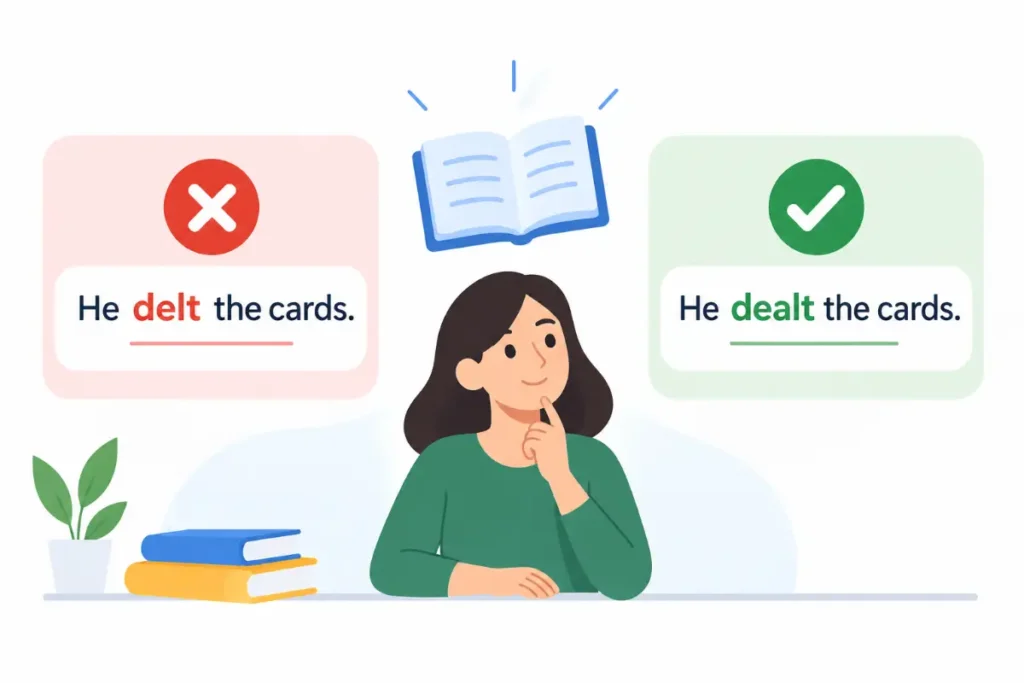
- The manager delt with the complaint.
Correct:
- The manager dealt with the complaint.
The shorter spelling may appear in informal writing or online posts because people make quick spelling mistakes. It isn’t the standard English form.
Related Irregular Verbs
Learning deal alongside other irregular verbs can help you understand why its past form doesn’t follow the usual ed pattern.
Here are a few common examples.
| Present Form | Past Form | Example |
|---|---|---|
| Deal | Dealt | We dealt with the problem. |
| Feel | Felt | She felt tired after work. |
| Keep | Kept | He kept the receipt. |
| Leave | Left | They left early. |
| Sleep | Slept | I slept well last night. |
| Meet | Met | We met after lunch. |
| Sell | Sold | She sold her old car. |
There isn’t one rule that explains every irregular verb. English developed these forms over a long period of time and many older patterns remain in modern use.
The best approach is to learn each common verb as a pair. When you see deal, connect it with dealt. That association becomes stronger every time you use it.
A Quick Editing Test
If you’re proofreading your writing and aren’t sure about the spelling, use a simple three step check.
First find the base verb. Ask yourself if you mean deal.
Next decide when the action happened. If it happened in the past, use the past form.
Finally look at the spelling. The correct form contains ea before the final t.
You can apply the test to this sentence:
- She delt with the complaint yesterday.
The base verb is deal. The word yesterday tells you the action happened in the past. The correct past form is dealt.
So the final sentence is:
- She dealt with the complaint yesterday.
This method works well when you’re writing quickly because it gives you a clear process instead of relying on guesswork.
How To Remember The Difference
A simple memory trick is to connect deal with dealt as a pair.
Think:
Deal today. Dealt yesterday.
For example:
- I deal with the issue today.
- I dealt with the issue yesterday.
You can also connect the word with the phrase dealt with. If you remember that common phrase you will naturally remember the spelling.
Another useful trick is to picture the word deal and add the final t.
deal + t = dealt
The spelling isn’t based on a rule that you can apply to every English verb. It’s simply a practical way to remember this particular word.
Once the correct form becomes familiar you won’t need the trick very often. You’ll start recognizing dealt immediately.
FAQs
Is dealt the correct spelling?
Yes. Dealt is the correct spelling for the past tense and past participle of deal. Delt is not the standard English spelling of this verb.
Is delt a real word?
Delt isn’t the standard past form of deal in English. If you mean that someone handled a problem or distributed cards in the past then use dealt.
What is the past tense of deal?
The past tense of deal is dealt. For example, you can say, “She dealt with the problem yesterday.” The same form works with every subject.
Why is deal changed to dealt?
Deal is an irregular verb. Instead of adding ed like regular verbs such as walk and walked, it changes to dealt in the past tense.
Is it dealed or dealt?
Dealt is correct. You should not add ed to make the past tense. The sentence “He dealt with the issue” is correct while “He dealed with the issue” is not.
What does dealt with mean?
Dealt with usually means handled or managed something. For example, “The manager dealt with the complaint” means the manager took action to handle the complaint.
What does dealt mean in card games?
In card games, dealt means that cards were given to players. For example, “The dealer dealt five cards to each player.” It is the past form of deal in this context too.
How can I remember the spelling?
Connect deal and dealt as a pair. A simple memory trick is deal today and dealt yesterday. You can also remember that the correct past form keeps the ea and adds the final t.
Conclusion
When you’re deciding between dealt vs delt, the correct choice is dealt. It is the past tense and past participle of deal. The spelling delt is not the standard form used in English.
The verb deal has several meanings. It can mean handling a problem, managing a situation, treating someone in a certain way, or distributing cards in a game. In all of these past tense uses, the form stays dealt.
A useful way to remember it is to connect deal with dealt. Think about the difference between “I deal with problems every day” and “I dealt with the problem yesterday.” The change is simple once you see the pattern.
So the next time you’re unsure, don’t guess based on how the word sounds. Find the base verb and remember its past form. Deal becomes dealt. That one small connection will help you spell the word correctly every time.

Dr. Elena Vance holds a Ph.D. in Linguistics from Columbia University and has spent over 15 years analyzing the evolution of the English language. A former university professor turned full-time writer and editor, Elena specializes in breaking down high-level grammatical concepts, punctuation nuances, and style guides (APA, Chicago, MLA) into clear, actionable advice. When she isn’t hunting down dangling modifiers, she can be found collecting vintage dictionaries and reading classic literature.