
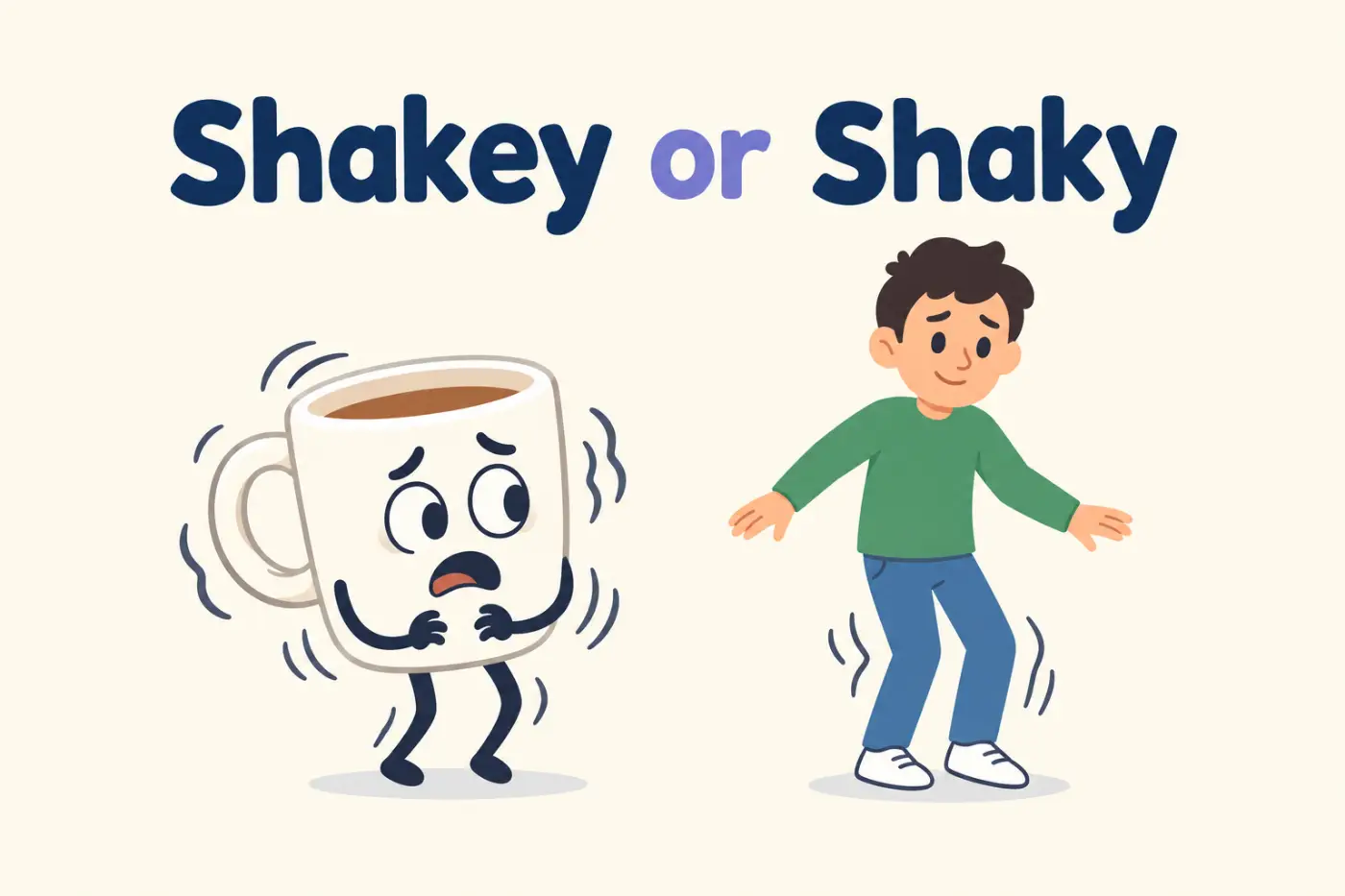
If you’re wondering about shakey or shaky the correct spelling is shaky. The spelling shakey is usually a mistake when you mean something that shakes or feels unsteady.
This confusion is easy to understand. The word sounds like it could end in ey because many English words use that ending. But shaky follows a different spelling pattern. Once you know the pattern you won’t have to guess again.
In this guide you’ll learn why shaky is correct how the word is formed and how to use it naturally. We’ll also look at common mistakes related words and examples that show exactly how the word works in real English.
Quick Definition
Shaky is an adjective that means unsteady trembling or not firm. It can describe something physical such as a shaky table or a person with shaky hands. It can also describe something uncertain or unreliable such as a shaky plan or a shaky argument.
Direct Answer
Shaky is the standard and correct spelling. Shakey is generally an incorrect spelling when you mean unsteady trembling or uncertain.
Comparison Table
| Word | Meaning | Example Sentence | When to Use It |
|---|---|---|---|
| Shaky | Unsteady trembling uncertain or unreliable. | My hands were shaky after the long run. | Use this spelling in standard English. |
| Shakey | Usually a misspelling of shaky. | The table is shakey. | Avoid this spelling in normal writing. |
Why People Get Shaky Wrong
The confusion comes from the ending. When people hear shaky they may naturally think the word should end in ey. English has many words with that ending so the guess doesn’t seem unreasonable.
For example words such as key honey and money can make the spelling pattern feel familiar. Yet English does not use one ending for every word that has a similar sound. The spelling depends on how the word was formed.
There is another clue that makes the correct spelling easier to remember. Shaky comes from the verb shake. When we add the suffix y to describe something that has the quality of the base word we get shaky.
Think of the relationship like this.
Shake → shaky.
The final e in shake drops before the y is added. That gives us shaky rather than shakey.
This small spelling change follows a common pattern in English. Once you see the connection between shake and shaky the correct form becomes much easier to remember.
The Spelling Rule Behind Shaky
The best way to understand this word is to look at its base word. The base word is shake. When the adjective shaky is formed the final e is removed and y is added.
So the spelling develops like this.
Shake → shak + y → shaky.
You don’t keep the final e from the original verb. That gives you the standard spelling used in dictionaries and edited English.
The same kind of change happens with many other English words. A word ending in a silent e can lose that e before a suffix begins with a vowel. The exact rule depends on the suffix and the word, but this pattern is common enough to be useful.
For this particular word you don’t need to memorize a complicated grammar rule. Just connect the adjective to its base verb.
Shake gives you shaky.
That connection is more useful than trying to remember the spelling of the adjective by sound alone.
What Does Shaky Mean
Shaky has several related meanings. The basic idea is a lack of steadiness.
The most literal meaning describes physical movement. Something shaky moves slightly or trembles instead of staying still.
For example:
- The old chair felt shaky.
- His hands were shaky after the workout.
- The ladder looked shaky against the wall.
- She walked across the shaky bridge carefully.
In these sentences the word describes something physically unstable.
But shaky doesn’t always describe movement. It can also describe something that isn’t reliable or convincing.
For example:
- The company has a shaky financial record.
- His excuse sounded shaky.
- Their plan is still shaky.
- The witness gave a shaky account of what happened.
Here the word has a more figurative meaning. It suggests doubt or weakness rather than physical trembling.
The Two Main Uses Of Shaky
Understanding these two uses will help you recognize the word in almost any sentence.
Shaky As Physically Unsteady
The first use relates to movement balance or stability. A person can have shaky hands. A building can have a shaky structure. A table can feel shaky because one leg isn’t level.
For example:
- This desk is shaky and needs to be fixed.
- My voice was shaky during the presentation.
- The puppy stood on its shaky legs.
- The camera produced shaky video.
In each case the subject isn’t completely steady.
Sometimes the cause is obvious. A table might wobble because one leg is short. A person’s hands might tremble after exercise. A video might shake because the person holding the camera is moving.
Shaky As Uncertain Or Weak
The second use is more abstract. It describes something that lacks strength confidence or reliability.
For example:
- The team’s financial situation is shaky.
- That argument rests on shaky evidence.
- She has a shaky understanding of the subject.
- Their agreement is on shaky ground.
The phrase on shaky ground is especially common. It means a person or situation is in an uncertain or weak position.
For example:
- The business is on shaky ground after several months of losses.
- His explanation put him on shaky ground during the debate.
Nobody is suggesting that the person is literally standing on a shaking floor. The phrase uses physical instability as a picture for uncertainty.
Shaky In Everyday Conversations
You don’t need formal language to use this adjective. It fits naturally into everyday speech.
Imagine a friend has just finished a difficult workout. You might say:
- Your legs look shaky.
If someone has just given a nervous speech you could say:
- Your voice sounded a little shaky.
If a piece of furniture needs repair you might say:
- That chair is pretty shaky.
If someone presents an argument that doesn’t seem convincing you could say:
- That sounds like a shaky argument.
The word works well because it gives a clear picture. Instead of saying something is simply unstable or uncertain you can choose shaky when you want a more natural conversational tone.
Examples With Shaky
Context makes spelling and meaning easier to remember. Read these examples and notice how the adjective changes slightly depending on what it describes.
Shaky Hands
Shaky hands means hands that are trembling or unsteady.
- My hands were shaky after carrying those heavy boxes.
- She had shaky hands because she was nervous.
- His shaky hands made it hard to write clearly.
Shaky Voice
A shaky voice sounds unsteady. It can happen because someone is nervous upset frightened tired or emotional.
- Her voice was shaky when she talked about the accident.
- I could hear his shaky voice over the phone.
- She took a breath and tried to steady her shaky voice.
Shaky Table
A shaky table moves or wobbles because it isn’t stable.
- The restaurant gave us a shaky table.
- One leg is loose so the table feels shaky.
- We need to fix this shaky table before dinner.
Shaky Bridge
A shaky bridge may move or feel unstable when people walk across it.
- The hikers crossed the shaky bridge one at a time.
- That old bridge looked shaky from a distance.
Shaky Evidence
Shaky evidence means evidence that isn’t strong or reliable enough to support a claim with confidence.
- The case was based on shaky evidence.
- The report makes several claims but provides shaky evidence.
This use is common in news writing academic discussion and everyday arguments.
Shaky Compared With Unsteady
Shaky and unsteady are close in meaning. Both can describe something that isn’t firm or stable.
However they don’t always create exactly the same feeling.
Unsteady is often neutral and descriptive. It can simply mean something isn’t stable.
- The baby’s steps were unsteady.
- The ladder felt unsteady.
Shaky can sound more vivid and conversational. It often suggests trembling movement or a lack of confidence.
- Her hands were shaky.
- His voice sounded shaky.
The words can overlap but the choice depends on the situation and the tone you want.
Shaky Compared With Trembling
Trembling focuses more directly on repeated small movements. It often describes a person or body part.
- His hands were trembling.
- She was trembling with fear.
Shaky can describe the same physical condition but has a wider range of uses.
- His hands were shaky.
- The old table was shaky.
- The company’s finances are shaky.
- That explanation is shaky.
So trembling is more closely tied to physical movement while shaky can describe physical instability and figurative weakness.
Shaky Compared With Uncertain
The word uncertain is mainly about doubt. Shaky can express doubt too but often sounds more informal.
Compare these sentences.
- I am uncertain about his explanation.
- His explanation is shaky.
The first sentence simply says you have doubts. The second suggests that the explanation itself is weak or poorly supported.
This distinction matters in writing. Use uncertain when you want a neutral word for doubt. Use shaky when you want to suggest that something lacks strength reliability or solid support.
Shaky Compared With Weak
Weak is a much broader word. It can describe physical strength arguments signals evidence plans and many other things.
Shaky often adds the idea of instability.
Compare these examples.
- He has weak legs.
- He has shaky legs.
Weak legs may mean the person’s muscles lack strength. Shaky legs suggest that the legs are trembling or struggling to remain steady.
The difference can be small but meaningful. Shaky paints a more specific picture.
Common Sentences With Shaky
Learning common sentence patterns can help you use the word naturally instead of simply memorizing its definition.
Here are some examples you might hear or read.
- My hands are still shaky.
- The ground felt shaky beneath our feet.
- That chair looks shaky.
- His voice became shaky.
- She gave a shaky smile.
- The company is in a shaky position.
- The evidence is shaky at best.
- Their relationship is on shaky ground.
- He has a shaky grasp of basic grammar.
- The plan rests on shaky assumptions.
These examples show how flexible the adjective can be. It works with body parts objects voices plans arguments evidence and situations.
The core idea stays the same. Something isn’t as steady strong or reliable as it should be.
How Shaky Is Formed
The easiest way to remember the spelling is to start with the verb shake. The adjective shaky comes from that word and describes something that shakes or lacks steadiness. When the adjective is formed the final e in shake is dropped before y is added.
So the spelling follows this simple pattern.
Shake → shak + y → shaky.
That gives you shaky rather than shakey. You don’t need to treat the adjective as a completely separate word. Think of it as a close relative of shake and the spelling becomes much easier to recall.
This pattern also helps explain why the extra e doesn’t belong in the adjective. The word isn’t formed by simply attaching y to the entire spelling of shake. The final silent e is removed first.
Why The Final E Disappears
English has several spelling patterns that involve a final silent e. You may already know this from words such as make, hope, and write. When certain endings are added the final e can disappear so the new word has the expected spelling.
The same idea applies here.
Shake becomes shaky.
The change is small but it matters. Writing shakey keeps the final e even though standard English spelling doesn’t use it in this adjective.
A useful habit is to identify the base word before you spell the new form. If you know that shaky comes from shake you have a strong clue about the correct letters.
Why Shakey Looks Correct
The incorrect spelling can look convincing at first glance. That’s because English contains many words that end in ey. Your brain may naturally expect the same ending in a word that sounds similar.
Consider words such as honey, money, valley, and journey. Their spellings make shakey look familiar. But familiar isn’t the same as correct.
Pronunciation doesn’t help much either. Shaky and shakey would normally be pronounced the same way if someone read both spellings aloud. That means you can’t rely on sound to choose the right version.
The spelling needs to be learned from the word itself. Once shaky becomes familiar to you the extra e will start to look strange.
When To Use Shaky
Use shaky when you want to describe something that isn’t steady firm secure or reliable. The meaning depends on the thing being described.
A physical object can be shaky.
- The old ladder looks shaky.
- The chair became shaky after one of its legs loosened.
- We stood on a shaky wooden platform.
A person’s body can be shaky.
- My hands were shaky after the long drive.
- His legs felt shaky after the race.
- She was still shaky after the frightening experience.
A person’s voice can also be shaky.
- Her voice sounded shaky during the interview.
- He gave a shaky reply and looked away.
The word can describe ideas and situations too.
- The argument is based on shaky evidence.
- The company has a shaky financial position.
- Their agreement is on shaky ground.
That last group uses the word in a figurative sense. Nothing has to physically shake. The word simply suggests weakness or uncertainty.
Shaky As A Physical Description
The most basic use of the adjective involves movement or poor stability. Something shaky may wobble tremble vibrate or move when it should stay still.
Imagine a table with one short leg. If you touch it the table moves from side to side. You could call it a shaky table.
Now imagine someone holding a cup after running several miles. Their hand may tremble slightly. You could say they have shaky hands.
The same idea works for a voice. A nervous person may struggle to keep their voice steady. Their voice can sound shaky.
Shaky Objects
Objects often become shaky because they’re old damaged loose poorly built or placed on an uneven surface.
- The bookshelf is shaky because one screw is loose.
- That fence looks shaky after the storm.
- The old fan makes the desk shaky.
- The camera produced shaky footage while I was walking.
In these examples the adjective gives the reader a quick picture. You can almost imagine the movement.
Shaky Body Parts
The word commonly describes hands legs knees and voices. Physical shaking can happen because of fear excitement exhaustion cold or other causes.
- Her hands were shaky before the big presentation.
- My knees felt shaky after climbing the stairs.
- His legs were shaky after the long hike.
- The child’s voice was shaky when he answered the question.
The word itself doesn’t explain why the shaking happens. You need the rest of the sentence or the surrounding context to provide that information.
Shaky As A Figurative Description
English often uses physical ideas to describe abstract situations. Shaky is a good example.
A plan can’t literally shake. An argument doesn’t have hands that tremble. Yet we use the adjective to show that an idea or situation lacks strength.
For example:
- The plan is shaky.
- The evidence is shaky.
- Their financial position is shaky.
- His explanation sounds shaky.
In each sentence the word suggests doubt. The subject isn’t stable in a figurative sense.
This use is common in everyday speech because it lets you express an idea quickly. Saying That argument is shaky tells the listener that you don’t think the argument has enough support.
What Does On Shaky Ground Mean
On shaky ground is a common English expression. It means being in an uncertain weak or risky position.
For example:
- The business is on shaky ground after losing several major customers.
- His explanation put him on shaky ground during the meeting.
- Their relationship has been on shaky ground for months.
The phrase doesn’t usually refer to literal ground. It creates an image of someone standing on a surface that might give way.
You can use this expression for relationships businesses arguments plans and other situations that lack security.
If a company is losing money it might be on shaky ground. If someone’s argument has little evidence it can also be on shaky ground. The shared idea is uncertainty.
What Does Shaky Evidence Mean
Shaky evidence means evidence that isn’t strong or reliable enough to support a claim with confidence.
For example:
- The article makes a serious claim but offers shaky evidence.
- The case was built on shaky evidence.
- We shouldn’t make a major decision based on shaky evidence.
This doesn’t always mean the evidence is completely false. It means the evidence has weaknesses. It may be incomplete unclear poorly supported or unreliable.
That distinction matters. Calling evidence shaky expresses doubt without automatically claiming that every part of it is wrong.
What Does Shaky Confidence Mean
You can also use shaky to describe confidence. Shaky confidence suggests that someone feels unsure and may lose confidence easily.
For example:
- He walked into the interview with shaky confidence.
- Her shaky confidence improved after several successful presentations.
The phrase is understandable but low confidence or uncertain confidence may sound more natural in some contexts. The best choice depends on the tone of the sentence.
In casual writing shaky confidence can create a stronger image. It suggests confidence that exists but isn’t firmly established.
What Does A Shaky Start Mean
A shaky start means something began poorly or without much confidence.
For example:
- The team had a shaky start but improved in the second half.
- My first week at the new job was a little shaky.
- The presentation got off to a shaky start.
The phrase doesn’t mean that anything physically moved. It describes an uncertain beginning.
This is a useful expression because many situations can have a shaky start. A meeting can begin badly. A new business can struggle during its first few months. A student can have trouble during the first weeks of a class.
The situation may still improve later. Shaky describes the condition at that point rather than predicting how everything will end.
Common Mistakes With This Word
The most obvious mistake is adding an unnecessary e before the final y. Another mistake is using the adjective in a place where a different word would express the meaning more clearly.
Consider this sentence.
- I had a shaky understanding of the topic.
This is grammatically fine. It means the person’s understanding is weak or incomplete.
Now consider:
- I had a shaky table.
That sentence sounds as if the speaker owns or has access to an unstable table. If the intended meaning is that the table needs repair then the sentence works. If the writer means the table is simply old they may need a different adjective.
Good word choice depends on context. Correct spelling is only one part of clear writing.
Shaky And Shaking
These words look similar but they serve different purposes.
- Shaky is an adjective. It describes something that is unsteady or uncertain.
- Shaking can describe an action or an ongoing movement.
Compare these sentences.
- My hands are shaky.
- My hands are shaking.
The first describes the condition of the hands. The second describes what the hands are doing.
You can also say:
- The shaky bridge made everyone nervous.
- The bridge was shaking in the strong wind.
The first focuses on the bridge’s unstable condition. The second focuses on the movement happening at that moment.
Shaky And Shaken
Shaken has another meaning. It can describe a person who feels deeply upset or disturbed after an event.
For example:
- She was shaken after the accident.
- He looked shaken by the news.
That is different from shaky.
A person can have shaky hands because they’re nervous. A person can be shaken because something frightening or upsetting happened.
Sometimes both words can describe the same situation but from different angles.
- She was shaken after the crash and her hands were shaky.
The first adjective describes her emotional state. The second describes the physical trembling.
How To Remember The Correct Spelling
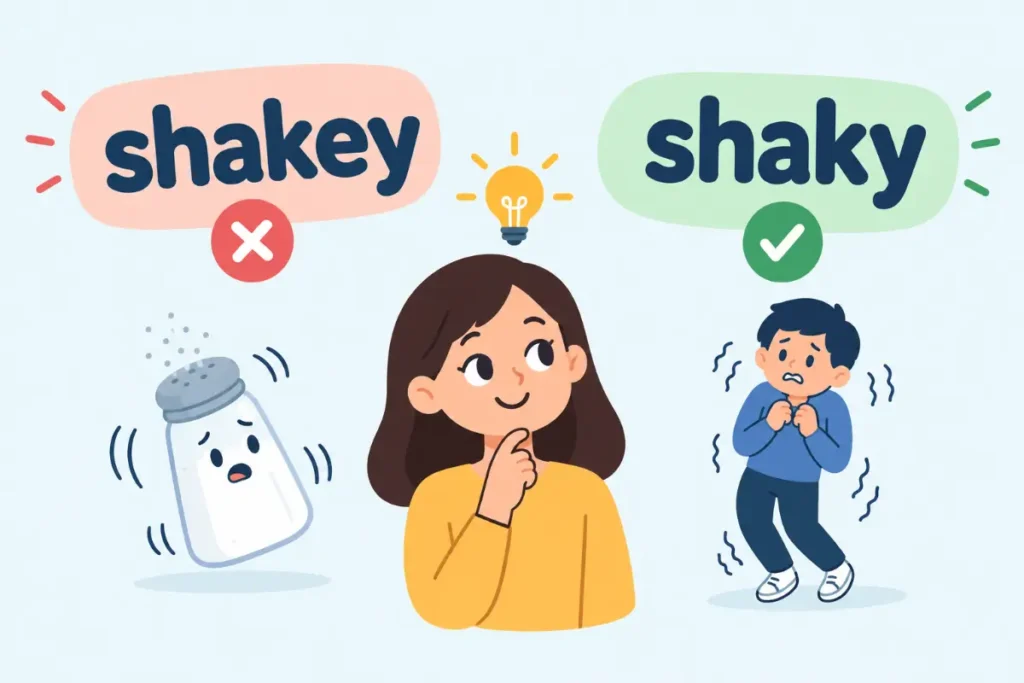
The simplest memory trick is to connect the adjective with shake.
Think:
Shake loses e and becomes shaky.
That one connection is enough for most writers.
You can also picture the spelling as shak plus y. This keeps the word short in your mind and makes the unnecessary e easier to spot.
Another useful trick is to write the two forms side by side.
- Shake → shaky.
- Shakey → incorrect.
Don’t spend too much time memorizing complicated spelling rules for this word. A simple connection to its base word is easier to remember and more useful in real writing.
A Quick Proofreading Trick
If you often type the wrong version use a simple proofreading check. Search your document for shakey before you submit or publish it.
If you find it check the sentence. In standard English the word you want is almost certainly shaky.
This trick is especially useful when writing quickly. You don’t have to rely on memory alone. A ten second search can catch a mistake that might otherwise slip through.
For important writing such as a resume school assignment business email or article you can also use a spell checker. Still take a moment to understand the correction. Knowing why the software changed the word helps prevent the same mistake later.
More Examples Of Shaky In Real Writing
The best way to make a spelling choice stick is to see the word doing real work in different sentences. Shaky can describe a person’s physical condition a weak structure an uncertain plan or an argument that lacks solid support. The meaning changes slightly with the context but the central idea stays the same.
Shaky Hands
People often use this adjective to describe hands that tremble or aren’t fully steady.
- My hands were shaky after lifting the heavy box.
- She had shaky hands when she opened the envelope.
- His hands felt shaky after the long workout.
- The artist’s shaky hands made the fine lines difficult to draw.
The cause can be physical or emotional. Someone might have shaky hands because of fear cold exhaustion excitement or intense effort. The adjective describes what the hands are doing rather than explaining the cause.
Shaky Legs
The same idea applies to legs.
- My legs were shaky after the race.
- Her legs felt shaky after climbing six flights of stairs.
- His shaky legs made it hard to stand for long.
- The child took a few steps on his shaky legs.
Here the word usually suggests weakness trembling or poor balance. Context tells the reader which meaning fits best.
Shaky Voice
A shaky voice can reveal nervousness fear sadness or strong emotion.
- Her voice was shaky as she answered the question.
- He tried to sound confident but his voice was shaky.
- I could hear a shaky voice on the other end of the phone.
This use is especially common in stories and personal writing because a person’s voice can reveal feelings without directly stating them.
Instead of writing She was nervous you might write Her voice was shaky. The second sentence gives the reader a clearer picture of how that nervousness appeared.
Shaky Structures And Objects
The adjective can describe anything that moves or wobbles when it should remain firm.
Shaky Chair
- The chair is shaky because one of the legs is loose.
- I wouldn’t sit on that shaky chair.
- We replaced the old shaky chairs before the guests arrived.
The word tells you that the chair doesn’t feel stable. It doesn’t necessarily mean the chair is about to break.
Shaky Table
- The kitchen table is shaky again.
- I put a folded napkin under the leg to stop the table from wobbling.
- We need to repair that shaky table before dinner.
A table can be shaky because a leg is loose or the floor is uneven. The exact reason doesn’t matter to the basic meaning.
Shaky Fence
- The fence became shaky after the storm.
- That shaky fence needs a few new posts.
- The dog pushed against the shaky gate and opened it.
The adjective helps the reader understand that the structure isn’t firm.
Shaky Bridge
- The hikers crossed the shaky bridge one at a time.
- The old bridge looked shaky after years of heavy rain.
- I wasn’t comfortable walking across that shaky bridge.
In these examples the word creates a strong sense of physical instability.
Shaky Plans And Ideas
English speakers also use shaky for things that aren’t physical. This is one of the most useful meanings to understand because you’ll see it often in articles conversations and workplace writing.
A shaky plan is a plan that isn’t strong or well thought out.
- Their plan is still shaky because they haven’t found enough funding.
- We had a shaky plan at first but improved it after the meeting.
- The project could fail because it rests on a shaky plan.
A plan doesn’t literally wobble. The adjective compares an uncertain plan to an unstable physical object.
This kind of comparison is common in everyday English. It makes abstract ideas easier to picture.
Shaky Arguments
A shaky argument is an argument that isn’t convincing because its reasoning or support has weaknesses.
For example:
- His argument sounds shaky because he doesn’t provide any evidence.
- The debate became difficult when the speaker relied on a shaky claim.
- The conclusion rests on a shaky argument.
The word doesn’t automatically mean the argument is completely wrong. It means the argument isn’t strong enough to inspire confidence.
That’s a useful distinction in careful writing. You can question the strength of an idea without making a stronger claim than the evidence allows.
Shaky Evidence
Evidence can also be described as shaky when it doesn’t provide strong support.
Imagine a report makes a major claim but gives only one unclear source. You might say:
- The report is based on shaky evidence.
This tells the reader that the support is questionable. It doesn’t necessarily prove that the claim is false.
You may also see phrases such as:
- Shaky evidence.
- Shaky sources.
- Shaky assumptions.
- Shaky reasoning.
- Shaky conclusions.
These combinations are common because they all describe something that lacks a firm foundation.
Shaky Financial Situation
The word can describe money problems too.
A business might have a shaky financial position if it has large debts low sales or uncertain income.
For example:
- The company is in a shaky financial position.
- The small business had a shaky year after losing several major customers.
- Investors became concerned about the company’s shaky finances.
Again the meaning is figurative. The company’s finances aren’t physically shaking. They are unstable or uncertain.
Shaky Relationship
A relationship can also be described as shaky when it lacks stability.
- Their relationship has been shaky for months.
- The two sides are on shaky terms.
- Their partnership is on shaky ground.
The phrase on shaky ground is especially useful here. It suggests that something could become weaker or fail if the problems continue.
You can use it for friendships romantic relationships business partnerships and other connections between people or groups.
Shaky Memory
People sometimes describe their memory as shaky when they aren’t sure they remember something correctly.
For example:
- My memory is a little shaky on the details.
- His memory of the event is shaky.
- I have a shaky memory of that trip because it happened so long ago.
This doesn’t necessarily mean someone has a serious memory problem. In casual speech it can simply mean that the person isn’t confident about the details.
For example you might remember the event clearly but forget the exact date. Saying My memory is shaky on the date shows that you aren’t completely certain.
Shaky Understanding
A shaky understanding is an incomplete or uncertain understanding of a subject.
For example:
- I had a shaky understanding of grammar when I started writing.
- His shaky understanding of the rules caused several mistakes.
- She has a shaky understanding of the topic but is improving quickly.
This expression is useful because it shows that someone understands part of a subject but doesn’t have a strong grasp of it yet.
It can also apply to skills.
- He has a shaky grasp of basic math.
- Her shaky knowledge of the software slowed the project.
Shaky Ground As An Idiom
The expression shaky ground deserves special attention because it appears often in natural English.
When someone is on shaky ground they are in an uncertain or vulnerable position. Their situation may become worse if they don’t fix the problem.
For example:
- The company is on shaky ground after several months of losses.
- His argument is on shaky ground because the facts don’t support it.
- Their partnership is on shaky ground after the disagreement.
You can think of the image behind the expression. Standing on solid ground feels safe. Standing on unstable ground makes you careful because you don’t know what will happen next.
That physical image gives the expression its power.
Is Shaky Formal Or Informal
Shaky works in both casual and formal writing. It isn’t slang. You can use it in an email an article an essay or a conversation.
Still the word has a fairly conversational feel. In highly technical writing you may sometimes want a more precise word such as unstable uncertain weak or unreliable.
For example:
- The structure is shaky.
This works well in everyday writing.
A technical report might say:
- The structure is unstable.
The second sentence gives a more exact technical description. The first sounds more natural in ordinary conversation.
The best word depends on your audience and the level of detail you need.
Shaky Or Unstable
These words overlap but they aren’t perfect substitutes.
- Unstable usually focuses on a lack of stability. It can describe physical objects situations emotions markets or structures.
- Shaky often sounds more vivid and less formal. It can also suggest nervous movement or weak support.
Compare these examples.
- The ladder is unstable.
- The ladder is shaky.
Both sentences tell us that the ladder isn’t steady. The second sounds more conversational and gives a stronger sense of movement.
Now compare:
- The economy is unstable.
- The economy is shaky.
Both can work. Unstable sounds more neutral. Shaky suggests concern and uncertainty in a more conversational way.
Shaky Or Nervous
These words can overlap when describing people but they don’t mean exactly the same thing.
Nervous describes a feeling of worry or fear.
Shaky can describe a physical sign of that feeling.
For example:
- I was nervous before the interview.
- My hands were shaky before the interview.
The first sentence tells us about the emotion. The second tells us how that emotion affected the body.
You can combine them naturally.
- I was so nervous that my hands were shaky.
That sentence gives both the cause and the physical result.
Shaky Or Trembling
Trembling describes repeated small movements. It often refers to a person’s body.
- Her hands were trembling.
- He was trembling with fear.
Shaky is broader.
- Her hands were shaky.
- The bridge was shaky.
- The argument was shaky.
- Their financial position was shaky.
So if you’re describing movement in a body part trembling may be more precise. If you’re describing instability in a wider range of situations shaky is more flexible.
Shaky Or Weak
These words also overlap but create different images.
Weak means lacking strength or power. Shaky suggests instability or uncertainty.
Compare:
- He has weak legs.
- He has shaky legs.
Weak legs may lack physical strength. Shaky legs may tremble or struggle to stay steady.
Now consider an argument.
- The argument is weak.
- The argument is shaky.
Both suggest problems. Weak gives a broad judgment about its strength. Shaky suggests that the support or reasoning isn’t stable.
Neither word is always better. Choose the one that matches the idea you want to express.
Shaky Or Uncertain
Uncertain focuses on doubt. Shaky can express doubt but often adds the idea of weakness.
Compare:
- We are uncertain about the results.
- The results are based on shaky evidence.
The first sentence says that we don’t know something for sure. The second points to a reason for doubt.
This difference can help you choose the right word in essays and professional writing. If you’re simply unsure use uncertain. If something seems poorly supported or unstable use shaky.
A Simple Memory Trick
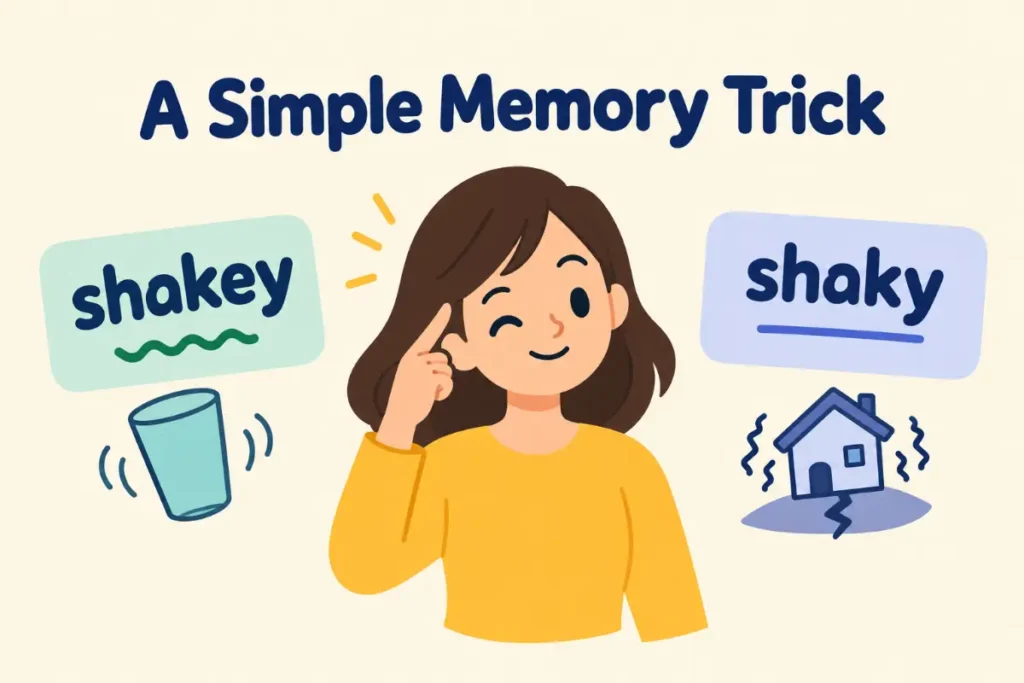
If you keep writing the wrong spelling the easiest trick is to remember the base word.
Think:
Shake becomes shaky.
Remove the final e and add y.
That gives you shaky.
You can also remember that the adjective has only one e in the entire word and that e appears at the end of the suffix rather than before the y.
Writing the word a few times in real sentences can reinforce the pattern.
- The table is shaky.
- My hands are shaky.
- His argument is shaky.
- The business is on shaky ground.
The goal isn’t to memorize a long spelling rule. The goal is to make the correct form familiar enough that you recognize it immediately.
A Quick Editing Test
When you’re proofreading and see shakey stop for a moment. Ask yourself what base word the adjective comes from. The base word is shake. The adjective is formed by dropping the final e and adding y.
So the standard spelling is shaky. This simple check can be useful when writing quickly. You don’t need to rethink the entire word every time. Just connect it to its base form.
FAQs
Is shakey or shaky correct?
Shaky is the correct spelling in standard English. Shakey is normally a misspelling when you mean unsteady trembling uncertain or unreliable.
Why is shaky spelled without an e?
The adjective comes from the verb shake. When the word changes into the adjective shaky the final e is dropped before y is added. This gives us shak plus y and produces the standard spelling.
Is shakey a word?
Shakey isn’t the standard spelling of the adjective meaning unsteady or uncertain. You should use shaky in normal English writing.
There can be proper names or brand names that use unusual spellings. Those special uses don’t change the standard spelling of the adjective.
What does shaky mean?
Shaky means physically unsteady or trembling. It can also mean uncertain weak or unreliable when you use it to describe an idea plan argument relationship or situation.
For example you can have shaky hands or a shaky argument. The first describes physical movement while the second describes weakness or uncertainty.
What is the difference between shaky and shaking?
Shaky is an adjective that describes a condition. Shaking usually describes an action or movement that is happening.
You can say My hands are shaky to describe their condition. You can say My hands are shaking to describe the movement taking place.
What is the difference between shaky and shaken?
Shaky often describes something that is trembling or unstable. Shaken can describe someone who feels upset or disturbed after an event.
For example you might say Her hands were shaky after the accident and She was shaken by the accident. The first focuses on physical movement while the second focuses on her emotional reaction.
Is shaky a formal word?
Yes. Shaky is a standard English adjective and isn’t slang. It works in conversations emails articles and many other forms of writing.
In highly technical writing you may sometimes choose a more exact word such as unstable or unreliable.
What does on shaky ground mean?
On shaky ground means being in an uncertain weak or risky position. It can describe a relationship business argument plan or other situation.
For example The company is on shaky ground after several months of losses means the company isn’t in a secure position.
Conclusion
If you’ve been stuck between shakey or shaky the answer is simple. Use shaky when you mean unsteady trembling uncertain weak or unreliable. Shakey isn’t the standard spelling of this adjective.
The easiest way to remember the spelling is to connect it with shake. Drop the final e and add y to get shaky. That simple connection is more useful than trying to memorize a complicated rule.
The word has several useful meanings. You can describe shaky hands shaky legs or a shaky voice when talking about physical movement. You can also describe shaky evidence a shaky argument or a shaky relationship when talking about something uncertain or weak.
When you’re proofreading your writing keep one quick test in mind. Think shake becomes shaky. If you see an extra e before the final y check the word again. In standard English the spelling you want is shaky.

Sienna Watson is a veteran copywriter and communications coach who has helped startup founders, marketers, and professionals polish their writing for over a decade. Realizing that most people don’t need a degree in linguistics—just clear, impactful communication—Sienna focuses on practical grammar, business writing etiquette, and eliminating wordiness. She advocates for plain language, strong verbs, and persuasive prose that gets results.