
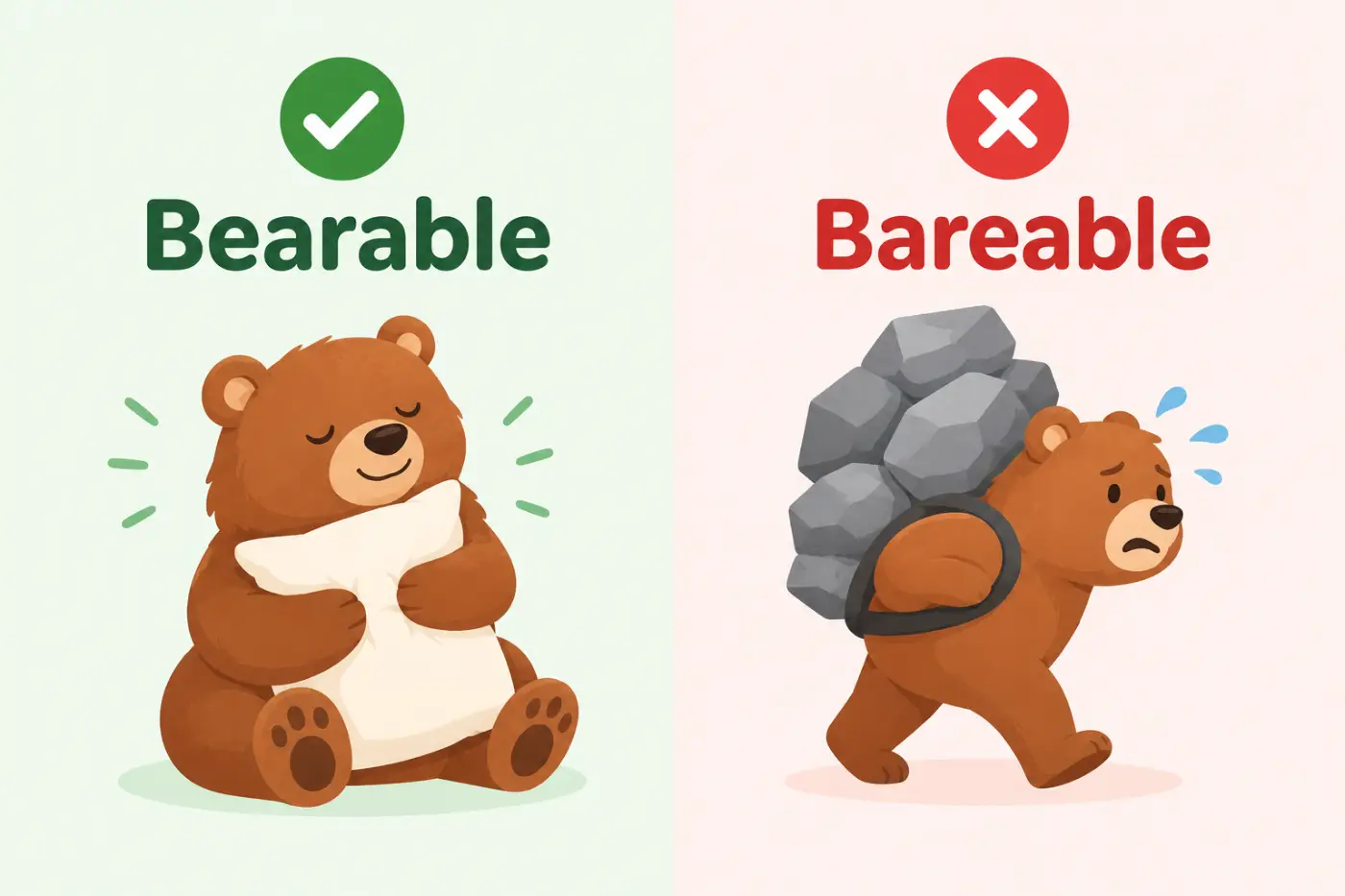
If you’re wondering about bearable vs bareable the correct spelling is bearable. The word bareable is not standard English. It can look tempting because bare is a real word but the adjective you need when you mean something can be endured is built from bear.
Bearable means something can be tolerated or endured. You might describe pain as bearable. You might say the heat is bearable after the sun goes down. You can also use it for an unpleasant situation that isn’t pleasant but isn’t impossible to handle.
The confusion makes sense at first glance. English has many words where adding a suffix seems simple. Yet this one depends on the meaning of the base word. Once you understand that connection you won’t have to guess at the spelling again.
This guide explains the difference in plain English. You’ll learn what bearable means where it comes from how to use it in everyday sentences and why bareable looks right even though it isn’t the standard spelling.
Quick Definition
Bearable is an adjective that means capable of being endured or tolerated. It comes from the verb bear which can mean to endure or put up with something. Bareable is not the standard spelling of this adjective.
Direct Answer
Bearable is the correct spelling when you mean something can be endured or tolerated. Bareable is incorrect in standard English.
Comparison Table
| Word | Meaning | Example Sentence | When to Use It |
|---|---|---|---|
| Bearable | Able to be endured or tolerated. | The pain was bearable after I took a break. | Use this word for something you can stand or endure. |
| Bareable | Not a standard English word. | This spelling is incorrect in standard usage. | Do not use it when you mean bearable. |
What Does Bearable Mean
Bearable describes something that you can handle even if you don’t enjoy it. It doesn’t mean the situation is good. It simply means you can tolerate it without reaching your limit.
Imagine sitting in a room that’s a little too warm. You might say the temperature is bearable. The room isn’t comfortable but you can stay there.
The same idea works with physical pain.
- The headache was bearable after I rested.
- The pain became more bearable after the medicine started working.
It also works with difficult experiences and emotions.
- The long wait was finally bearable because I had a book to read.
- Losing the game was disappointing but still bearable.
- The noise was bearable during the day but became annoying at night.
The central idea is always the same. Something may be unpleasant difficult painful or annoying but you can still endure it.
Where Bearable Comes From
The spelling becomes much easier when you look at the word that comes before the suffix.
Bearable comes from bear plus able.
The verb bear has several meanings. It can refer to carrying something physically. It can also mean enduring something difficult.
For example:
- She couldn’t bear the pain.
- I can’t bear listening to that noise.
- He had to bear the cost himself.
When able is added to the verb in this sense the result is bearable. The meaning is something that can be borne or endured.
That connection gives you a useful spelling clue. If you’re describing something that you can tolerate you want the word connected to bear. You don’t want to build the word from bare.
Bear And Bare Have Different Meanings
The biggest reason people make this mistake is that bear and bare are both real English words. They sound the same in many common uses but their meanings are completely different.
Bear can mean to carry or endure.
- I can’t bear this noise.
- She had to bear the responsibility.
- The pain was hard to bear.
Bare usually means uncovered or exposed. It can also mean simple or lacking something.
- The walls were bare.
- He walked across the bare floor.
- The room had only the bare essentials.
These meanings lead to very different words.
If you mean something can be tolerated you need bearable. If you’re thinking about something being uncovered you may be thinking about bare and one of its related forms.
That’s where the spelling trap comes from. The eye sees bare and able and naturally wants to put them together. But standard English doesn’t use bareable for this meaning.
Why Bareable Looks Like It Should Be Correct
At first glance bareable seems logical. English often creates adjectives by adding able to a verb.
Consider these examples:
- Read becomes readable.
- Wash becomes washable.
- Enjoy becomes enjoyable.
- Understand becomes understandable.
So it’s reasonable to think that bare plus able could become bareable.
The problem is that the meaning isn’t based on bare. The adjective bearable comes from the verb bear in the sense of enduring or tolerating something.
This is a good example of why spelling can’t always be solved by simply attaching a suffix to the word that looks familiar. You need to identify the meaning first.
Ask yourself what you are trying to say.
If you mean can be endured then think bear.
If you mean uncovered then think bare.
That small meaning check will point you to the correct spelling.
How To Use Bearable In Everyday Writing
You’ll often see this word in conversations about pain weather stress noise cost and difficult situations. It works well when you want to say that something is unpleasant but still manageable.
Talking About Pain
Pain is one of the most common things described as bearable.
- The pain is bearable now.
- Her back pain became more bearable after she rested.
- The first few minutes were uncomfortable but the pain was bearable.
Notice that the word doesn’t say the pain is minor. It only tells the reader that the person can tolerate it.
Someone might have significant pain and still call it bearable. Another person might experience the same level of pain and find it unbearable.
Talking About Heat And Cold
Temperature is another common use.
- The weather is bearable in the early morning.
- The heat became more bearable after the rain.
- The cold was bearable because I had a warm jacket.
Again the word suggests a limit. The conditions aren’t ideal but they can still be handled.
Talking About Noise
You can use the word for sounds that bother you.
- The construction noise was bearable during the afternoon.
- The music was loud but still bearable.
- After an hour the constant buzzing became barely bearable.
This last example introduces a useful phrase that you’ll see often in real writing.
Barely bearable means something can be tolerated but only just. The situation is close to becoming too difficult to handle.
Talking About Cost
The word can also describe money.
- The monthly payment is bearable.
- The repair cost was high but still bearable.
- That price isn’t bearable for most families.
Here the meaning shifts slightly from physical endurance to financial tolerance. You are saying the cost can still be handled.
Talking About Emotional Situations
People also use the word for stress sadness disappointment and other difficult feelings.
- The disappointment was bearable because we had another chance.
- The long separation was hard but bearable.
- The stress became more bearable after she talked to a friend.
This use sounds natural because bear has long been used to describe the ability to endure difficult experiences.
Bearable Does Not Mean Pleasant
This distinction matters.
If something is bearable it doesn’t necessarily feel good. It simply doesn’t cross the point where you can no longer tolerate it.
Consider these three sentences:
- The heat was pleasant.
- The heat was bearable.
- The heat was unbearable.
These sentences show three different levels.
Pleasant means you enjoy the experience.
Bearable means you can tolerate the experience.
Unbearable means you cannot tolerate the experience.
That middle position is what makes the word useful. You can describe something honestly without saying it’s comfortable or enjoyable.
For example you might say:
- The movie was long but bearable.
That sentence tells the reader that you didn’t love the movie. Still you didn’t find it impossible to sit through.
Bearable And Unbearable
The most useful word related to bearable is unbearable.
The prefix un changes the meaning to the opposite.
Bearable means capable of being endured.
Unbearable means impossible or extremely difficult to endure.
Compare these examples:
- The heat was bearable.
- The heat was unbearable.
- The pain was bearable.
- The pain was unbearable.
- The noise was bearable.
- The noise was unbearable.
The difference is clear. In the first sentence of each pair the person can tolerate the situation. In the second sentence the situation has gone beyond their limit.
You can also use barely bearable when something is right on the edge.
- The noise was barely bearable.
- The heat was barely bearable.
- The waiting time was barely bearable.
This phrase is especially useful because it gives you more detail than simply saying something was bearable.
Bearable And Tolerable
Bearable and tolerable are close in meaning. Both can describe something that can be endured.
For example:
- The pain was bearable.
- The pain was tolerable.
Both sentences tell us that the person could handle the pain.
There is a small difference in feel. Tolerable often sounds more formal or measured. Bearable tends to sound more natural in everyday conversation.
You might hear someone say:
- The wait was bearable.
In a more formal report you might see:
- The conditions remained tolerable.
Both words work but the tone changes slightly.
Bearable And Manageable
These words also overlap but they aren’t exact substitutes.
Bearable focuses on endurance. It tells us that you can put up with something.
Manageable focuses on control. It tells us that you can deal with something successfully.
Compare these examples:
- The pain was bearable.
- The workload was manageable.
You could also use both words in one situation.
- The workload was heavy but manageable.
- The long hours were difficult but bearable.
The first sentence focuses on getting the work done. The second focuses on putting up with the difficult schedule.
Knowing these small differences makes your word choice more precise.
Common Mistakes With Bearable
The spelling mistake usually happens because bare is a familiar English word. Since bare can combine with other words in natural ways people may assume that adding able creates bareable. That seems reasonable at first but it changes the word’s root and gives you the wrong spelling for the meaning you want.
The correct word comes from bear. In this use bear means to endure something difficult or unpleasant. When you add able the result is bearable. Keeping that meaning in mind makes the spelling much easier to remember.
Mistake One Using Bareable For Something You Can Endure
This is the most common error.
Incorrect:
- The pain was bareable.
Correct:
- The pain was bearable.
The sentence means that the person could tolerate the pain. Since the meaning comes from bear you need the spelling with ea.
Mistake Two Confusing Bare With Bear
These words sound alike in many situations but their meanings are different.
Bear can mean to endure.
- I can’t bear the noise anymore.
Bare can mean uncovered.
- The walls were bare.
That difference matters when you form related words. If you are talking about something that can be endured then bearable is the right choice.
Mistake Three Assuming Every Word Uses The Same Suffix Pattern
English has many words that take able in a predictable way. That can make this spelling problem feel like a simple word building exercise.
For example:
- Comfort becomes comfortable.
- Reason becomes reasonable.
- Fashion becomes fashionable.
- Enjoy becomes enjoyable.
But you still need to know which base word creates the meaning. In bearable the base is bear. It isn’t bare.
The Difference Between Bear And Bare
Understanding these two short words is the key to understanding the spelling.
What Bear Means
Bear has several meanings. It can refer to an animal. It can also mean to carry something or endure something.
As an animal:
- We saw a bear at the wildlife park.
As a verb meaning carry:
- The bridge can bear a heavy load.
As a verb meaning endure:
- She couldn’t bear the thought of leaving.
The third meaning gives us bearable.
What Bare Means
Bare usually describes something uncovered or exposed. It can also describe something plain or basic.
For example:
- He walked across the bare floor.
- The tree had bare branches.
- The room contained only the bare essentials.
None of these meanings has anything to do with enduring pain or difficulty.
That is why bareable doesn’t work as the standard spelling for something that can be tolerated.
How The Suffix Able Works
The ending able often means capable of or fit for a particular action.
Look at these examples.
Readable means something can be read.
Washable means something can be washed.
Breakable means something can be broken.
Affordable means something can be afforded.
In bearable the same basic idea applies. Something that is bearable can be borne or endured.
The word bear is unusual because its spelling doesn’t look like the meaning most people have in mind. When you hear the phrase bear with me you aren’t thinking about an animal. You are asking someone to be patient and tolerate a delay or difficulty.
That same verb gives us the adjective bearable.
Real Examples With Bearable
A few natural examples can show how flexible this word is.
Physical Discomfort
- The headache is bearable now.
- The pain was bearable after a few hours.
- The soreness was uncomfortable but bearable.
- The treatment caused some discomfort but it was bearable.
These sentences don’t say the discomfort is small. They simply say that the person can tolerate it.
Difficult Weather
- The heat is bearable in the morning.
- The cold was bearable with the right clothes.
- The humidity made the afternoon barely bearable.
- The temperature became more bearable after sunset.
This is a common everyday use because weather can range from pleasant to unbearable.
Long Trips
- The ten hour drive was bearable because we stopped often.
- The flight was long but bearable.
- The traffic was heavy but still bearable.
The word works well when something is tiring or annoying but not completely overwhelming.
Work And Stress
- The workload is bearable this week.
- The stress became more bearable after the deadline passed.
- The long hours were difficult but bearable.
Here the word describes mental or emotional strain rather than physical pain.
Noise And Annoyance
- The music was loud but bearable.
- The construction noise was barely bearable.
- The constant interruptions made the meeting less bearable.
This gives the word a broad range. You don’t need to limit it to pain or suffering.
Bearable In Positive And Negative Sentences
You can use the word in both positive and negative constructions.
A positive sentence might say:
- The situation was bearable.
A negative sentence might say:
- The situation wasn’t bearable.
You can also strengthen the meaning with words such as barely still quite and reasonably.
For example:
- The pain was barely bearable.
- The weather was still bearable.
- The wait was quite bearable.
- The cost was reasonably bearable.
These combinations help you show exactly how difficult something feels.
The Meaning Of Barely Bearable
The phrase barely bearable deserves special attention because it contains both words that people often confuse.
Barely means only just or by a very small amount.
So barely bearable means something can be endured but only with difficulty. It is close to becoming unbearable.
Consider these examples.
- The heat was barely bearable.
- The noise was barely bearable.
- The pain was barely bearable.
- The long wait was barely bearable.
The first word is barely because it describes the degree. The second word is bearable because it describes something that can be endured.
This distinction is useful because barely is a correct English word. The problem isn’t the word bare itself. The problem comes from using bareable as the spelling of the adjective.
Bearable And Endurable
Endurable is another word with a similar meaning. It means capable of being endured.
For example:
- The pain was bearable.
- The pain was endurable.
Both sentences work but bearable is much more common in ordinary conversation.
You may see endurable in formal writing or in contexts where the writer wants to stress the idea of endurance. Most people would naturally choose bearable in everyday speech.
If you’re writing an email or talking with a friend then bearable will usually sound more natural.
Bearable And Survivable
These words can overlap but they carry different ideas.
Bearable means you can tolerate something.
Survivable means you can survive something without dying or being destroyed.
For example:
- The pain was bearable.
This tells us that the person could tolerate the pain.
- The accident was survivable.
This tells us that a person could survive the accident.
Something can be survivable without being bearable. A painful experience might not threaten your life but could still be extremely difficult to endure.
That difference matters in serious writing because the two words don’t carry the same level of meaning.
Bearable And Acceptable
These words also have different focuses.
Bearable describes something you can endure.
Acceptable describes something that meets a standard or is considered okay.
For example:
- The noise was bearable.
You can tolerate the noise.
- The noise level was acceptable.
The noise meets a certain standard.
A situation can be bearable but not acceptable. You might tolerate a long wait at a restaurant but still feel that the service wasn’t acceptable.
This is a useful distinction when you want your writing to say exactly what you mean.
When To Use Bearable In Formal Writing
There is nothing informal or incorrect about bearable. You can use it in academic writing business writing reports and other formal contexts when the meaning fits.
For example:
- The researchers found that the treatment was generally bearable for participants.
- The financial burden remained bearable for most households.
- The noise level was considered bearable during normal operating hours.
Still you should choose the word based on the tone of the sentence. In a highly technical report you might need a more precise term such as tolerable or manageable. In general writing bearable is clear and natural.
How To Proofread This Word
If you aren’t sure about the spelling pause and ask yourself one simple question.
Am I talking about something that can be endured.
If the answer is yes then connect the word to bear.
You can also replace the word with tolerable. If that substitution makes sense then bearable is probably the word you’re looking for.
For example:
- The heat was bearable.
Replace it:
- The heat was tolerable.
The meaning stays close. That tells you the word relates to bear as a verb meaning endure.
This quick check takes only a second once you get used to it.
A Simple Memory Trick
Think of the phrase I can bear it.
Now turn that idea into an adjective.
I can bear it.
It is bearable.
That connection is much stronger than trying to memorize the spelling alone.
You can use the same trick with several examples.
I can bear the pain.
The pain is bearable.
I can bear the heat.
The heat is bearable.
I can bear the noise.
The noise is bearable.
Once you connect bear with the idea of enduring something the spelling becomes much harder to forget.
Why Bareable Is So Tempting
The incorrect spelling looks familiar because bare is already a common word. Your brain may see bare and assume the adjective simply needs able added to it.
But English words aren’t always built from the most visually obvious root. Meaning matters.
Think of bearable as belonging to the bear family.
- Bear.
- Bearable.
- Unbearable.
- Forbearance.
- Bearing.
These words are connected to ideas such as carrying enduring tolerating or putting up with something.
By contrast bare belongs to a different word family.
- Bare.
- Barely.
- Bareness.
These words relate to being uncovered empty plain or limited.
Once you separate the two families the spelling becomes much clearer.
How Bearable Works In Different Sentences
The word bearable can describe many kinds of experiences. It often appears when someone wants to show that a situation is difficult but still possible to handle. The exact meaning depends on the thing being described but the basic idea stays the same.
You can use it with physical discomfort emotional stress unpleasant conditions costs delays noise and many other experiences. That flexibility is one reason the word appears so often in everyday English.
Bearable Pain
Pain is probably the clearest example.
- The pain was bearable after I rested.
- The soreness is uncomfortable but bearable.
- The pain became more bearable as the day went on.
In these sentences the person isn’t saying the pain is pleasant. They’re saying it hasn’t reached a point where they can’t tolerate it.
You can also use bearable to describe a change in pain.
- The pain was unbearable in the morning but became bearable by evening.
That sentence gives the reader a clear sense of movement. The pain started beyond the person’s comfort limit and later became easier to tolerate.
Bearable Weather
Weather can also be bearable.
- The summer heat is bearable in the early morning.
- The cold was bearable with a thick coat.
- The humidity made the afternoon barely bearable.
This use is common in everyday conversation because people often compare weather with their personal comfort level.
Notice that bearable doesn’t give an exact temperature. It describes how manageable the conditions feel to a person.
One person might find ninety degrees bearable while another person might find it unbearable. The word allows you to describe that personal experience without giving a precise measurement.
Bearable Noise
Noise is another useful example.
- The traffic noise was bearable during the day.
- The music was loud but still bearable.
- The drilling became less bearable after several hours.
The word works especially well when something starts as tolerable and becomes harder to handle.
You can show that change with modifiers.
- The noise was somewhat bearable at first.
- The noise was barely bearable by noon.
- The noise became completely unbearable by evening.
Each sentence gives a different level of intensity.
Bearable Costs
You can also describe prices and expenses this way.
- The repair bill was expensive but bearable.
- The monthly rent is barely bearable on one salary.
- The extra cost was bearable because we had planned for it.
Here the word means the cost can be handled financially. It doesn’t mean the price is cheap.
That’s an important distinction. A person can call a $2,000 expense bearable while still thinking it’s expensive.
Bearable Waiting Time
Waiting can be frustrating. If the wait isn’t too difficult to tolerate you can describe it as bearable.
- The thirty minute wait was bearable.
- The long line was bearable because we had somewhere to sit.
- The delay was annoying but still bearable.
This type of sentence sounds natural in reviews and everyday conversations.
The Difference Between Bearable And Unbearable
The prefix un creates the opposite meaning.
Bearable means capable of being endured.
Unbearable means too difficult or unpleasant to endure.
Compare these examples.
- The heat was bearable.
- The heat was unbearable.
- The pain was bearable.
- The pain was unbearable.
- The noise was bearable.
- The noise was unbearable.
The difference is simple but powerful. One word tells us that the person can handle the situation. The other tells us that the situation has crossed their limit.
You can also use almost unbearable when something is getting close to that point.
- The heat was almost unbearable.
- The noise was almost unbearable.
- The pressure was almost unbearable.
This wording gives you more room to describe a situation that is extremely difficult without saying it has become completely impossible to tolerate.
Bearable And Tolerable
Bearable and tolerable are close synonyms. Both can describe something that a person can endure.
For example:
- The pain was bearable.
- The pain was tolerable.
Both sentences are correct.
The difference is mostly about tone and emphasis. Bearable often sounds more personal and conversational. Tolerable can sound a little more formal or detached.
Compare these examples.
- The heat was bearable once the sun went down.
- The temperature remained tolerable throughout the test.
The first sentence sounds like ordinary conversation. The second could easily appear in a report.
Neither word is automatically better. Choose the one that fits the tone of your writing.
Bearable And Manageable
These words are related but they don’t mean exactly the same thing.
Bearable focuses on endurance. It answers the question of how difficult something is to put up with.
Manageable focuses on your ability to deal with something successfully.
For example:
- The pain was bearable.
- The workload was manageable.
The first sentence tells us the person could tolerate the pain. The second tells us the person could handle the amount of work.
Sometimes both words can describe the same situation.
- The workload was heavy but manageable.
- The long hours were difficult but bearable.
The first sentence focuses on getting the work done. The second focuses on tolerating the difficult schedule.
That small difference can make your writing more precise.
Bearable And Endurable
Endurable also means capable of being endured. It has a similar meaning to bearable but is less common in everyday American English.
For example:
- The discomfort was bearable.
- The discomfort was endurable.
Both are understandable. Still bearable sounds more natural in most ordinary situations.
If you’re writing a simple email or talking with a friend you would normally choose bearable. Endurable may appear in more formal or literary writing but it isn’t the first choice for most speakers.
Bearable And Acceptable
These words can look similar in some sentences but they express different ideas.
Bearable means something can be endured.
Acceptable means something meets a standard or is considered satisfactory.
Consider this example.
- The noise was bearable but not acceptable.
That sentence is perfectly possible. You can tolerate a certain level of noise while still believing that the noise is too high for a workplace or apartment building.
The same idea works with behavior.
- His rude comments were bearable for a while but they weren’t acceptable.
The speaker could put up with the comments temporarily but didn’t consider them appropriate.
This distinction is useful because it prevents you from treating bearable and acceptable as exact synonyms.
Bearable And Comfortable
These words are even farther apart in meaning.
Comfortable suggests ease or pleasant conditions.
Bearable only suggests that something can be endured.
For example:
- The chair was comfortable.
- The chair was bearable.
The first sentence suggests that sitting in the chair felt good or at least caused no discomfort.
The second suggests that the chair wasn’t great but the person could sit in it.
You might even say:
- The hotel room wasn’t comfortable but it was bearable.
That sentence sounds natural because it clearly separates enjoyment from tolerance.
The Difference Between Barely And Bearably
This is another point that can confuse writers.
Barely is a common adverb. It means only just or by a very small amount.
Bearably is an adverb formed from bearable. It means in a way that can be endured.
For example:
- The heat was barely bearable.
- The heat was bearably warm.
The first sentence is much more common in everyday English. It says the heat was almost too much to handle.
You can think of the words this way.
Barely describes degree.
Bearable describes the ability to endure.
They may appear together but they don’t have the same job.
Is Bearable Always About Something Bad
No. The word usually appears with something unpleasant but the experience doesn’t have to be extremely negative.
For example:
- The movie was long but bearable.
- The wait was boring but bearable.
- The weather was warm but bearable.
In each sentence the speaker sees some problem but doesn’t think it’s serious enough to make the experience impossible.
The word often carries a slightly negative tone because people usually don’t talk about pleasant experiences as things they have to endure. You wouldn’t normally say a delicious meal was bearable unless you’re joking or making a point.
That subtle tone matters. If something is genuinely enjoyable use words such as pleasant comfortable or enjoyable instead.
How Native Speakers Use The Word Naturally
Native speakers often pair bearable with words that show degree.
Common combinations include:
- Barely bearable.
- Almost bearable.
- Quite bearable.
- Still bearable.
- More bearable.
- Less bearable.
- Surprisingly bearable.
- Completely unbearable.
These combinations help the writer show how close the situation is to the person’s limit.
For example:
- The first few hours were quite bearable.
- The heat became less bearable in the afternoon.
- The noise was still bearable with the windows closed.
- The second half of the trip was more bearable after we found a faster route.
These examples sound more natural than simply repeating the same basic sentence pattern.
How To Use Bearable In A Sentence
The easiest structure is:
Something + is or was + bearable.
For example:
- The pain is bearable.
- The wait was bearable.
- The cost is bearable.
- The heat was bearable.
You can also add a reason.
- The wait was bearable because I had a book.
- The heat was bearable because the room had a fan.
- The cost was bearable because we had saved money.
- The pain was more bearable after I rested.
You can compare two situations as well.
- The morning weather was more bearable than the afternoon heat.
- The second week was more bearable than the first.
- The new schedule is much more bearable than the old one.
These patterns give you plenty of ways to use the word without making your sentences sound forced.
A Useful Test For The Spelling
When you’re unsure about the spelling bearable vs bareable try removing the ending able.
Ask yourself which base word gives you the meaning.
If you mean endure or put up with then the base word is bear.
For example:
- I can bear the pain.
- The pain is bearable.
The connection is clear.
If you’re thinking about something uncovered then you’re dealing with bare.
For example:
- The floor is bare.
- The walls are bare.
You aren’t describing something that can be endured in these sentences.
This meaning test is more reliable than simply trying to remember which letters look familiar.
A Quick Memory Trick
Think of this sentence:
I can bear it.
Then turn it into:
It is bearable.
That simple connection gives you both the meaning and the spelling.
You can repeat the pattern with different situations.
I can bear the heat. The heat is bearable.
I can bear the noise. The noise is bearable.
I can bear the delay. The delay is bearable.
The trick works because you’re connecting the spelling to meaning instead of memorizing a random group of letters.
Other Words From The Bear Family
Knowing related words can reinforce the correct spelling.
Unbearable
Unbearable means impossible or extremely difficult to endure.
- The noise became unbearable.
Bearing
Bearing can refer to the way someone carries themselves or to the act of carrying or enduring something depending on context.
- She has a confident bearing.
- The cost is the responsibility of the buyer.
Forbear
Forbear is a less common verb meaning to refrain from doing something or to show restraint.
- He decided to forbear from making another comment.
You don’t need to memorize every related word. The useful point is that bearable belongs to a word family built around bear rather than bare.
Why Context Helps With Spelling
Context gives your brain a meaning before it processes every letter. That can make spelling easier.
Consider this sentence:
- The pain was bearable.
The word pain immediately tells you that we’re talking about endurance. That points toward bear.
Now consider:
- The floor was bare.
The word floor gives you a different meaning. You’re talking about an uncovered surface.
When you pay attention to meaning you can often catch spelling mistakes without using a dictionary.
This is especially useful when proofreading your own work. Don’t just scan the letters. Read the sentence and ask what each word is supposed to mean.
A Short Practice Exercise
Try choosing the correct word in each sentence.
The answers are below.
- The long flight was bearable because I slept most of the way.
- The room had bare walls and almost no furniture.
- The pain became bearable after a few hours.
- We walked across the bare floor.
- The heat was barely bearable by noon.
The key is to look at meaning.
Sentences about enduring something use bearable. Sentences about something uncovered or exposed use bare.
That distinction is the foundation of the entire spelling question.
FAQs
Is bearable or bareable correct?
Bearable is the correct spelling when you mean something can be endured or tolerated. Bareable isn’t the standard spelling for this meaning. The word comes from bear which can mean to endure something difficult.
What does bearable mean?
Bearable means capable of being endured or tolerated. It describes something that may be unpleasant or difficult but isn’t too much to handle. For example you might say that a long wait was bearable because you had something to read.
Is bareable a real word?
Bareable isn’t recognized as the standard spelling of the adjective meaning capable of being endured. It usually appears as a spelling mistake caused by confusion between bear and bare. Use bearable when you’re talking about something a person can tolerate.
Why is bearable spelled with an e?
The word comes from bear in the sense of enduring or tolerating something. Adding able gives us bearable. The spelling with ea connects the adjective to its base word.
What is the difference between bearable and unbearable?
Bearable means something can still be endured. Unbearable means something is too difficult painful or unpleasant to endure. For example a mild headache might be bearable while severe pain could be unbearable.
Is bearable the same as tolerable?
The two words have very similar meanings. Both can describe something that can be endured or accepted without becoming too difficult. Bearable often sounds more natural in everyday conversation while tolerable can sound slightly more formal.
Can you use bearable to describe weather?
Yes. You can use bearable for heat cold humidity and other weather conditions. For example you could say that the summer heat was bearable in the morning but became unbearable in the afternoon.
What is the opposite of bearable?
The most direct opposite is unbearable. It describes something that cannot be endured or is extremely difficult to tolerate. Intolerable can also have a similar meaning.
Conclusion
If you’ve been stuck on bearable vs bareable the answer is simple. Use bearable when you mean something can be endured or tolerated. The spelling bareable is not the standard form of this word.
The easiest way to remember it is to connect the adjective with the verb bear. You can bear pain. You can bear noise. You can bear a long wait. Something you can bear is bearable. That connection gives you both the meaning and the spelling.
Don’t let the word bare throw you off. Bare is a real word but it has a different meaning. It usually describes something uncovered exposed plain or lacking something. A bare floor and a bearable floor describe completely different ideas.
The next time you need this word pause for a second and think about the meaning. If you’re saying that you can tolerate something choose bearable. That quick connection to bear is all you need to keep the spelling straight.

Dr. Elena Vance holds a Ph.D. in Linguistics from Columbia University and has spent over 15 years analyzing the evolution of the English language. A former university professor turned full-time writer and editor, Elena specializes in breaking down high-level grammatical concepts, punctuation nuances, and style guides (APA, Chicago, MLA) into clear, actionable advice. When she isn’t hunting down dangling modifiers, she can be found collecting vintage dictionaries and reading classic literature.