

Have you ever stopped while writing an email and wondered if you should write check in or check-in? Both forms are correct in American English. The right choice depends on how you use the words in a sentence.
Use check in as a verb when someone arrives at a hotel, registers for a flight, or contacts another person to share an update. For example, you might say, “We need to check in at the hotel before dinner.”
Use check-in as a noun or an adjective. You might write, “The hotel check-in starts at 3 p.m.” or “Please visit the check-in desk.” In these examples, the words name an activity or describe something.
The difference may look small, but it can change how a sentence reads. A misplaced hyphen can make your writing look less polished, especially in emails, travel plans, work messages, and online content.
This guide explains the spelling rule in plain English. You’ll learn when to use each form, see natural examples, avoid common mistakes, and discover a simple trick to remember the difference.
Quick Definition
Check in is a two word verb that means to register your arrival or contact someone to share information. Check-in is a hyphenated noun or adjective that refers to the arrival process or describes something related to it. The correct form depends on the job the words perform in the sentence.
Direct Answer
Both spellings are correct, but they serve different grammatical purposes. Write check in when describing an action and check-in when naming the process or describing a related item.
Check In vs Check-in at a Glance
| Word or Phrase | Meaning | Example Sentence | When to Use It |
|---|---|---|---|
| Check in | To register or report your arrival | We need to check in before boarding. | Use it as a verb. |
| Check-in | The process of registering or reporting arrival | Check-in begins at noon. | Use it as a noun. |
| Check-in | Related to registration or arrival | The check-in counter is near the entrance. | Use it as an adjective. |
| Check-ins | More than one check-in event | The manager schedules weekly check-ins. | Use it as a plural noun. |
| Checks in | An action performed by a third person | She checks in with her team every morning. | Use it for a present tense verb with a singular subject. |
| Checked in | An action completed in the past | We checked in an hour ago. | Use it for a past tense verb. |
| Checking in | An action happening now or around the present time | I’m checking in with the client today. | Use it as a verb form. |

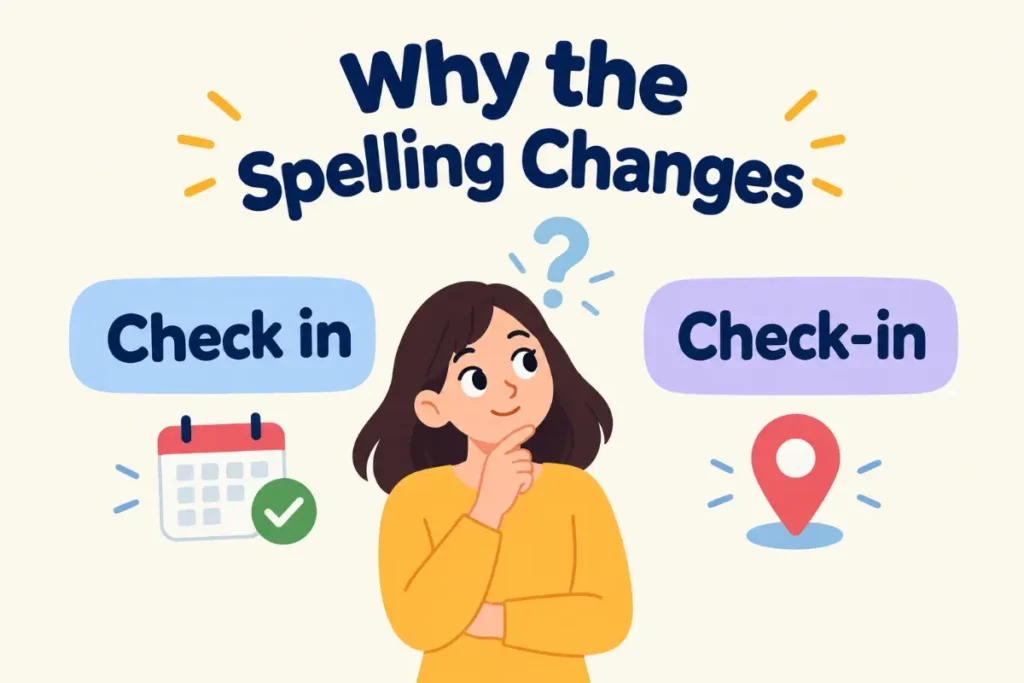
Why the Spelling Changes
English often combines words in different ways depending on their role in a sentence. Sometimes two words work together as a verb. In other cases, they form a noun or describe another word.
The phrase check in follows this pattern.
Consider these two sentences.
“We will check in after lunch.”
“Our check-in is scheduled for 1 p.m.”
The first sentence describes an action. The second names an event. The meaning is closely related, but the grammar is different.
This pattern appears in many common English expressions. You might write “log in” when describing an action and “login page” when naming a type of page. Similarly, you might “sign up” for a class and complete a “sign-up form.”
These examples show why it helps to look at the whole sentence instead of choosing a spelling based only on how the words sound.
When to Use Check In
Use check in when the words function as a verb. A verb tells the reader what someone does or what happens.
People commonly use this expression when they arrive at hotels, airports, events, hospitals, and other places that require registration. It also appears in everyday conversations when someone contacts another person to ask for an update or offer support.
Use Check In for Hotel Arrivals
Hotels often ask guests to check in before they enter their rooms. The action may involve confirming a reservation, showing identification, or receiving a room key.
Here are some examples.
- We plan to check in at the hotel around 4 p.m.
- You can check in at the front desk.
- The guests need to check in before they receive their room keys.
- I forgot to check in when we arrived.
- Can we check in early on Saturday?
In each sentence, check in describes an action. That’s why the words remain separate.
You can also change the verb to match the tense or subject.
- She checks in before going to her room.
- We checked in shortly after noon.
- They are checking in now.
- He will check in when he reaches the hotel.
The spelling stays the same in the base form. The verb changes only when the sentence calls for a different tense or subject.
Use Check In for Air Travel
Airlines use check in to describe the process of confirming that a passenger plans to take a flight. Depending on the airline and airport, passengers may complete this step online, at a kiosk, or at an airport counter.
For example.
- We need to check in for our flight tonight.
- You should check in online before leaving home.
- Maya checked in through the airline’s website.
- Passengers can check in using the mobile app.
- Did you check in for your morning flight?
Notice that the expression remains open when it describes the action.
The same rule applies when a sentence includes extra information.
- We checked in for our flight two hours before departure.
- Please check in at the airport counter if you need help.
- He wants to check in online before his trip.
Adding more words doesn’t change the basic spelling rule.
Use Check In When Contacting Someone
The expression also means to contact someone to ask how things are going, share information, or make sure everything is fine.
This use is common at work and in personal conversations. It doesn’t always involve a physical arrival or a formal registration process.
For example.
- I’ll check in with you after the meeting.
- She checks in with her parents every evening.
- Our manager checked in to see how the project was going.
- Can you check in with the team before Friday?
- I wanted to check in and see how you’re feeling.
In these sentences, check in describes communication. It still works as a verb, so you should not add a hyphen.
You may also see this expression in messages such as “Just checking in to see if you received my email.” Here, checking in is a verb form, and the words remain separate.
Use Check In for Events and Appointments
Some events require attendees to register when they arrive. The process may include confirming a name, scanning a ticket, or collecting a badge.
For example.
- Please check in when you arrive at the conference.
- All visitors must check in at reception.
- We checked in at the event entrance.
- You can check in with the event staff near the main door.
- Students need to check in before the workshop begins.
The same rule applies to medical visits and office appointments.
- Please check in at the clinic when you arrive.
- I checked in for my appointment ten minutes early.
- New patients should check in at the reception desk.
The expression describes what a person does. Keep the words separate.
When to Use Check-in
Use check-in as a noun or an adjective. A noun names a person, place, thing, or event. An adjective describes a noun.
The hyphen helps show that the two words work together as one unit. You can usually identify this form by asking what the sentence is naming or describing.
Use Check-in as a Noun
A noun names the act of checking in, the process itself, or a planned meeting where people exchange updates.
For example.
- Check-in begins at 3 p.m.
- The hotel check-in took less than five minutes.
- Our weekly check-in is scheduled for Monday.
- The airport check-in was quick and easy.
- We had a brief check-in before the presentation.
In each example, check-in names an event, process, or meeting. The hyphenated form is appropriate.
You can often place words such as the, a, or our before the noun.
- The check-in was delayed.
- A check-in is scheduled for tomorrow.
- Our check-in went well.
These words help you recognize the noun form. However, you should still read the full sentence to confirm its role.
Use Check-in as an Adjective
An adjective describes a noun. The expression check-in often appears before words such as desk, counter, process, time, and form.
For example.
- The check-in desk is beside the entrance.
- Please visit the check-in counter.
- We completed the check-in process online.
- The check-in time is listed on your reservation.
- I filled out the check-in form before arriving.
Here, check-in tells readers what kind of desk, counter, process, time, or form you mean.
The hyphen connects the words so readers can understand them as one description.
This rule also applies to workplace language.
- We have a weekly check-in meeting.
- The team uses a check-in form to share updates.
- Our check-in schedule changes every month.
In each example, check-in describes the noun that follows it.
Use Check-ins for More Than One Event
When you refer to several check-in events or meetings, use the plural form check-ins.
For example.
- Our team holds two check-ins each week.
- The manager scheduled daily check-ins during the launch.
- Weekly check-ins help us track progress.
- The hotel offers separate check-ins for group bookings.
- We completed three check-ins during the training program.
The plural ending belongs at the end of the compound noun. Keep the hyphen in place.
- Avoid writing “check ins” when you mean several meetings or registration events. That spelling treats the phrase like a verb, which doesn’t fit the intended meaning.
Compare these sentences.
- “We check in every Monday.”
- “We have check-ins every Monday.”
The first describes an action. The second names recurring events.
Use Check-in in Workplace Communication
In many workplaces, a check-in is a short conversation about progress, goals, problems, or next steps.
It might happen between a manager and an employee, between teammates, or between a business and its client.
For example.
- Let’s schedule a quick check-in for Thursday.
- Our weekly check-in covers current goals and deadlines.
- The client requested a check-in before the final delivery.
- I added a short check-in to the project calendar.
- The team agreed to hold monthly check-ins.
The noun form works well in meeting invitations, calendars, project plans, and professional emails.
For instance, you could write “Project Check-in” as a calendar event title. You could also write “Weekly Client Check-in” in a work schedule.
These labels name meetings rather than describe actions, so the hyphenated form makes sense.
How to Tell the Difference in a Sentence
The easiest way to choose the correct spelling is to identify the job the words perform.
Ask yourself one simple question. Am I describing an action, or am I naming or describing something?
If the words describe an action, write check in. If they name a process or describe a noun, write check-in.
A Simple Test You Can Use
Look at this sentence.
“I need to check in before my appointment.”
What does the speaker need to do? The speaker needs to register or report arrival. The words describe an action, so check in is correct.
Now look at this sentence.
“My check-in is scheduled for 10 a.m.”
What is scheduled? A check-in event is scheduled. The phrase names an event, so check-in is correct.
Try another pair.
“Please check in with the receptionist.”
“The check-in desk is on your left.”
In the first sentence, check in tells someone what to do. In the second, check-in describes the desk.
This test works in most everyday situations. You don’t need to memorize a long list of exceptions. Focus on the role of the words.
Common Mistakes to Avoid
Even experienced writers sometimes mix up the two forms. The expressions look similar, and spellcheck tools don’t always explain the difference.
Here are the mistakes worth watching for.
Mistake One. Using a Hyphen in a Verb Phrase
- Incorrect. We need to check-in before boarding.
- Correct. We need to check in before boarding.
The sentence describes an action. The words should remain separate.
Another example.
- Incorrect. Please check-in at the front desk.
- Correct. Please check in at the front desk.
The same rule applies to hotels, flights, appointments, and meetings.
Mistake Two. Leaving Out the Hyphen in a Noun
- Incorrect. Our weekly check in starts at 9 a.m.
- Correct. Our weekly check-in starts at 9 a.m.
The sentence names a meeting. The hyphenated noun is the better choice.
Another example.
- Incorrect. The check in counter is closed.
- Correct. The check-in counter is closed.
The compound term describes a counter, so the hyphen connects the words.
Mistake Three. Confusing a Meeting With an Action
Consider these examples.
- “We’ll check in with the client tomorrow.”
- “Our client check-in is tomorrow.”
Both sentences are correct, but they express the idea in different ways.
The first describes what the team will do. The second names a scheduled event.
Writers sometimes add a hyphen to the first sentence because they think the expression always needs one. Others leave out the hyphen in the second sentence because they assume the words must always remain separate.
Both approaches miss the point. The sentence determines the spelling.
Mistake Four. Writing the Plural Incorrectly
Incorrect. We have three check ins this week.
Correct. We have three check-ins this week.
When you use the expression as a plural noun, keep the hyphen and add s to the end.
However, the verb form follows a different pattern.
“We check in three times each week.”
Here, check in describes an action. It doesn’t become a hyphenated noun just because the sentence mentions a number.
Mistake Five. Adding a Hyphen Because the Words Appear Together
Two words appearing next to each other doesn’t automatically mean they need a hyphen.
For example.
- I will check in tomorrow.
- We plan to check in early.
- She needs to check in with her supervisor.
All three sentences use the verb form. Keep the words separate.
Now compare these examples.
- We scheduled a check-in tomorrow.
- The check-in process takes five minutes.
- Please read the check-in instructions.
These sentences use the noun or adjective form. The hyphen is appropriate.
The key is grammar, not the physical distance between the words.
Is Check-in One Word or Two Words
Check-in is written as two words joined by a hyphen. Check in is written as two separate words without a hyphen.
Neither form is normally written as one word in standard American English when used in these common senses.
For example.
- Correct. Please check in at the hotel.
- Correct. The check-in desk is near the lobby.
- Incorrect. Please checkin at the hotel.
- Incorrect. The checkin desk is near the lobby.
You may encounter different forms in usernames, website addresses, product names, or software labels. Those special cases don’t change the standard spelling rule for regular writing.
In a sentence, use the open verb form for the action and the hyphenated form for the noun or adjective.
Is Check-in Always Hyphenated as a Noun
In standard American usage, check-in is commonly hyphenated when it functions as a noun or adjective.
For example.
- The check-in was fast.
- We need a check-in meeting.
- The check-in desk opens at noon.
Some organizations may follow their own style guides or use a different form in a product name. A company might also use checkin as part of a website address or a branded feature.
For everyday writing, though, check-in is the clearest standard choice for the noun and adjective forms.
Consistency also matters. If you are writing a long article or business document, use the same form throughout unless a specific style guide requires something else.
What Happens When You Add Other Words
The expression may appear with other words, but the main distinction remains the same.
Check In With Someone
When you contact a person to ask for an update or offer support, use check in with.
Examples.
- I’ll check in with my manager tomorrow.
- She checked in with her friend after the exam.
- Please check in with the sales team before the meeting.
- We are checking in with customers this afternoon.
The words describe an action, so no hyphen is needed.
Check In On Someone
The phrase check in on someone means to contact or visit them to make sure they are doing well.
Examples.
- I called to check in on my neighbor.
- The nurse checked in on the patient.
- We should check in on the new employee next week.
- Her brother checks in on her every few days.
The word on doesn’t change the spelling of the verb phrase.
Check-in Meeting
A check-in meeting is a short meeting where people share updates, discuss concerns, or review progress.
Examples.
- Our check-in meeting starts at 11 a.m.
- The team scheduled a check-in meeting for Friday.
- We use check-in meetings to discuss weekly goals.
Here, check-in describes the meeting. Keep the hyphen.
Check-in Time
Check-in time refers to the time when a person can register or begin a stay or activity.
Examples.
- The hotel’s check-in time is 3 p.m.
- Our check-in time appears on the booking confirmation.
- Please confirm the check-in time before your trip.
Because check-in describes time, the hyphenated form is appropriate.
Related Forms You Should Know
The base expression appears in several useful forms. Knowing these variations can help you write more naturally.
| Form | Grammatical Role | Example |
|---|---|---|
| Check in | Base verb | We check in before the flight. |
| Checks in | Present tense verb | He checks in every morning. |
| Checked in | Past tense verb | She checked in yesterday. |
| Checking in | Present participle or gerund | I’m checking in with my manager. |
| Check-in | Noun or adjective | The check-in process is simple. |
| Check-ins | Plural noun | We schedule regular check-ins. |
Check In and Checks In
Use check in with subjects such as I, you, we, and they in the simple present tense.
For example.
- I check in every Friday.
- You check in at reception.
- We check in before the event.
- They check in after arriving.
Use checks in with he, she, it, or a singular person’s name.
For example.
- He checks in with his manager.
- She checks in before every flight.
- Jordan checks in at the front desk.
The s belongs to the verb because of the subject. It doesn’t turn the phrase into a noun.
Checked In
Use checked in when the action happened in the past.
For example.
- We checked in early.
- She checked in at the hotel.
- The guests checked in before dinner.
- I checked in with my supervisor yesterday.
The words remain separate because the expression still functions as a verb.
Checking In
Use checking in when the action is happening now or when the phrase serves as a gerund. A gerund is a verb form ending in ing that acts like a noun.
For example.
- I’m checking in with the team now.
- They are checking in at the airport.
- Checking in early can save time.
- She is checking in with her doctor tomorrow.
In the last two examples, checking in describes an activity. The words remain separate.
Compare this sentence.
“Checking in early is helpful.”
“The early check-in was helpful.”
The first uses a verb form as the subject of the sentence. The second uses check-in as a noun modified by early.
Is It Check-in or Check in at a Hotel
Use check in when describing the act of arriving and registering at a hotel. Use check-in when referring to the process, desk, time, or other related item.
Correct examples include the following.
- We will check in at the hotel at 4 p.m.
- Hotel check-in begins at 3 p.m.
- Please visit the check-in desk.
- Our check-in time is listed in the confirmation email.
- Guests can check in using the hotel’s website.
Travel websites and hotel policies often use both forms on the same page. That’s normal because the words perform different grammatical jobs.
For instance, a hotel might say, “You can check in after 3 p.m. Please bring your identification to the check-in desk.”
The first phrase describes an action. The second describes a desk.
Is It Check-in or Check in at an Airport
Air travel follows the same spelling rule.
Use check in for the action of confirming your flight or registering as a passenger. Use check-in for a noun or an adjective related to that process.
Examples.
- We need to check in before our flight.
- Online check-in opens 24 hours before departure.
- The check-in counter is near the entrance.
- Passengers can check in through the airline’s app.
- The airport check-in process was quick.
The form doesn’t depend on the airport, airline, or type of flight. It depends on the grammatical role of the words.
If you are describing what a passenger does, use check in. If you are naming a service or describing a counter, use check-in.
How to Use the Phrase in Professional Writing
The expression appears often in workplace messages. People use it to arrange meetings, request updates, and stay in touch with colleagues.
Choosing the correct form helps your writing look clear and professional.
In Emails
Use check in when you describe the action of contacting someone.
For example.
“Hi Alex. I wanted to check in on the project and see if you need anything from me.”
You could also write.
“I’ll check in with you tomorrow after I review the report.”
Both examples use the verb phrase correctly.
When naming a meeting or event, use check-in.
For example.
“Our weekly check-in is scheduled for Tuesday at 10 a.m.”
“The client check-in will take place after the product review.”
These sentences name meetings, so the hyphenated noun works.
In Meeting Invitations
Calendar invitations often use check-in as part of the event title.
Examples include the following.
- Weekly Team Check-in.
- Project Check-in.
- Client Check-in.
- Monthly Progress Check-in.
- New Employee Check-in.
Each title names a meeting. The hyphen helps readers recognize the phrase as a single unit.
If you write a sentence describing the action, keep the words separate.
“We will check in with the team before the presentation.”
In Customer Service
Customer service teams may use the expression to describe routine contact with clients or customers.
For example.
- I’ll check in with the customer tomorrow.
- The support team checks in after each service visit.
- We scheduled a customer check-in for next week.
- Our monthly check-ins help us understand customer concerns.
The action takes the open form. The meeting or event takes the hyphenated form.
This distinction helps teams write clear notes, schedules, and reports.
How to Remember the Difference
You don’t need a complicated grammar rule to remember the spelling. Use one short question.
Is it an action or a thing?
If it is an action, write check in. If it is a thing, event, process, or description, write check-in.
Use the Action Test
Try replacing the phrase with another verb, such as arrive, register, or contact.
“We need to check in before boarding.”
You could rewrite this as “We need to register before boarding.” The sentence still works because check in describes an action.
Now consider this sentence.
“Our check-in is at noon.”
You can’t replace check-in with register without changing the sentence structure. Here, the expression names an event.
The action test gives you a quick way to spot the difference.
Use the Naming Test
Ask if the words name something.
“The check-in took ten minutes.”
The phrase names a process or event. Use the hyphen.
“The check-in desk is open.”
The phrase describes a desk. Use the hyphen.
“I need to check in.”
The phrase describes an action. Keep the words separate.
Once you recognize the pattern, the correct form becomes much easier to choose.
Similar Word Pairs That Follow the Same Pattern
English has many expressions that change form depending on their role in a sentence. Studying a few of them can make the check in rule easier to remember.
Log In and Login
Use log in as a verb.
- Please log in to your account.
- I need to log in before the meeting.
Use login as a noun or adjective in common American usage.
- I forgot my login.
- The login page is not loading.
The verb describes an action. The noun or adjective names or describes something related to access.
Sign Up and Sign-up
Use sign up as a verb.
- I want to sign up for the course.
- You can sign up online.
Use sign-up as a noun or adjective when following a style that hyphenates the term.
- The sign-up process is simple.
- We created a sign-up sheet.
Some style guides use signup as one word for the noun or adjective. The important lesson is that the verb remains two separate words.
Set Up and Setup
Use set up as a verb.
- We need to set up the meeting room.
- She will set up the new computer.
Use setup as a noun or adjective.
- The computer setup took an hour.
- We reviewed the setup instructions.
This is a useful comparison because the spelling changes when the words shift from an action to a thing.
Follow Up and Follow-up
Use follow up as a verb.
- I’ll follow up with the client tomorrow.
- Please follow up after the interview.
Use follow-up as a noun or adjective.
- We scheduled a follow-up.
- The follow-up email arrived this morning.
- She booked a follow-up appointment.
The same basic idea applies. Look at the role of the expression before choosing the spelling.
Does American English Differ From British English
The basic distinction between check in and check-in is widely used in both American and British English. In both varieties, the open form commonly works as a verb, while the hyphenated form commonly works as a noun or adjective.
However, individual dictionaries, publishers, and organizations may differ in some compound word choices. Some may prefer a different style in specific settings.
For everyday American English, use these forms.
- We need to check in at the hotel.
- Our check-in is scheduled for 3 p.m.
- Please visit the check-in counter.
- I’ll check in with you tomorrow.
If you are writing for a company, newspaper, or academic publication, follow its style guide when it gives a specific rule. For general emails, articles, and personal writing, the verb versus noun distinction is a reliable guide.
Should You Use Check In or Check-in in SEO Content
If you write blog posts, travel guides, hotel pages, or help articles, both forms can appear naturally in the same piece.
Use the verb form when explaining an action.
For example.
“Guests can check in online before they arrive at the hotel.”
Use the noun or adjective form when describing a process or service.
For example.
“Our check-in process takes only a few minutes.”
Search engines can understand related word forms and sentence context. You don’t need to force one spelling into every heading or paragraph.
Instead, answer the reader’s question clearly and use the form that fits each sentence. Natural writing usually serves readers better than repeating a keyword unnecessarily.
For a hotel article, you might use phrases such as hotel arrival, guest registration, front desk, online registration, and check-in time when they fit the topic.
For a workplace article, related terms might include team meeting, progress update, client meeting, and weekly review.
These related expressions add useful context without making the writing repetitive.
FAQs
Is check in or check-in correct?
Both forms are correct, but they have different uses. Write check in as a verb when describing an action. Write check-in as a noun or adjective when naming or describing something.
Is check in one word or two words?
Check in is written as two separate words when used as a verb. Check-in uses two words joined by a hyphen when it functions as a noun or adjective. In standard writing, avoid spelling the expression as one word.
Do you hyphenate check in when using it as a verb?
No. Keep the words separate when they describe an action. For example, write “Please check in at the front desk” without a hyphen.
Is it check-in desk or check in desk?
Check-in desk is the standard form. The expression describes the type of desk, so the hyphenated adjective is appropriate.
Is it hotel check in or hotel check-in?
Use hotel check-in when naming the arrival process or describing a related service. Use check in when describing what a guest does. For example, “Hotel check-in starts at 3 p.m.” and “We will check in at 3 p.m.” are both correct.
What is the plural of check-in?
The plural is check-ins. For example, “We have two check-ins scheduled this week.” The hyphen stays in place, and the plural ending goes at the end.
Is checking in hyphenated?
No. When checking in functions as a verb form, keep the words separate. For example, write “I’m checking in with my manager” without a hyphen.
What is the difference between check in and check-in in a sentence?
Check in describes an action, such as registering at a hotel or contacting a colleague. Check-in names an event or process or describes something related to it. The role of the words in the sentence determines the spelling.
Conclusion
The difference between check in and check-in comes down to grammar. Use check in when describing an action, such as registering at a hotel, confirming a flight, or contacting someone for an update. Use check-in when naming the process or describing something related to it.
For example, write “We will check in after lunch” because the words describe an action. Write “Our check-in is after lunch” because the words name an event. Both forms are correct when used in the right place.
If you get stuck, look at the sentence instead of guessing. Ask yourself if the phrase tells the reader what someone does or names something. That simple test will help you choose the right spelling in emails, travel plans, work documents, and everyday writing.
Remember this rule. Check in is an action. Check-in is a thing or a description. Keep that distinction in mind, and you’ll have a much easier time using the expression correctly.

Sienna Watson is a veteran copywriter and communications coach who has helped startup founders, marketers, and professionals polish their writing for over a decade. Realizing that most people don’t need a degree in linguistics—just clear, impactful communication—Sienna focuses on practical grammar, business writing etiquette, and eliminating wordiness. She advocates for plain language, strong verbs, and persuasive prose that gets results.