
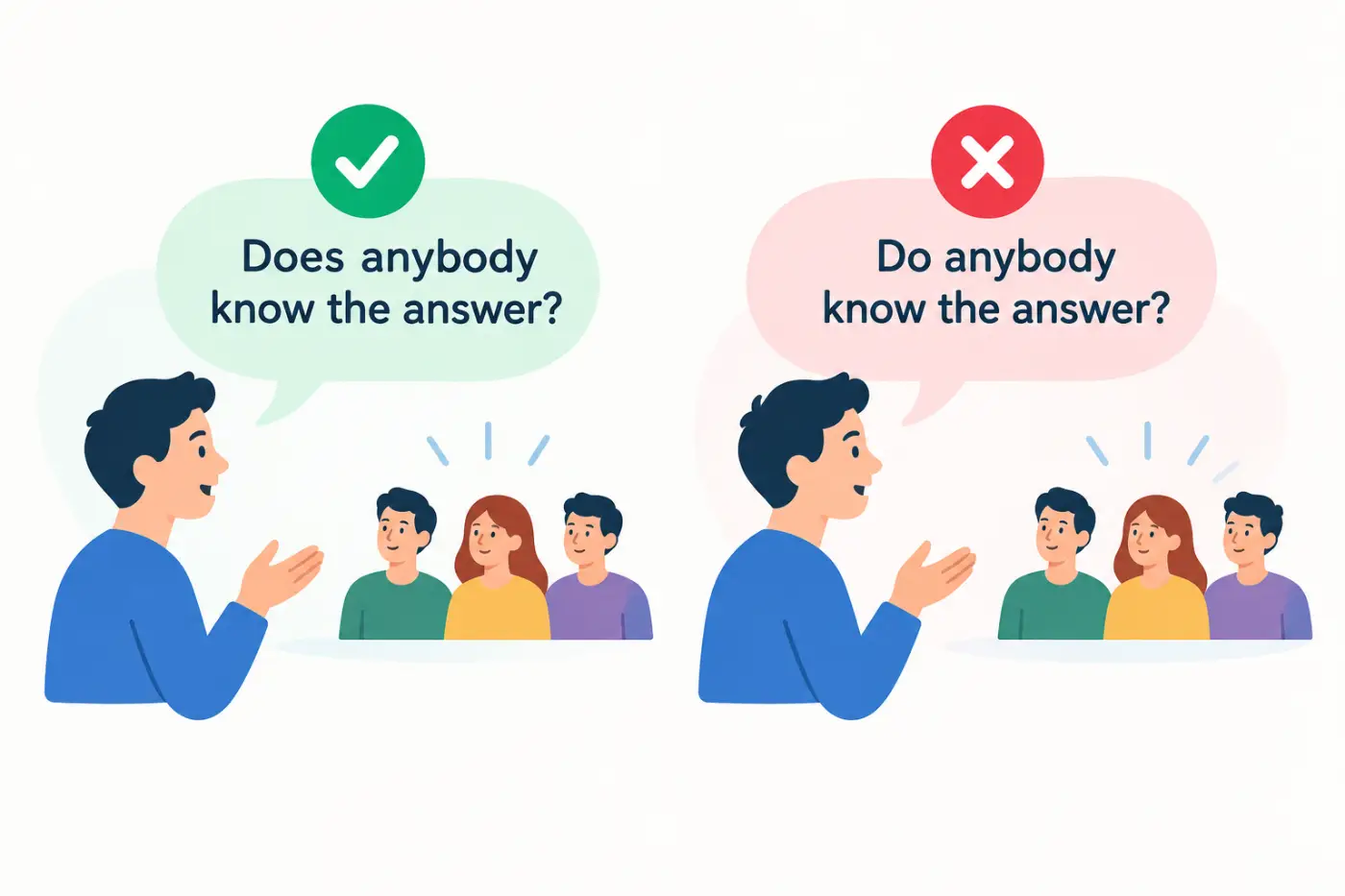
The correct phrase is does anybody. Use does with anybody because anybody is treated as a singular pronoun in standard English. For example, say, “Does anybody know the answer?” rather than “Do anybody know the answer?”
The confusion makes sense. Anybody refers to people, and people are usually plural. However, grammar follows the pronoun’s role in the sentence rather than the number of people it might refer to.
Once you understand this simple rule, you’ll know how to use anybody with does, do, is, has, and other common verbs. You’ll also learn how to make questions and negative sentences sound natural in everyday American English.
Quick Definition
Does anybody is the correct form when you ask if any person does something. Anybody is a singular indefinite pronoun, so it takes the singular helping verb does in present tense questions. For example, “Does anybody need help?”
Direct Answer
Use does anybody in standard American English. Do not use do anybody when anybody is the subject of a present tense question. The verb changes to do when the subject is plural or when you use the pronoun I or you.
Comparison of Does Anybody and Do Anybody
| Phrase | Meaning | Example Sentence | When to Use It |
|---|---|---|---|
| Does anybody | Asks if any person does something | Does anybody have a pen? | Use with anybody in a present tense question. |
| Do anybody | An incorrect form in standard English when anybody is the subject | Do anybody have a pen? | Replace it with does anybody. |
| Do any people | Asks about people as a plural group | Do any people work here? | Use do with the plural subject people. |
| Does anybody else | Asks if another person does something | Does anybody else agree? | Use does because anybody remains singular. |
Why Does Anybody Is Correct
The main rule is simple. Anybody is grammatically singular, even when it refers to an unknown person from a large group. That is why you pair it with does rather than do.
Consider this question.
“Does anybody know where my keys are?”
The speaker wants to know if at least one person has the answer. The person could be a friend, a family member, or someone else in the room. The number of possible people does not change the grammar.
Now look at another example.
“Do the students know where my keys are?”
Here the subject is students. Students is plural, so do is the correct helping verb.
The difference comes down to the subject of the sentence. Anybody is singular. Students is plural. The helping verb must agree with the subject.
What Anybody Means in English
Anybody means any person at all. It refers to a person who may or may not exist in a particular situation. The speaker usually does not know who that person is or does not need to identify them.
For example.
- Does anybody have a question.
- Does anybody want some coffee.
- Does anybody remember my name.
- Does anybody live near this park.
In each sentence the speaker asks about one possible person or any member of a group. The answer could be yes or no. The identity of the person is not the main point.
Anybody is an indefinite pronoun. That means it refers to a person without naming a specific individual. Other common indefinite pronouns include somebody, someone, everybody, and nobody.
These pronouns are generally treated as singular in standard English. As a result they usually take singular verbs.
- Does somebody need a ride.
- Does everyone understand the rule.
- Does anyone know the way.
- Does nobody want to join us.
The same pattern applies to all these examples. The subject is grammatically singular even when the sentence refers to many possible people.
Why Anybody Can Sound Plural
The confusion comes from the meaning of the word. Anybody can refer to any person in a group. That group may contain two people or two hundred people.
Imagine a teacher asking a class of thirty students a question. The teacher might say, “Does anybody know the answer?” The teacher is speaking to the entire class. Still the word anybody does not become plural.
Think of anybody as a way to ask about one possible person from a group. You are not saying that several people must know the answer. You are asking if at least one person knows it.
This is why the singular verb sounds natural in standard English. The grammar follows the word anybody rather than the size of the group.
A similar rule applies to everyone. You can ask, “Does everyone have a ticket?” even when a hundred people are waiting to enter a concert.
The group may be large, but everyone is grammatically singular. Anybody works the same way.
How to Use Does Anybody in Questions
Questions are the most common place to see this phrase. In the simple present tense you usually place does before the subject anybody. Then you use the base form of the main verb.
The basic pattern is:
Does + anybody + base form of the verb + the rest of the question.
Here are some natural examples.
- Does anybody know the answer.
- Does anybody want to come with us.
- Does anybody speak Spanish.
- Does anybody need more time.
- Does anybody remember that movie.
- Does anybody have a spare charger.
Notice the verbs after anybody. They are know, want, speak, need, remember, and have. They stay in their base forms.
You do not add an s to the main verb after does. The helping verb already carries the grammatical form needed for the question.
For example, “Does anybody knows the answer?” is incorrect in standard English. The correct sentence is “Does anybody know the answer?”
Use the Base Form After Does
This is one of the most useful rules to remember. When does appears in a present tense question, the main verb stays in its base form.
| Incorrect Sentence | Correct Sentence |
|---|---|
| Does anybody knows him. | Does anybody know him. |
| Does anybody wants tea. | Does anybody want tea. |
| Does anybody likes this song. | Does anybody like this song. |
| Does anybody needs help. | Does anybody need help. |
| Does anybody works here. | Does anybody work here. |
The same rule applies to other singular subjects that use does in questions.
For example, you would say, “Does she work here?” rather than “Does she works here?” You would also say, “Does your brother play tennis?” rather than “Does your brother plays tennis?”
The helping verb does carries the present tense marking. Adding another s to the main verb creates a grammatical error.
Questions With Has and Have
The verb have can confuse learners because it changes form in some sentences. With anybody in a present tense question you use does followed by have.
Correct examples include:
- Does anybody have a phone charger.
- Does anybody have a question.
- Does anybody have an extra ticket.
- Does anybody have time to help.
- Does anybody have the meeting notes.
Avoid “Does anybody has a question?” The correct form is “Does anybody have a question?”
The rule works the same way because have is the base form of the verb. Does carries the tense marking.
However, you can use has in a sentence without does.
For example, “Anybody who has a ticket can enter.” In this sentence anybody is the subject of a statement rather than a question formed with does. The verb has agrees with the singular subject.
This difference is worth remembering. Use does anybody have in a direct question. Use anybody has in a suitable statement or relative clause.
When to Use Do Instead of Does
Although anybody takes does in a standard present tense question, the word do is correct with many other subjects. The key is to identify the subject before choosing the helping verb.
Use do with I, you, we, and they. Use does with he, she, it, and singular nouns. Indefinite pronouns such as anybody, somebody, and everybody also take does when they form the subject of a present tense question.
Look at these examples.
- Do you need a ride.
- Do they know the answer.
- Do we have enough food.
- Does anybody need a ride.
- Does somebody know the answer.
- Does everybody have enough food.
The first three sentences use do because their subjects are you, they, and we. The last three use does because their subjects are anybody, somebody, and everybody.
A Simple Comparison With Other Subjects
| Subject | Correct Helping Verb | Example |
|---|---|---|
| I | Do | Do I need to sign this form. |
| You | Do | Do you know the address. |
| We | Do | Do we have enough time. |
| They | Do | Do they live nearby. |
| He | Does | Does he work here. |
| She | Does | Does she know the answer. |
| It | Does | Does it need more water. |
| Anybody | Does | Does anybody need help. |
| Somebody | Does | Does somebody have a pen. |
| Everybody | Does | Does everybody understand. |
This table shows why the choice is not based on how many people might be involved. It depends on the grammatical subject.
What Happens With Any People
The phrase any people follows a different pattern because people is plural. If people is the subject of a question you generally use do.
For example.
- Do any people work late here.
- Do any people still use that service.
- Do any people in your class speak French.
These sentences use do because the subject is people. The word any does not make a noun singular or plural. The noun after it determines the number.
Compare these two questions.
- Does anybody work late here.
- Do any people work late here.
Both questions ask about people who work late. The first uses the singular indefinite pronoun anybody. The second uses the plural noun people.
In everyday American English the first question often sounds more natural. The second is also grammatical but may sound less common in some situations. You might instead ask, “Do any of your coworkers work late here?”
That version makes the plural subject clear and gives the question a more specific meaning.
How to Use Anybody in Negative Sentences
Anybody also appears in negative statements. In these sentences the usual pattern is do not or does not followed by anybody and the base form of the main verb.
For a singular third person subject such as anybody you use does not. In casual American English most speakers shorten does not to doesn’t.
Examples include:
- Anybody doesn’t know the answer.
- I don’t think anybody knows the answer.
- She doesn’t think anybody needs help.
- He doesn’t know anybody here.
- We don’t believe anybody saw the accident.
The first example is grammatically possible in a narrow context but it is not the natural way to express the intended meaning in most everyday situations. The other examples show more natural patterns.
The important distinction is the subject of the sentence. In I don’t think anybody knows the answer the main subject of the first clause is I. That is why the sentence uses don’t. In the second clause anybody is the subject of knows.
Use Doesn’t With Anybody as the Subject
When anybody directly serves as the subject of a negative statement you can use doesn’t.
For example.
– Anybody doesn’t get special treatment here.
This sentence is grammatically awkward for most everyday contexts. A more natural way to express the idea is “Nobody gets special treatment here.”
The form anybody doesn’t can appear in some contexts when the speaker is correcting a specific claim or stressing a contrast. However, it is not the usual choice for a general negative statement.
For natural everyday English use these patterns instead.
- Nobody knows the answer.
- I don’t think anybody knows the answer.
- Nobody wants to miss the bus.
- I don’t think anybody wants to miss the bus.
These forms sound clear and natural. They also help you avoid a common problem with negative sentences.
The Difference Between Anybody and Nobody
Anybody and nobody do not mean the same thing.
Anybody refers to any person. Nobody means no person. The choice affects the meaning of the sentence but does not change the singular agreement rule.
| Word | Meaning | Example |
|---|---|---|
| Anybody | Any person at all | Does anybody know the answer. |
| Somebody | A person who is not named | Does somebody know the answer. |
| Everybody | All people in a group | Does everybody know the answer. |
| Nobody | No person | Nobody knows the answer. |
Notice that nobody takes knows in the final example. The sentence does not need does because it is a statement rather than a question.
You can also ask, “Does nobody know the answer?” This question expresses surprise or disappointment that no one seems to know.
In everyday speech you may hear “Doesn’t anybody know the answer?” This is a natural negative question. It often shows frustration or surprise.
Both forms are correct.
Common Mistakes With Does Anybody
Many learners understand the main rule but still make errors when they build longer sentences. The best way to avoid these mistakes is to pay attention to the helping verb and the form of the main verb.
Mistake One Using Do With Anybody
Incorrect: Do anybody know the answer.
Correct: Does anybody know the answer.
Anybody is singular in standard English. Use does for a present tense question with this subject.
You might hear the incorrect form in casual speech or in some dialects. However, it is not the standard form for formal writing schoolwork or professional communication.
Mistake Two Adding an S to the Main Verb
Incorrect: Does anybody knows my name.
Correct: Does anybody know my name.
The helping verb does already carries the present tense marking. Keep the main verb in its base form.
The same rule applies to other verbs.
- Does anybody want a seat.
- Does anybody understand this lesson.
- Does anybody remember the password.
- Does anybody play the piano.
Do not write wants, understands, remembers, or plays after does in these questions.
Mistake Three Using Has After Does
Incorrect: Does anybody has a ticket.
Correct: Does anybody have a ticket.
The base form have follows does. You should not use has in this question.
Remember that has is correct in a statement such as “Anybody who has a ticket can enter.” The mistake occurs when you place has directly after does.
Mistake Four Confusing Anybody With Everybody
Anybody and everybody are both singular indefinite pronouns. However, their meanings differ.
Anybody asks about any possible person. Everybody refers to all the people in a group.
For example.
- Does anybody want dessert.
- Does everybody want dessert.
The first question asks if at least one person wants dessert. The second asks about the entire group.
Both use does because both pronouns are grammatically singular.
Mistake Five Forgetting the Helping Verb
Incorrect: Anybody know the answer.
Correct: Does anybody know the answer.
In a standard present tense question you usually need the helping verb does before anybody. Without it the sentence sounds incomplete in standard written English.
However, short forms can appear in casual speech. Someone might say “Anybody know where the keys are?” in a quick conversation. This is an informal shortened question. For schoolwork professional writing and most published content use the complete form.
Mistake Six Using Does in Every Question
Some learners overcorrect and use does with plural subjects.
Incorrect: Does they know the answer.
Correct: Do they know the answer.
Does is not the correct choice for every question. It works with singular third person subjects and singular indefinite pronouns such as anybody.
Use do with you we they and plural nouns.
For example.
- Do the children need help.
- Do your friends live nearby.
- Do these shoes fit.
- Do we have another option.
Once you identify the subject the correct form becomes easier to choose.
Real Life Examples of Does Anybody
Grammar becomes easier when you see how people use a phrase in everyday situations. These examples show how to use anybody naturally at home at work at school and in casual conversations.
Everyday Questions at Home
- Does anybody want breakfast.
- Does anybody know where my phone is.
- Does anybody need a clean towel.
- Does anybody have the TV remote.
- Does anybody want to watch a movie.
- Does anybody remember to feed the dog.
These questions work when you are speaking to family members or roommates. You do not need to name each person.
You can also add words to make the question more specific.
- Does anybody in this house know how to fix the sink.
- Does anybody have time to help me clean the kitchen.
- Does anybody want to order pizza tonight.
The added words do not change the subject. Anybody still controls the verb agreement.
Examples at Work
- Does anybody have a question about the new schedule.
- Does anybody know how to use this software.
- Does anybody need a copy of the report.
- Does anybody have the client’s contact details.
- Does anybody want to volunteer for the next project.
- Does anybody know when the meeting starts.
These examples fit meetings emails and everyday workplace conversations. They sound polite and direct without making the question more complicated than it needs to be.
If you are leading a meeting you might say, “Does anybody have a question before we move on?” This gives people a chance to speak up.
You could also ask, “Does anybody need more time to finish the task?” That question invites people to share a problem without putting one person on the spot.
Examples at School
- Does anybody know the answer to question five.
- Does anybody need help with the homework.
- Does anybody have an extra pencil.
- Does anybody remember the science experiment.
- Does anybody want to read the next paragraph.
- Does anybody understand these instructions.
A teacher can use these questions to invite answers from the whole class. Students can use them when asking for help from classmates.
For example, a student who has lost a pencil might ask, “Does anybody have a spare pencil I can borrow?” The question sounds natural because it asks if at least one person can help.
Examples in Casual Conversations
- Does anybody know a good place to eat nearby.
- Does anybody want to go for a walk.
- Does anybody watch that show.
- Does anybody remember his name.
- Does anybody live around here.
- Does anybody know what time the store closes.
These questions are useful when talking with friends or strangers. They allow you to ask the whole group without choosing a specific person.
You can also use anybody in questions about opinions and preferences.
- Does anybody else think this movie is too long.
- Does anybody agree with that idea.
- Does anybody prefer tea over coffee.
- Does anybody have a different suggestion.
The word else is common in these questions. It means you are asking about another person in addition to someone who has already shared an opinion.
How to Use Anybody in Different Tenses
The present tense rule is the main point of this article. However, anybody can appear in past tense questions future questions and other sentence patterns too.
The helping verb changes based on the tense. The pronoun itself remains singular.
Present Tense
Use does anybody when you ask about a regular action or a current fact.
Examples.
- Does anybody work on Sundays.
- Does anybody know her phone number.
- Does anybody need another chair.
- Does anybody live in that building.
Use the base form of the main verb after does. This is the standard pattern for present tense questions.
Past Tense.
Use did anybody to ask about a past event. Did works with singular and plural subjects in simple past questions.
Examples.
- Did anybody call me last night.
- Did anybody see the package.
- Did anybody tell you about the change.
- Did anybody finish the assignment.
Do not use did with a past tense form of the main verb in these questions.
Incorrect: Did anybody called you.
Correct: Did anybody call you.
The helping verb did already shows the past tense. The main verb stays in its base form.
Future Tense
You can use will anybody to ask about a future action. Will does not change based on the subject.
Examples.
- Will anybody attend the meeting tomorrow.
- Will anybody help us move the furniture.
- Will anybody be home tonight.
- Will anybody need a ride after the event.
You do not use does or do after will to form these questions. The future helping verb will comes before the subject.
Questions With Can and Could
Can and could also work with anybody. These words are modal verbs. They help express ability possibility or polite requests.
Examples.
- Can anybody solve this puzzle.
- Can anybody help me carry these boxes.
- Could anybody explain this rule.
- Could anybody lend me a pen.
You do not need does after can or could. The modal verb already forms the question.
For example “Can anybody help?” is correct. “Does can anybody help?” is not correct in standard English.
Questions With Is and Are
Sometimes the main verb is be rather than an action verb. In these cases use is with anybody.
Examples.
- Is anybody home.
- Is anybody ready to leave.
- Is anybody available this afternoon.
- Is anybody interested in joining us.
Do not say “Are anybody home?” in standard English. Anybody takes the singular form is.
Compare this with a plural subject.
- Are the children home.
- Are your friends ready to leave.
- Are the guests available this afternoon.
The subject determines the verb form. Anybody is singular. Children friends and guests are plural.
Questions With Has and Have in Other Tenses
In the present perfect tense use has anybody followed by a past participle.
Examples.
- Has anybody seen my keys.
- Has anybody finished the report.
- Has anybody called the office.
- Has anybody tried this recipe.
This differs from the simple present question does anybody have.
Compare these examples.
- Does anybody have a ticket.
- Has anybody bought a ticket.
The first asks if any person has a ticket now. The second asks if any person has completed the action of buying a ticket.
The grammar changes because the tense and meaning change.
Does Anybody Else Follow the Same Rule
Yes. The word else does not change the subject. Anybody remains singular even when you add else.
Examples include:
- Does anybody else know the answer.
- Does anybody else need help.
- Does anybody else want to join us.
- Does anybody else have a suggestion.
The phrase anybody else means any other person. It is useful when someone has already answered or shared an opinion and you want to hear from another person.
For example, during a meeting you might ask, “Does anybody else have a question?” You are inviting more questions after someone has already spoken.
The same rule applies to anybody else in negative questions.
- Doesn’t anybody else agree.
- Doesn’t anybody else remember that day.
These questions often express surprise or disappointment. The contraction doesn’t stands for does not.
Is Do Anybody Ever Correct
In standard American English you should use does anybody when anybody is the subject of a present tense question. The form do anybody is generally considered nonstandard in that setting.
However, you may hear people say it in some dialects or informal speech. Spoken English varies by region and community. Hearing a form in conversation does not automatically make it suitable for formal writing.
There is also an important distinction between do anybody and sentences where do is followed by a different subject.
For example, “Do any people need help?” is correct because people is plural. “Do you know anybody here?” is also correct because you takes do.
In the second sentence anybody is not the subject. It is the object of the verb know. The subject is you, so do is correct.
That difference matters. You should not choose the helping verb simply by spotting the word anybody somewhere in the sentence. Find the subject first.
When Anybody Is the Object
An object receives the action of a verb or follows a preposition. Anybody can serve as an object rather than a subject.
Look at these examples.
- Do you know anybody here.
- Do they need anybody to help.
- Do we have anybody on the team who can fix this.
- Do you want anybody to come with you.
All four questions are correct. The subject is you they or we. Those subjects take do.
Anybody appears later in the sentence and does not control the helping verb.
Compare these two examples.
- Does anybody know you.
- Do you know anybody.
The first uses does because anybody is the subject. The second uses do because you is the subject. The same word appears in both questions but its role changes.
This is one of the easiest ways to understand the rule. Do not look only for the word anybody. Look at the person or thing doing the action in the sentence.
Easy Ways to Remember the Rule
You don’t need to memorize a long list of grammar rules to get this right. A few simple tricks can help you choose the correct verb quickly.
Remember That Anybody Is Singular
Think of anybody as one possible person. You are asking if at least one person does something rather than saying that a group acts together.
For example, ask “Does anybody know the answer?” when you want to hear from anyone in the room.
This simple idea also works with somebody everybody and nobody. These words are grammatically singular even when they refer to people across a group.
Use the Base Verb After Does
Remember this pattern.
Does + anybody + base verb.
Examples.
- Does anybody know.
- Does anybody care.
- Does anybody understand.
- Does anybody agree.
- Does anybody remember.
If you find yourself adding an s to the main verb you may be making a common mistake. The word does already carries the present tense form.
Replace Anybody With Someone
Another helpful trick is to replace anybody with someone. Both words are singular indefinite pronouns.
For example, you can change “Does anybody know the answer?” to “Does someone know the answer?”
Both questions use does. This quick substitution can help you check your sentence before you say it or write it.
Keep in mind that the meanings are slightly different. Anybody asks about any possible person. Someone often suggests that a particular person may know or do something.
Find the Subject Before Choosing the Verb
This trick is especially useful in longer sentences. Find the subject first and then decide which helping verb fits.
Compare these examples.
- Does anybody know your brother.
- Do you know anybody in this class.
- Does anybody want to join us.
- Do they know anybody in this class.
The first and third questions use does because anybody is the subject. The second and fourth use do because you and they are the subjects.
Once you find the subject the choice becomes much easier.
Related Grammar Questions
The rule for anybody connects to several other common English questions. Learning these patterns will help you speak and write with more confidence.
Does Anybody or Does Anyone
Both forms are correct. Anybody and anyone have nearly the same meaning and usually work in the same types of sentences.
For example, you can say “Does anybody know the answer?” or “Does anyone know the answer?” Both sound natural in American English.
The choice often comes down to personal preference or the flow of the sentence. The verb agreement stays the same because anyone is also singular.
Does Anybody or Does Somebody
Both are grammatically correct. However, anybody and somebody can suggest slightly different meanings.
Anybody usually refers to any possible person. Somebody often suggests that a person exists or that the speaker expects someone to respond.
For example, “Does anybody have a pen?” asks if any person has one. “Does somebody have my pen?” may suggest that the speaker believes a person has taken or borrowed it.
Both questions use does.
Does Everybody or Do Everybody
Use does everybody in standard English. Everybody is grammatically singular even though it refers to all the people in a group.
For example, say “Does everybody understand the instructions?” rather than “Do everybody understand the instructions?”
You can use do when the subject is a plural noun. For example, “Do all the students understand the instructions?” The subject students is plural.
Does Nobody or Do Nobody
Use does nobody in a present tense question when nobody is the subject.
For example, “Does nobody want to help?” is grammatically correct. It may sound surprised or frustrated because the speaker expected at least one person to volunteer.
In a statement you can say “Nobody wants to help.” You don’t need does because the sentence is not a question.
Does Anybody Have or Does Anybody Has
Use does anybody have in a direct present tense question.
For example, “Does anybody have a spare ticket?” is correct. “Does anybody has a spare ticket?” is incorrect in standard English.
The reason is simple. Does already marks the present tense. The main verb must stay in its base form.
FAQs
Is does anybody or do anybody correct?
Does anybody is the correct form in standard American English when anybody is the subject of a present tense question. Anybody is a singular indefinite pronoun so it takes does. For example, say “Does anybody know my name?”
Why do we say does anybody instead of do anybody?
English treats anybody as singular even when it refers to an unknown person in a large group. Singular subjects such as anybody and somebody take does in present tense questions. Use do with subjects such as you we and they.
Is anybody singular or plural?
Anybody is grammatically singular. It can refer to any person in a group but that does not make it a plural pronoun. This is why you say “Does anybody need help?” rather than “Do anybody need help?”
Should I say does anybody have or does anybody has?
Say does anybody have. The helping verb does carries the present tense form so the main verb stays in its base form. The same rule applies to questions such as “Does anybody know?” and “Does anybody want to leave?”
Is does anyone also correct?
Yes. Anyone and anybody have almost the same meaning and follow the same grammar rule. You can say “Does anyone know the answer?” or “Does anybody know the answer?” Both are correct.
Can I use do anybody in casual conversation?
You may hear do anybody in some dialects or informal speech. However, it is not the standard form for a present tense question when anybody is the subject. For school assignments professional writing and standard American English use does anybody.
Is does anybody else correct?
Yes. Does anybody else is correct because the word else does not change the singular subject. For example, “Does anybody else have a question?” is a natural way to invite more people to speak.
Do I use does anybody for past tense questions?
No. Use did anybody for simple past tense questions. For example, say “Did anybody call me yesterday?” The main verb stays in its base form after did so you should not say “Did anybody called me yesterday?”
Conclusion
The correct choice is does anybody when anybody is the subject of a present tense question. The word anybody is grammatically singular even when it refers to a group of possible people. That’s why standard English uses does instead of do.
Remember the simple pattern of does followed by anybody and the base form of the main verb. Say “Does anybody know?” rather than “Does anybody knows?” The helping verb does already carries the present tense marking.
Also remember to check the subject before choosing a helping verb. In “Do you know anybody?” the correct word is do because you is the subject and anybody is the object. The position of the word matters just as much as the word itself.
The next time you hesitate over does anybody or do anybody, ask yourself one quick question. Is anybody the subject of a present tense question? If it is, use does anybody. This small habit will help you write clearer sentences and speak more naturally.

Sienna Watson is a veteran copywriter and communications coach who has helped startup founders, marketers, and professionals polish their writing for over a decade. Realizing that most people don’t need a degree in linguistics—just clear, impactful communication—Sienna focuses on practical grammar, business writing etiquette, and eliminating wordiness. She advocates for plain language, strong verbs, and persuasive prose that gets results.