

If you’ve ever wondered about fare better or fair better you’re dealing with two real English words that have completely different jobs. Only one works in the common phrase used to say that someone will do better or have a better result.
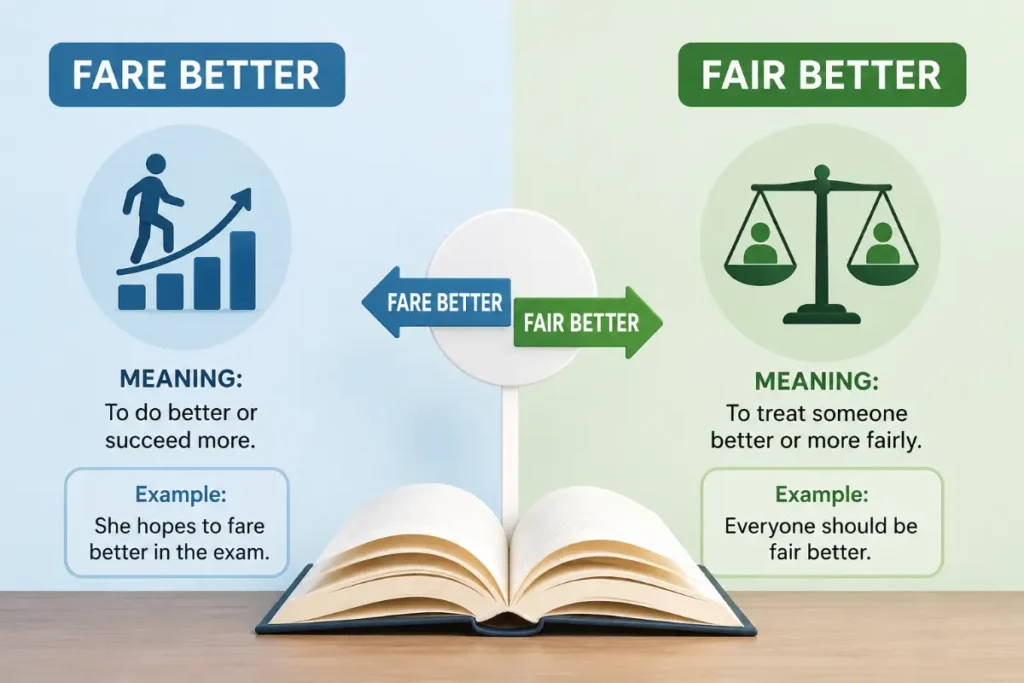
The correct expression is fare better. The word fare is a verb that means to perform or do in a particular way. So when you say that someone will fare better you mean that person will probably do better or have a better outcome.
The word fair has a different meaning. It can describe something that is reasonable or just. It can also describe something that is light in color or pleasant in appearance. Because the two words sound exactly alike in many varieties of English they’re easy to mix up when writing.
Once you understand what each word means the difference becomes much easier to remember. This guide explains the correct phrase the meaning of fare how fair is used and the common expressions that can help you avoid this mistake.
Quick Definition
Fare better means to do better or achieve a better result. Fair better is not the standard expression when you mean improved performance or a better outcome.
Direct Answer
The correct phrase is fare better when you mean do better or achieve a better result. Use fair when you mean reasonable just attractive or light in color.
Comparison Table
| Word or phrase | Meaning | Example sentence | When to use it |
|---|---|---|---|
| Fare | To perform or do in a certain way | She fared well on the exam. | Use it when talking about performance or results. |
| Fare better | To do better or get a better result | You may fare better with a different approach. | Use it when comparing possible results. |
| Fair | Reasonable or just | The judge made a fair decision. | Use it when talking about justice or equal treatment. |
| Fair | Light in color | He has fair hair. | Use it when describing color or appearance. |
| Fair | Pleasant or acceptable | We had fair weather. | Use it for certain descriptions of conditions. |

Why The Confusion Happens
The main reason for the confusion is pronunciation. Fare and fair are homophones in standard American English. Homophones are words that sound alike but have different meanings and spellings.
Think about the words to and too. They sound alike but you can’t use them in the same places. The same idea applies here.
When you hear someone say that a person might fare better after making a change you can’t see the spelling. You only hear the sound. Once you write the sentence down the difference matters.
This creates a common trap. Someone may know the phrase from speech but have never seen it written. When they type it they choose fair because that spelling is more familiar. The sentence can look reasonable at first glance even though the word doesn’t fit its meaning.
The best way to avoid the mistake is to focus on meaning rather than sound. Ask yourself what you’re trying to say. If you mean do better then you need fare.
What Fare Means
Fare is a verb when it means to perform or progress in a particular way. It often appears when people talk about results experiences situations or future outcomes.
- You might hear someone ask:
- How did you fare on the test.
- That question means:
- How did you do on the test.
- You might also say:
- She fared well during the interview.
- This means she did well during the interview.
The verb often appears with words such as well poorly better worse and badly. These words help describe the result.
For example:
- The new students fared well in their first semester.
- The older computer fared poorly after the software update.
- He may fare better with more practice.
- The team fared worse than expected.
- Small businesses can fare well in this market.
The basic idea stays the same. You’re describing how someone or something performs or gets along in a particular situation.
What Fare Better Means
When you say that someone will fare better you mean that person is likely to do better under different conditions.
For example:
- You might fare better if you study in the morning.
- She would fare better with a little more preparation.
- The company could fare better after changing its pricing.
- Some students fare better when they work in small groups.
In each sentence the phrase points to an improved result.
It doesn’t always mean that the person will succeed. It simply means the person is expected to do better than under another condition.
Imagine two study methods. A student struggles when studying alone but performs well with a study partner. You could say:
The student may fare better with a study partner.
That means the second approach may produce a better result.
Why Fair Does Not Work In This Phrase
The word fair doesn’t carry the meaning of perform or do. Its most common meanings relate to justice equality appearance or conditions.
- Consider this sentence:
- The teacher gave every student a fair chance.
- Here fair means reasonable and equal.
- Now consider:
- The student may fare better with more practice.
- Here fare means do.
- Changing fare to fair changes the word’s function and makes the phrase incorrect for the intended meaning.
This is a useful test. Replace the word with do. If the sentence still makes sense you probably need fare.
For example:
- You may fare better with a tutor.
- Replace fare better with do better.
- You may do better with a tutor.
The meaning stays clear. That tells you fare is the right choice.
Fare Better Compared With Do Better
The easiest way to understand fare better is to connect it with do better.
These phrases are close in meaning.
- You may do better with more practice.
- You may fare better with more practice.
Both sentences say that more practice could lead to a better result.
There is a small difference in style. Do better is more common in everyday speech. Fare better can sound slightly more formal or polished. You’ll often see it in articles reports advice and discussions about performance.
For example a parent might say:
- You’ll do better if you slow down.
- A teacher might write:
Students may fare better when they have extra time to review.
Neither sentence is wrong. The choice depends on the tone and context.
Real Examples Of Fare Better
Learning through examples can make the distinction stick. Look at how the phrase works in different situations.
At School
A student might struggle with math but improve after getting extra help.
- Maria may fare better if she meets with a tutor twice a week.
The phrase describes her expected performance after a change.
At Work
A worker may perform better in a quieter environment.
- You might fare better if you work on the project without constant interruptions.
Again the phrase means do better.
In Business
A company may have stronger results after changing its strategy.
- The small business could fare better by focusing on local customers.
Here fare better describes the expected business result.
In Sports
A player may perform better after changing a training routine.
- The team could fare better with a stronger defense.
The phrase describes the team’s expected performance.
In Everyday Decisions
Someone may get a better result by choosing another option.
- You may fare better if you leave earlier.
The meaning is simple. Leaving earlier may help you get a better result.
Fare Well And Fare Better
You may already know the expression fare well. It follows the same pattern.
Fare well means to do well or have a good result. For example:
- She fared well in her first competition.
- The company fared well during the difficult year.
- How did you fare at the interview.
The phrase fare better simply adds a comparison.
- She fared well in the first competition.
- She fared better in the second competition.
The first sentence says she did well. The second says she did better in the second competition.
This distinction is useful because it shows how the verb works naturally with different words.
Fare Worse And Fare Poorly
The same verb can describe a negative result.
Fare worse means to do worse.
- The team fared worse after losing its best player.
- You may fare worse if you ignore the warning signs.
Fare poorly means to perform poorly or have a bad result.
- The product fared poorly after its price increased.
- He fared poorly on the first part of the exam.
So fare isn’t limited to positive results. It can describe good bad better or worse outcomes.
The Different Meanings Of Fair
Understanding fair makes the spelling difference much easier. This word has several common meanings and none of them mean perform or progress.
Fair Means Reasonable
When something is fair it treats people in a reasonable and equal way.
- The manager made a fair decision.
- Everyone deserves a fair chance.
- That doesn’t seem fair to the other players.
In these sentences fair relates to justice or equal treatment.
Fair Means Light In Color
Fair can also describe someone with light skin hair or eyes.
- She has fair hair and blue eyes.
- The child has fair skin.
This meaning is less connected to the phrase you’re trying to remember but it explains why fair is such a familiar word.
Fair Means Pleasant Or Acceptable
Fair can also describe weather or conditions.
- We had fair weather during the trip.
- The forecast calls for fair conditions tomorrow.
It can also describe something that is acceptable but not especially good.
- His performance was fair.
- The restaurant received a fair rating.
Again none of these meanings fit the idea of doing better.
Common Mistakes With Fare
The most common mistake is using fair when you mean fare. But there are a few other things worth watching.
Using Fare As A Noun
Fare can also be a noun. In that use it has a different meaning. For example:
- The bus fare is five dollars.
- We couldn’t afford the airfare.
- The taxi fare was higher than expected.
Here fare means the money charged for a trip.
There is another noun meaning too. Fare can refer to the type of food or entertainment being offered. For example:
- The restaurant serves traditional Italian fare.
- The festival offered a wide range of local fare.
So one spelling can have several meanings. Context tells you which meaning applies.
Using Fair When You Mean Good Performance
Another common mistake appears in sentences about results.
Incorrect:
- You may fair better with more experience.
Correct:
- You may fare better with more experience.
The intended meaning is you may do better. That calls for the verb fare.
A Simple Memory Trick
- Here’s a practical way to remember the difference.
- Think of fare as connected to performance.
- Both ideas relate to how someone or something does.
- You can fare well.
- You can fare poorly.
- You can fare better.
- You can fare worse.
- Now think of fair as connected to justice.
- A fair decision is reasonable.
- A fair rule treats people equally.
- A fair chance gives people an equal opportunity.
- This simple split can save you from guessing.
- If you’re talking about how something goes use fare.
- If you’re talking about justice or equal treatment use fair.
A Second Memory Trick
- You can also replace the phrase with do better.
- Take this sentence:
- You might fare better with more practice.
- Now replace the phrase:
- You might do better with more practice.
- The meaning remains almost exactly the same. That gives you a quick test when you’re unsure.
- Try it with a sentence about fairness:
- Everyone deserves a fair chance.
- Replacing fair with do doesn’t work.
- Everyone deserves a do chance.
- That makes the difference obvious.
Fare Better In Formal Writing
This expression works well in formal writing because it is concise and clear. You can use it in school essays reports business articles professional emails and other forms of writing. For example:
- Employees may fare better when expectations are clear.
- New businesses often fare better when they understand their customers.
- Students may fare better with regular practice.
- Patients may fare better when they follow the treatment plan.
The phrase isn’t overly formal. It simply gives you an alternative to do better.
Still you shouldn’t use it just to sound sophisticated. If do better sounds more natural in your sentence then use it. Clear writing matters more than choosing the fancier expression.
Fare Better In Everyday Speech
People use fare better in conversation too. It may appear more often in careful speech than in casual conversation but it isn’t strange or outdated.
Imagine a friend asks why you’re still having trouble with a computer program.
You might say:
- I think I’d fare better if someone showed me how to use it.
- That sounds natural. You could also say:
- I think I’d do better if someone showed me how to use it.
- The second version is more casual. The first puts a little more focus on the outcome.
- Both are correct.
How Fare Changes With Tense
Because fare is a regular verb its forms are easy to learn.
The present form is fare.
- Some students fare well under pressure.
The third person singular form is fares.
- She fares well when she has enough time.
The past tense is fared.
- He fared well during the interview.
The present participle is faring.
- How are you faring in your new job.
These forms all keep the same basic idea. They describe how someone or something is doing.
Questions With Fare
You may encounter fare in questions more often than you realize.
A classic example is:
- How did you fare?
- This means:
- How did you do?
You might hear it after an exam interview trip competition or difficult experience.
For example:
- How did you fare on the final exam?
- How did your team fare against the champions?
- How are you faring in your new role?
- These questions focus on performance or progress.
- They do not relate to fairness.
Fare Better Or Perform Better
Perform better is another close alternative. It works especially well when talking about measurable results.
For example:
- The new software helps employees perform better.
- Students performed better after getting extra practice.
- The athlete may perform better after changing her training plan.
Fare better has a slightly broader meaning. It can describe performance but it can also describe how someone gets along in a situation.
Compare these examples.
- The athlete performed better in the second race.
- The athlete fared better in the second race.
Both work. The first focuses strongly on performance. The second can suggest the overall result or experience.
Fare Better Or Succeed
- The words fare better and succeed are related but they aren’t identical.
- To succeed means to achieve the desired result.
- To fare better means to achieve a better result compared with another situation or option.
For example:
- She succeeded in the course.
- She fared better in the advanced course than in the beginner course.
The first tells us she achieved success. The second compares her results.
Someone can fare better without completely succeeding.
For example:
- I still didn’t pass the exam but I fared better this time.
The person improved but did not reach the final goal.
When Fair Is The Right Word
You don’t need to avoid fair. It is a common and useful English word. You simply need to use it for the right meaning.
Here are some natural examples.
- The rules are fair to everyone.
- That’s a fair price for the service.
- She gave me a fair warning.
- Every child deserves a fair chance.
- The referee made a fair call.
- We had fair weather during most of the trip.
In each sentence fair relates to reasonableness equality conditions or appearance.
Related Phrases With Fair
Learning common expressions with fair can help separate it from fare.
Fair Chance
A fair chance means an equal or reasonable opportunity.
- Everyone deserves a fair chance to explain their side.
Fair Price
A fair price means a price that seems reasonable.
- We paid a fair price for the used car.
Fair Decision
A fair decision is reasonable and unbiased.
- The committee made a fair decision after hearing both sides.
Fair Treatment
Fair treatment means being treated reasonably and equally.
- All employees deserve fair treatment.
Fair Game
Fair game can mean something that is considered acceptable to criticize challenge or target depending on context.
- Once the story became public it was considered fair game for reporters.
These phrases make the meaning of fair very different from the verb fare.
Related Phrases With Fare
Now look at the other side.
Fare Well
This means to do well.
- I hope you fare well in your new position.
Fare Better
This means to do better.
- You may fare better with a different strategy.
Fare Worse
This means to do worse.
- The business could fare worse if costs continue to rise.
Fare Poorly
This means to perform poorly.
- The product fared poorly in early tests.
How Did You Fare
This asks how someone did.
- How did you fare on your driving test.
Seeing these expressions together makes the pattern much easier to remember.
Why Context Solves The Problem
When two words sound alike the surrounding words usually give you the answer.
- If the sentence contains ideas such as do better perform results progress or outcome then fare is probably the word you need.
- If the sentence contains ideas such as justice equal reasonable price chance or treatment then fair is probably the right choice.
For example:
- The new plan may help workers fare better.
The sentence talks about performance and results.
Now compare:
- The new policy should give workers a fair chance.
This sentence talks about equal treatment.
The sound is similar but the meaning tells you which spelling belongs there.
A Quick Proofreading Test
When you’re editing your writing and see fair or fare pause for a moment. Don’t simply ask which spelling looks right. Ask what the word means in that sentence.
- If you can replace it with do or perform then fare is likely correct.
- If you can replace it with reasonable just or equal then fair is likely correct.
For example:
- You may fare better after more practice.
- Replace fare with do.
- You may do better after more practice.
- That works.
Now try:
- Everyone deserves a fair opportunity.
- Replace fair with reasonable.
- Everyone deserves a reasonable opportunity.
- That also works.
This method is quick and reliable because it focuses on meaning rather than appearance.
Common Sentences To Remember
Sometimes the best way to learn a word pair is to memorize a few natural sentence patterns. You don’t need to memorize every rule if you can recognize the phrases people actually use.
Here are several useful examples.
- You may fare better with more experience.
- She fared well during the interview.
- The team fared worse than expected.
- How did you fare on the test.
- The company fared well during the first year.
- Everyone deserves a fair chance.
- We agreed that the price was fair.
- The judge made a fair decision.
- The teacher treated every student fairly.
- They asked for fair treatment.
Notice the difference. The forms related to fare describe results or performance. The forms related to fair describe justice or reasonableness.
Is Fare Better Always Better Than Fair Better
No. The answer depends on the meaning you want.
If you mean do better then the correct expression is fare better. If you mean something related to justice or equal treatment then fair may be the right word but it will usually need a different noun or phrase after it.
For example:
- You may fare better with a new study plan.
- You deserve a fair opportunity to explain yourself.
The first sentence compares results. The second talks about equal treatment.
The problem isn’t that fair is a bad word. The problem is that it doesn’t perform the job required in the expression do better.
Why This Matters In Professional Writing
A spelling mistake involving a homophone can be easy to overlook because the sentence may still sound correct when read aloud. That makes these errors especially common in emails reports applications and online content.
A reader may understand your meaning immediately. Still the wrong word can make the writing look careless.
Using the right word shows that you understand the meaning behind the sentence. That’s more useful than simply memorizing spelling rules.
This matters most when the writing represents you professionally. A small mistake can distract from an otherwise strong message.
The good news is that this particular distinction is easy to master. Once you connect fare with performance and fair with justice the choice becomes much more natural.
FAQs
Is fare better or fair better correct?
Fare better is correct when you mean do better or achieve a better result. The word fair has different meanings related to justice reasonableness appearance or conditions. It doesn’t mean perform.
What does fare better mean?
It means to do better or have a better result. For example you might fare better with more practice. The phrase often compares one situation with another.
Can I say fair better?
Not when you mean do better. Fair better isn’t the standard English expression for improved performance. Use fare better instead.
What is the difference between fare and fair?
Fare can mean to perform or do in a certain way. Fair can mean reasonable just or equal and it can also describe certain colors or conditions. They sound alike but have different meanings and spellings.
Is fare a verb?
Yes. When fare means to perform or progress it is a verb. You can say someone fares well fared poorly or may fare better.
What does fare well mean?
Fare well means to do well or have a good result. For example you could say that a student fared well on an exam. It can also be used when asking someone about their progress.
Is fare better formal English?
Yes. Fare better is standard English and works in both formal and casual settings. Do better is more common in everyday speech while fare better often appears in polished writing.
How can I remember the difference between fare and fair?
Connect fare with performance. If you can replace the word with do or perform then fare is probably correct. Connect fair with justice and equal treatment when the meaning involves something being reasonable or unbiased.
Conclusion
If you’ve been unsure about fare better or fair better the answer is simple when you focus on meaning. Use fare better when you mean do better or get a better result. The verb fare describes performance or progress.
The word fair has a different job. It can describe something reasonable or just. It can also describe light colors and certain conditions. Those meanings don’t fit the common expression about improved performance.
A quick substitution test can help. Replace the phrase with do better. If the sentence still makes sense then fare better is the form you need. If you’re talking about equal treatment or something reasonable then look at fair instead.
Keep one simple idea in mind. Fare is about how something goes. Fair is usually about how reasonable or equal something is. Remember that distinction and you’ll have a much easier time choosing the right word the next time you write the phrase.

Dr. Elena Vance holds a Ph.D. in Linguistics from Columbia University and has spent over 15 years analyzing the evolution of the English language. A former university professor turned full-time writer and editor, Elena specializes in breaking down high-level grammatical concepts, punctuation nuances, and style guides (APA, Chicago, MLA) into clear, actionable advice. When she isn’t hunting down dangling modifiers, she can be found collecting vintage dictionaries and reading classic literature.