
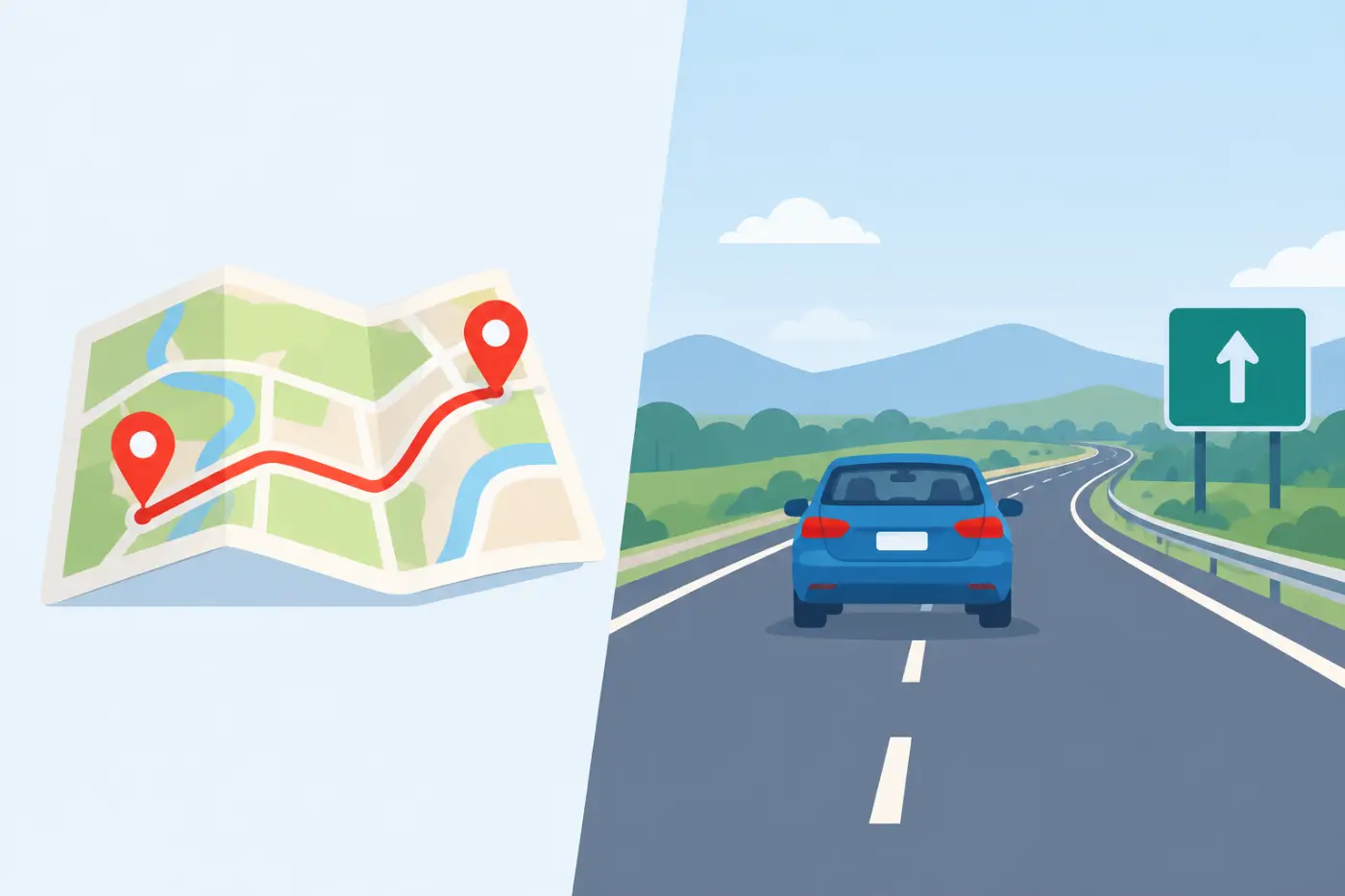
If you’re wondering about in route or en route the correct expression is in route. It means on the way to a place or destination. The phrase comes from French and English uses it as a fixed expression.
You might see it in a sentence like this: The package is en route to your home. You could also say that someone is en route to work or that a flight is en route to Chicago.
The confusion makes sense because en route sounds similar to an English phrase built around the word in. However in route doesn’t work as the standard expression when you mean on the way. This guide explains the difference clearly and shows you how to use the phrase in everyday writing.
Quick Definition
En route means on the way to a particular place. It describes someone or something that has started a journey but has not yet reached the destination.
In route is not the standard expression for this meaning. In most cases you should use en route instead.
Direct Answer
En route is the correct phrase when you mean on the way to a destination. In route is generally incorrect for this meaning.
Comparison Table
| Word or Phrase | Meaning | Example Sentence | When to Use It |
|---|---|---|---|
| En route | On the way to a place. | We are en route to the airport. | Use it for someone or something traveling toward a destination. |
| In route | Not the standard phrase for this meaning. | Avoid this usage. | Don’t use it when you mean on the way. |
| On the way | Traveling toward or going to a place. | We are on the way home. | Use it as the simple English alternative. |

What En Route Means
The phrase en route means that a person or thing is traveling toward a destination. The journey has begun but the destination has not yet been reached.
For example, imagine that you’re driving from Dallas to Austin. Once you leave Dallas and start heading toward Austin, you are en route to Austin. You could also simply say that you’re on the way to Austin.
The phrase can describe people vehicles packages flights emergency crews and many other things that move from one place to another.
Consider these examples.
- The ambulance is en route to the hospital.
- Your order is en route to your address.
- We stopped for gas while en route to Denver.
- The plane is en route to New York.
- She called me while en route to the meeting.
Each sentence describes movement toward a destination. That basic idea is the key to understanding the expression.
Where En Route Comes From
The phrase has French roots. In French en route means on the road or on the way. English adopted the expression and kept its original spelling.
You don’t need to know French to use it correctly. Still the origin explains why the phrase doesn’t follow the usual English pattern you might expect.
The word en can mean in or into in French depending on the context. The word route means road or route. Together the expression developed the sense of being on the way.
English contains many borrowed expressions from French. Some are common in everyday speech while others appear mostly in formal writing. En route falls somewhere in the middle. It can sound slightly polished but remains perfectly natural in ordinary conversation.
For example you might tell a friend:
- I’m en route to your house.
You could also say:
- I’m on my way to your house.
Both sentences are natural. The second one sounds more casual and direct.
How To Use En Route Correctly
The phrase usually appears before a destination. The destination can be a physical place such as a city airport office or home.
You can also use it before an event or activity when the context makes the destination clear.
En Route To A Place
This is the most common structure.
- We are en route to the airport.
- The delivery driver is en route to your location.
- They were en route to Boston when the storm began.
- The bus is en route to the downtown station.
The pattern is simple.
En route to + destination.
Once you remember that structure you can use the phrase with very little effort.
En Route Home
You can also use the expression without to when home follows it.
- I’m en route home.
- We were en route home when you called.
- She stopped for coffee while en route home.
You may also hear en route to home in some contexts but en route home sounds more natural in standard American English.
En Route To Work
The same structure works with everyday destinations.
- I’m en route to work right now.
- He called while en route to work.
- We picked up breakfast en route to work.
The phrase doesn’t require a long or formal journey. You can use it for a short trip across town.
En Route In Everyday Conversation
Some people think en route sounds too formal for casual speech. That’s not really the case.
It can fit naturally into a text message or quick update.
For example:
- I’m en route. I’ll be there soon.
- We’re en route to the restaurant.
- The kids are en route home.
- I’m already en route to the office.
That said on the way is often more natural in relaxed American conversation. If you’re texting a friend you might write I’m on my way instead of I’m en route.
Both expressions communicate the same basic idea. The choice often depends on tone.
En Route In Formal Writing
The phrase works well in professional writing too. You might see it in shipping updates travel information news reports or workplace messages.
For example:
- Your replacement order is en route.
- The inspection team is en route to the site.
- Emergency crews are en route to the affected area.
- The aircraft is currently en route to Los Angeles.
In these situations the phrase gives a clear update about movement. It tells the reader that the person or item has already started traveling.
Why People Confuse En Route And In Route
The confusion usually comes from the word in. English speakers often use in when talking about a place or position. For example you can be in the car in the city or in the airport. So it can feel natural to say that someone is in route when talking about travel.
The problem is that en route is a fixed expression. It doesn’t follow the same pattern as ordinary English phrases that use in. When you mean that someone or something is traveling toward a destination the standard expression is en route.
Another reason for the mistake is pronunciation. In casual speech the phrase can sound quick and blended. Someone who has mostly heard it spoken may not know that it contains the French word en. They may then write the phrase based on how they think it sounds.
The good news is that you don’t need to memorize a complicated grammar rule. Just connect en route with the simple phrase on the way. If you can replace the expression with on the way and the sentence still makes sense then en route is likely the phrase you need.
The Difference Between En Route And On The Way
En route and on the way have nearly the same basic meaning. Both describe someone or something moving toward a destination.
The main difference is tone. On the way is more common in casual American English. En route can sound a little more formal or polished but it remains easy to understand.
Compare these sentences.
- I’m on the way to the store.
- I’m en route to the store.
Both are correct. The first sounds more like everyday conversation. The second may sound more natural in a travel update a work message or a report.
You can also use on the way when you want to keep your writing very simple.
- Your package is on the way.
- Your package is en route.
Again both work. The first is especially common in customer messages because it is plain and direct.
When To Use En Route
The phrase works best when you want to show that travel has already started. It tells the reader that the person or thing is currently moving toward a destination.
When Someone Is Traveling
You can use it for people who are already on a journey.
- We are en route to the beach.
- She is en route to her parents’ house.
- They were en route to the airport when they heard the news.
The phrase focuses on the journey itself. It doesn’t tell us exactly where the person is at that moment. It simply tells us that the person is traveling toward the stated destination.
When A Vehicle Is Moving
Vehicles can also be described as en route.
- The bus is en route to the station.
- The train is en route to Philadelphia.
- The driver is en route to the pickup location.
This use is common in transportation and delivery updates because it gives a quick status update.
When A Package Is Being Delivered
Shipping companies often use the phrase to show that an order has left a facility and is moving toward the customer.
For example:
- Your package is en route.
- Your order is en route to your local delivery center.
- The replacement item is en route to your address.
Keep in mind that en route does not always mean the package is on the final delivery vehicle. It simply means the item is traveling toward its destination.
When Not To Use En Route
Although the phrase is useful it doesn’t belong in every sentence about travel. Sometimes another expression is clearer.
If you’re talking about a future trip you haven’t started yet you usually shouldn’t say that you’re en route.
For example:
- I’m leaving for Chicago tomorrow.
- We’re planning a trip to Seattle next week.
You aren’t en route yet because the journey hasn’t started.
Once you actually begin traveling you can say:
- I’m en route to Chicago.
- We’re en route to Seattle.
That small difference matters. En route describes an active journey rather than a plan for a future journey.
En Route Does Not Mean Arrived
This is another point that can cause confusion. When someone is en route they have not necessarily reached the destination.
Imagine your friend sends you a message saying:
- I’m en route to the restaurant.
That means your friend is on the way. They could be five minutes away or thirty minutes away. The sentence doesn’t tell you exactly how far they have traveled.
If your friend has already arrived you would say:
- I’m at the restaurant.
- I arrived at the restaurant.
So don’t use en route to describe someone who has reached the destination unless you’re referring to the trip in the past.
For example:
- We were en route to the restaurant when it started raining.
That sentence is correct even if the people eventually arrived.
En Route Can Describe Past Travel
The phrase works with different verb tenses. You can use it to describe something happening now or something that happened during an earlier journey.
Present Tense
- We are en route to the hotel.
- The ambulance is en route to the scene.
These sentences describe travel happening now.
Past Tense
- We were en route to the airport when the flight was canceled.
- She was en route home when her car broke down.
Here the phrase describes a journey that was in progress at a point in the past.
Future Context
You can also talk about a future point in a journey.
- Once we are en route we’ll call you.
- The team will send an update after the crew is en route.
The key idea stays the same. The expression refers to being on the way rather than being at the destination.
Is En Route One Word Or Two Words
En route is written as two words.
Don’t combine them into enroute in standard English. That form is considered incorrect.
The correct spelling is:
en route
The phrase also doesn’t need capitalization in the middle of a sentence unless a specific style guide or context calls for it.
For example:
- We are en route to Miami.
- The package is en route.
- She called while en route home.
At the beginning of a sentence you naturally capitalize the first word.
- En route to work I stopped for coffee.
The spelling is simple once you remember that the expression contains two separate words.
Does En Route Need To Be Italicized
In modern American English writing en route normally doesn’t need italics. English has used the expression for a long time and it has become familiar to many readers.
You may occasionally see foreign words or phrases italicized in older writing. That’s a style choice rather than a requirement for this expression.
For everyday articles emails school work and professional writing you can simply write en route in regular type.
En Route To Or En Route For
The most common construction is en route to when you name a destination.
- We are en route to the airport.
- The truck is en route to the warehouse.
- She is en route to New York.
You may sometimes see en route for in travel writing. However en route to is the clearer and more common choice when you mean traveling toward a destination.
There is another use of for that can make sense in a different structure.
- The train left Boston en route for Washington.
This construction appears in some varieties of English but American readers will usually find en route to Washington more direct.
If your goal is clear everyday US English stick with en route to when you identify the destination.
Common Sentences With En Route
Learning complete examples can make the phrase easier to use naturally. These sentences cover situations you may encounter in everyday writing.
- I’m en route to the office.
- We are en route to the airport.
- The package is en route.
- Your order is en route to your home.
- The ambulance is en route to the hospital.
- She called me while en route to work.
- They stopped for lunch while en route to Denver.
- The flight is currently en route to Chicago.
- He was en route home when his phone died.
- The repair team is en route to your location.
Each example describes movement toward a destination or movement during a journey. That is the central idea to remember.
How To Remember En Route
The easiest way to remember en route is to connect it with the phrase on the way. Both expressions describe someone or something traveling toward a destination. When you see the idea of movement toward a place in your sentence you can think of these two phrases as close matches.
For example:
- We are on the way to the airport.
- We are en route to the airport.
The wording is different but the basic meaning is the same. This simple connection can help you avoid choosing the wrong form when you’re writing quickly.
Another useful trick is to remember that en route is a fixed expression borrowed from French. You don’t need to translate it word by word. Treat it as one familiar phrase that means on the way.

En Route Compared With Similar Expressions
Several expressions can describe travel or movement. They may look similar but they don’t always work in the same situations.
En Route And On The Way
These are the closest alternatives.
On the way is the more casual choice. It’s extremely common in everyday American speech.
En route has a slightly more formal feel. You might see it in travel updates delivery notices workplace messages and news reports.
For example:
- I’m on the way to the store.
- I’m en route to the store.
Neither sentence is wrong. The first sounds more relaxed. The second sounds a little more polished.
En Route And In Transit
In transit means moving from one place to another. It often appears in shipping transportation and logistics.
For example:
- Your package is in transit.
- Your package is en route to the local facility.
The two expressions can overlap but they don’t always carry exactly the same focus. In transit emphasizes the state of being transported. En route emphasizes movement toward a destination.
A package can be in transit without the destination being mentioned. If you say that something is en route to Chicago you clearly identify where it is heading.
En Route And On The Road
On the road usually describes someone traveling by vehicle or spending time traveling.
- We have been on the road since six this morning.
- We are en route to Nashville.
The first sentence focuses on the experience or duration of travel. The second focuses on the destination.
You can use both expressions in the same conversation because they give slightly different information.
Can You Say En Route Without A Destination
Yes. You don’t always have to name a destination.
If someone asks where you are you can simply say:
- I’m en route.
This means you’re currently traveling. The destination may already be obvious from the conversation.
For example:
Are you still at the office.
No. I’m en route.
The phrase works because both people already understand where the person is going.
You can also use it in a delivery update.
- Your order is en route.
Here the customer may already know the expected destination. The phrase simply tells them that the item is currently on its way.
Can You Say En Route Home
Yes. En route home is a natural construction when you mean that you’re traveling toward your home.
For example:
- I was en route home when you called.
- She stopped for groceries while en route home.
- He got stuck in traffic en route home.
You don’t need to before home in this expression.
Compare these sentences.
- I am en route to the office.
- I am en route home.
The first uses to because the office is a noun phrase that names the destination. The second uses home in a way that does not require the preposition.
This is similar to other common English expressions such as go home and come home.
Can En Route Be Used With A Person
Yes. A person can be en route to a place.
- Maria is en route to the airport.
- My brother is en route to my house.
- The doctor is en route to the clinic.
The phrase doesn’t tell you how the person is traveling. They could be walking driving riding a train or flying.
That makes the expression useful when the method of transportation doesn’t matter.
Can En Route Be Used With Things
Yes. The subject doesn’t have to be a person.
Packages are often described as en route. Flights trains buses emergency vehicles and deliveries can also be described this way.
For example:
- The shipment is en route to the warehouse.
- The plane is en route to Boston.
- The rescue vehicle is en route to the scene.
- Your replacement card is en route.
In each sentence the subject is moving toward a destination.
Common Mistakes To Avoid
Knowing the correct phrase is only part of the job. You also want to avoid a few other mistakes that can make your sentence sound unnatural.
Writing Enroute As One Word
The standard spelling is en route with a space.
Don’t write enroute in standard American English.
For example:
- Correct: The package is en route.
- Incorrect: The package is enroute.
This is easy to fix once you remember that the expression contains two words.
Using In Route For Travel
If you mean that someone is on the way the standard choice is en route.
For example:
- Correct: We are en route to the hotel.
- Incorrect: We are in route to the hotel.
The second version may sound understandable because the words seem logical together. However it isn’t the standard expression for this meaning.
Using En Route For A Future Trip
Don’t use the phrase to describe a trip that hasn’t started.
For example if your flight leaves tomorrow you aren’t en route to the destination today.
Instead say:
- I’m flying to Los Angeles tomorrow.
- We’re leaving for Miami tomorrow morning.
- I’m heading to Boston next week.
Once the journey begins you can use the expression naturally.
Confusing Travel Plans With Current Travel
A sentence can sound almost right while giving the wrong time meaning.
Consider this:
- We are en route to Denver tomorrow.
The problem is that are en route describes travel that is happening now. If the trip will happen tomorrow use a future expression instead.
You could say:
- We will be en route to Denver tomorrow afternoon.
That sentence clearly places the journey in the future.
Is En Route Formal Or Casual
En route works in both casual and formal settings. Still on the way tends to sound more natural in relaxed conversation.
If you’re texting your friend you might say:
- I’m on my way.
If you’re giving a delivery update you might say:
- Your package is en route.
A news report might also use the phrase:
- Emergency crews are en route to the area.
The choice depends mostly on tone and context. You don’t need to avoid the expression just because it has French roots. It is well established in English and most American readers will understand it immediately.
When En Route Sounds Most Natural
The phrase works especially well when you want to give a quick travel status. It tells someone that movement has started and that the destination is still ahead.
This makes it useful in short updates.
- The driver is en route.
- The technician is en route to your location.
- The package is en route.
- We are en route to the venue.
It also works well when travel is part of a larger story.
- We were en route to the coast when the weather changed.
- She called her sister while en route to the airport.
- The family stopped for gas en route to their vacation rental.
In these examples the phrase gives useful information without slowing down the sentence.
A Simple Test For Choosing The Right Phrase
When you’re unsure about the spelling or wording ask yourself one question.
Do I mean on the way.
If the answer is yes then en route is the phrase you want.
For example:
- The ambulance is on the way to the hospital.
That can become:
- The ambulance is en route to the hospital.
If your sentence doesn’t mean that something is currently traveling toward a destination then you may need another expression.
For example:
- We plan to visit Chicago next month.
This isn’t a situation for en route because the journey hasn’t begun.
This simple test works in most everyday situations. It keeps the choice practical instead of forcing you to remember a long grammar rule.
En Route In American English
American English uses en route regularly in writing and speech. You may encounter it in shipping notices travel reports workplace communication and everyday conversations.
The phrase is especially useful when you want a short way to say that someone or something is currently traveling.
Still you don’t have to use it every time. On the way is often the better choice when you’re aiming for the simplest possible wording.
For example:
- I’m on the way home.
This sounds completely natural in a text message.
You could also write:
- I’m en route home.
That is correct too but it has a slightly more formal tone.
The best writing doesn’t come from using the fanciest phrase. It comes from choosing the phrase that fits the situation. If on the way sounds more natural for your reader then use it. If you want a concise travel status en route works perfectly.
FAQs
Is en route the correct phrase?
Yes. In route or en route has a clear answer when you mean on the way to a destination. The standard phrase is en route. In route isn’t the standard choice for this meaning.
What does en route mean?
En route means on the way or traveling toward a destination. It can describe a person a vehicle a package a flight or another moving thing.
Is en route one word?
No. The standard spelling is en route with a space between the two words. Writing enroute as one word is considered incorrect in standard English.
Can I say en route home?
Yes. En route home is natural and correct. For example you could say I called my sister while en route home.
Is en route formal?
En route can work in both casual and formal writing. However on the way usually sounds more relaxed in everyday American conversation. Both expressions can describe someone traveling toward a destination.
What is the difference between en route and on the way?
The two phrases have almost the same meaning. On the way is more common in casual speech while en route can sound a little more polished or formal.
Can I use en route for a package?
Yes. A package can be en route when it is traveling toward its destination. For example a shipping update might say that your package is en route.
Can I use en route for a future trip?
Not if you mean that the trip hasn’t started yet. En route describes a journey that is in progress. For a future trip you can say that you’re leaving tomorrow or traveling to a destination tomorrow.
Conclusion
If you’ve been stuck choosing in route or en route the answer is simple. Use en route when you mean that someone or something is on the way to a destination. The phrase is standard English and works in both everyday and professional writing.
Remember that en route contains two words. It doesn’t become enroute and it doesn’t change to in route when you talk about travel. You can use it for people packages vehicles flights and other things that are moving toward a destination.
The easiest memory trick is to connect en route with on the way. If you can replace the phrase with on the way and keep the same meaning then en route is probably the expression you need.
Next time you write a travel update take a second to check the phrase. Write en route to the airport en route to work or simply en route. That small habit will keep this common spelling and usage mistake out of your writing.

Sienna Watson is a veteran copywriter and communications coach who has helped startup founders, marketers, and professionals polish their writing for over a decade. Realizing that most people don’t need a degree in linguistics—just clear, impactful communication—Sienna focuses on practical grammar, business writing etiquette, and eliminating wordiness. She advocates for plain language, strong verbs, and persuasive prose that gets results.