
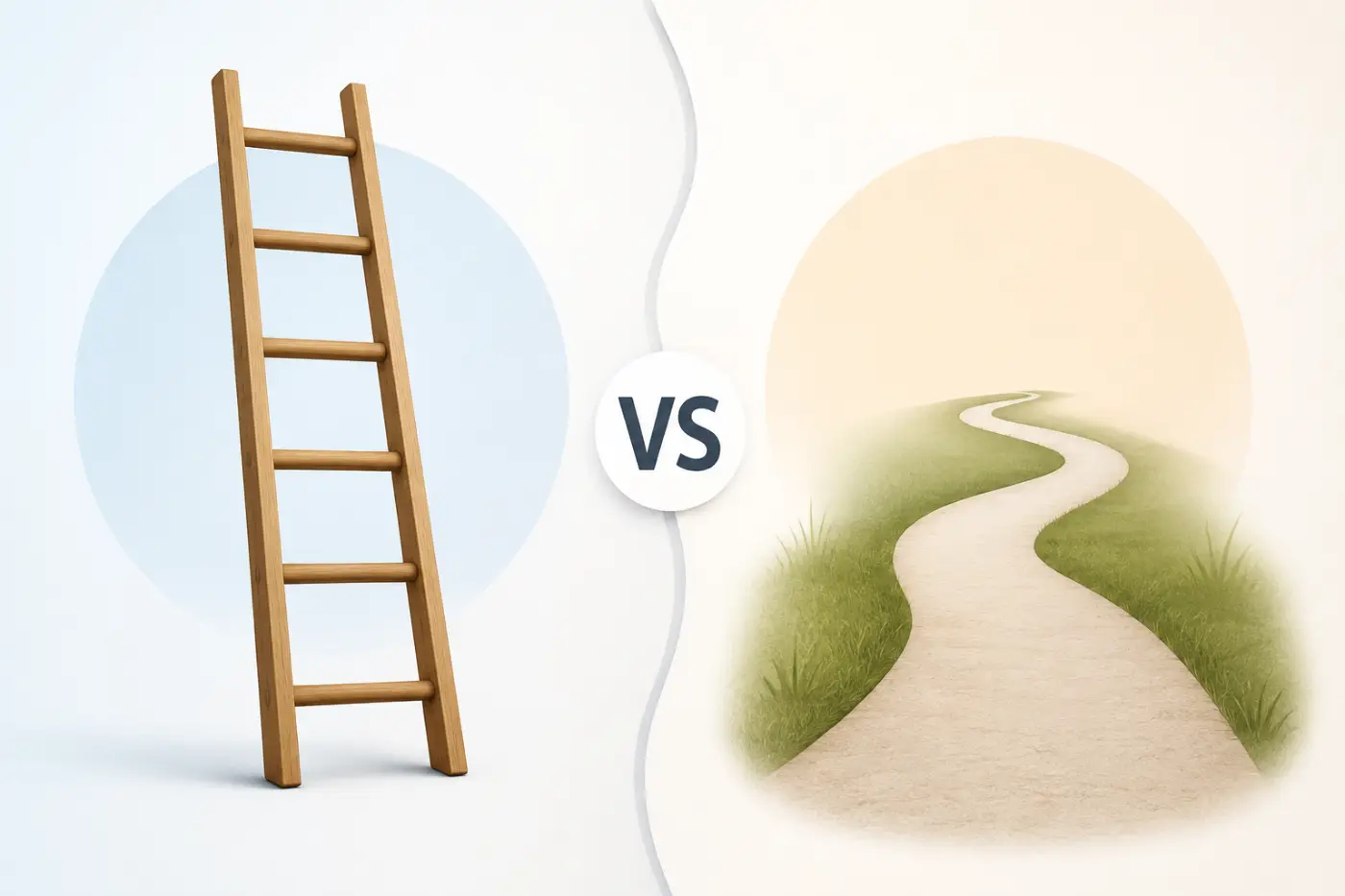
If you’re confused by ladder vs latter you’re dealing with two words that sound alike but have completely different meanings. Ladder is something you climb. Latter refers to the second of two people or things that were just mentioned.
The difference becomes much easier once you connect each word to a simple idea. A ladder helps you move up or down. Latter helps you point back to the second choice in a pair.
These words often cause trouble because they sound almost exactly the same in standard American English. Their spelling gives no clue about their meaning when you hear them in conversation. In this guide you’ll learn how to tell them apart how to use each one naturally and how to avoid the most common mistakes.
Quick Definition
Ladder is a noun that means a structure with steps or rungs that you climb. Latter is usually an adjective or noun that means the second of two people or things mentioned earlier.
Think of a ladder as something you can climb. Think of latter as a word that points to the second item in a pair.
Direct Answer
Use ladder when you mean a climbing tool or a series of levels. Use latter when you mean the second of two things that have already been mentioned.
Comparison Table
| Word | Meaning | Example Sentence | When to Use It |
|---|---|---|---|
| Ladder | A structure used for climbing | He climbed the ladder to reach the roof. | Use it for a physical ladder or a series of levels. |
| Latter | The second of two things mentioned | I like tea and coffee but prefer the latter. | Use it when referring back to the second item in a pair. |

Why These Words Cause Confusion
The main source of confusion is sound. In many American English accents ladder and latter sound the same or very close to the same. The middle consonant can also sound similar in normal speech.
That means you can hear someone say the word and still have no idea which spelling they mean. Context usually gives you the answer.
- Consider these two sentences.
- I put the ladder against the wall.
- I prefer the latter option.
The first sentence clearly refers to something you can climb. The second sentence refers to the second option in a pair. The words may sound alike when spoken but their meanings have nothing in common.
This is a good example of why spelling matters. When you speak, context carries much of the meaning. When you write, the spelling needs to carry part of that load.
What Ladder Means
A ladder is a structure made for climbing. It usually has two long sides connected by several horizontal steps called rungs.
You might use a ladder to reach a high shelf, clean a window, paint a wall, trim a tree, or get onto a roof.
Here are some natural examples.
- I left the ladder in the garage.
- She used a ladder to reach the top shelf.
- Please hold the ladder while I climb up.
- The painter carried a tall ladder into the house.
- The ladder was too short to reach the roof.
In each sentence, ladder refers to something physical. You can see it, touch it, carry it, and climb it.
Ladder As A Verb
Ladder can also appear as a verb in some contexts. As a verb, it can describe forming something into a ladder like structure or arranging something in levels. This use is less common in everyday American English than the noun. For most everyday writing, you’ll mainly see ladder used as a noun.
Common Types Of Ladders
There are several kinds of ladders and each serves a different purpose.
- A step ladder can stand on its own. It is common in homes because it works well for reaching cabinets, shelves, and light fixtures.
- An extension ladder can be made longer by extending one section over another. People often use this type for outdoor work.
- A folding ladder can be adjusted or folded for easier storage. It can be useful in small spaces.
- A rope ladder has flexible sides and rungs. It is often used in special settings rather than ordinary household work.
The basic meaning stays the same. A ladder helps someone move from a lower position to a higher one or sometimes from a higher position to a lower one.
Ladder Can Also Describe Levels
The word ladder does not always refer to a physical object.
It can also describe a series of levels that someone moves through. This use is common when talking about careers, social position, sports, business, or competition.
For example, you might hear someone say that a person is climbing the corporate ladder.
That does not mean the person is literally standing on a ladder. It means the person is moving toward higher positions at work.
Here are some examples.
- She is climbing the corporate ladder.
- He worked hard to move up the career ladder.
- The young player is moving up the rankings ladder.
- The team hopes to climb the league ladder this season.
These expressions use the physical idea of climbing as a metaphor. A metaphor is a comparison that helps explain an idea in a familiar way. The basic image is simple. A person starts at a lower level and climbs toward a higher one.
What Latter Means
Latter has a completely different job. It usually refers to the second of two people or things that were already mentioned.
For example.
- I have two choices, a morning flight and an evening flight. I prefer the latter.
- Here latter means the evening flight because it was the second option mentioned.
- The word does not describe an object you can climb. It points back to something already named.
- Another example makes the difference clear.
- John and Mark applied for the position. The latter received the job.
- John was mentioned first. Mark was mentioned second. Therefore latter refers to Mark.
This is the key rule to remember. When two things appear in a sentence or nearby discussion, latter can refer to the second one.
How Latter Works In A Sentence
The word usually needs some earlier context. A reader needs to know the two choices or people before latter can make sense.
Look at this example.
- I enjoy both reading and hiking but I prefer the latter.
- The two activities are reading and hiking. Reading comes first. Hiking comes second. So latter refers to hiking.
Now look at another example.
- The company offers online classes and in person classes. The latter are more popular.
- The first option is online classes. The second is in person classes. The word latter points to the second option.
- Without those earlier two choices, the word becomes unclear.
- You would not normally say:
- I prefer the latter.
- If the reader has no idea what two things you are talking about, there is nothing for latter to point back to.
Latter Refers To The Second Choice
A simple way to remember the meaning is to connect latter with the word last.
The connection is not a perfect spelling rule, but it can help you remember the basic idea. The latter item comes later in a pair.
For example.
- Cats and dogs are both popular pets, but I prefer the latter.
- Dogs are the second item mentioned. So latter means dogs.
Here is another example.
- The store sells apples and oranges. The latter are on sale today.
- Oranges come second. That makes oranges the latter choice.
- This simple pattern works in many sentences.
- First item plus second item equals latter.
- The word is especially useful when you want to avoid repeating a noun.
- Instead of writing:
- I can take the bus or the train. I prefer the train.
- You can write:
- I can take the bus or the train. I prefer the latter.
- The second version is shorter while still being clear.
Latter And Former
If you learn latter you should also learn former. These two words are commonly used together because they point to opposite positions in a pair.
- Former means the first of two people or things mentioned.
- Latter means the second of two people or things mentioned.
- Consider this sentence.
- I have worked in both Texas and California. I prefer the former.
- Texas was mentioned first. So former refers to Texas.
- Now change the final word.
- I have worked in both Texas and California. I prefer the latter.
- California was mentioned second. So latter refers to California.
- This gives you a very useful memory pair.
- Former means first.
- Latter means second.
Once you remember those two meanings, the word becomes much easier to use.

Examples With Former And Latter
Here are some examples that show how the pair works.
- Sarah and Emily both applied for the job. The former had more experience.
- Sarah came first in the sentence. Therefore former refers to Sarah.
- Sarah and Emily both applied for the job. The latter had more experience.
- Emily came second. Therefore latter refers to Emily.
- The restaurant offers indoor and outdoor seating. The former is quieter.
- Indoor seating came first. So former means indoor seating.
- The restaurant offers indoor and outdoor seating. The latter is more popular.
- Outdoor seating came second. So latter means outdoor seating.
This pair is especially useful in formal writing. It can make repeated references shorter and cleaner. Still, clarity should always come first.
When Latter Can Become Unclear
Although latter is grammatically correct, it can sometimes make writing harder to understand. The problem usually happens when a writer mentions too many things.
For example:
The manager discussed the budget, staffing, customer service, office repairs, and the new schedule. She said the latter needed more attention.
What does latter mean here?
A reader might assume it refers to the new schedule because that was mentioned last. But the traditional use of latter works best when you are choosing between two items. With five items in the sentence, the reference becomes unclear.
A clearer version would be:
The manager discussed the budget, staffing, customer service, office repairs, and the new schedule. She said the new schedule needed more attention.
This may use more words but it removes doubt.
Good writing is not about using the shortest possible sentence. It is about making the meaning easy to follow.
Latter Should Usually Involve Two Things
The safest way to use latter is when you have exactly two choices.
For example:
- The blue car and the red car were both available. I chose the latter.
- There are two cars. The red car is second. The meaning is clear.
- You can also use latter with two people.
- Emma spoke with Olivia before the meeting. The latter offered to help.
- Olivia was mentioned second. So latter refers to Olivia.
- You can use it with two actions or ideas too.
- The manager suggested changing the schedule or hiring another worker. The latter idea would cost more.
- The two choices are changing the schedule and hiring another worker. The second idea is the latter.
Common Mistakes With Ladder
The most common mistake is using latter when you mean the physical object used for climbing.
Incorrect:
- Please bring the latter from the garage.
- That sentence makes little sense unless something else was mentioned first and the word is being used to mean the second item.
Correct:
- Please bring the ladder from the garage.
- Another common mistake happens when someone uses ladder to refer to the second of two choices.
Incorrect:
I prefer the ladder of the two options.
Correct:
- I prefer the latter of the two options.
- The meanings are completely different. A ladder is an object or a figurative series of levels. Latter points to the second item in a pair.
Common Mistakes With Latter
The biggest mistake is using latter without giving the reader two clear things to compare.
For example:
- I prefer the latter.
- That sentence is only clear if the previous context already established two choices.
- Another mistake is confusing latter with later.
- These words look and sound similar but they do different jobs.
- Latter means the second of two things.
- Later means at a time after now or after another time.
- Compare these examples.
- I prefer the latter option.
- I will call you later.
- The first sentence refers to the second option. The second sentence refers to time.
Latter And Later
This is another spelling pair worth learning because the words are easy to mix up.
- Use latter when comparing two things.
- Use later when talking about time.
For example:
- We can meet on Monday or Tuesday. I prefer the latter.
- I am busy now but I can meet later.
- The distinction is simple once you focus on meaning.
- If you can replace the word with second then latter may be the right choice.
- If you can replace it with afterward or at a later time then later is probably the right word.
- Try this test.
- I prefer the latter.
- I prefer the second.
- The meaning still works.
Now try:
- I will call you later.
- I will call you second.
The second sentence does not have the same meaning. That tells you that later is the correct word.
A Simple Memory Trick
- Think of a physical ladder as something with rungs.
- A ladder helps you climb.
- Then think of latter as the second item that comes later in a pair.
- The spelling may not give you a perfect shortcut but the meanings create a strong mental picture.
You can also remember this small set.
- Ladder equals climb.
- Latter equals second.
- Later equals time.
These three words sound similar but their meanings are easy to separate once you connect each one to a different idea.
How To Tell The Difference In Seconds
- When you’re writing quickly, ask yourself one question.
- Am I talking about something I can climb?
- If yes, use ladder.
- If you’re talking about the second of two things already mentioned, use latter.
- If you’re talking about a future time, use later.
For example:
- I need a ladder to clean the windows.
- I chose between the two shirts and bought the latter.
- I will finish the work later.
- That quick meaning check can prevent all three spelling mistakes.
Real Life Examples Of Ladder
The word appears in many everyday situations.
Around The House
- I need a ladder to change the light bulb.
- The ladder is leaning against the garage.
- Please put the ladder away after you finish painting.
At Work
- The technician brought a ladder to reach the ceiling.
- She is moving up the corporate ladder.
- He hopes to climb the management ladder over the next few years.
In Sports
- The team is climbing the league ladder.
- The new ranking system created a different ladder for each division.
In Business
- She worked her way up the corporate ladder.
- The company created a career ladder for new employees.
In these examples, ladder either refers to a physical climbing tool or a series of levels.
Real Life Examples Of Latter
The word latter appears more often in formal or carefully written English than in casual conversation.
Comparing Two Options
- You can take the train or the bus. I prefer the latter.
- The restaurant offers indoor and outdoor seating. The latter is more relaxing.
Comparing Two People
- Maria and James both gave presentations. The latter spoke first.
- Tom and David applied for the position. The latter had more experience.
Comparing Two Ideas
- We could repair the old system or replace it. The latter would cost more.
- The teacher discussed grammar and vocabulary. The latter received more attention.
- The meaning stays consistent. The word points to the second item.
Is Latter Formal
Yes. Latter tends to sound more formal than simply saying the second one.
That does not make it wrong in everyday English. It simply means that you may hear it more often in essays reports articles books and professional writing.
In casual conversation, many Americans would say:
- I like the second one better.
- In more formal writing, you might see:
- I prefer the latter.
Both are correct. The best choice depends on the tone and the audience.
If your reader might struggle to identify the reference, the second one can be clearer. You should never choose a more formal word at the cost of clarity.
Is Latter A Noun Or An Adjective
- Latter can work as both an adjective and a noun depending on how it appears in a sentence.
- As an adjective, it modifies a noun.
- The latter option was cheaper.
- Here latter describes option.
- As a noun, it can stand for the second person or thing.
- I compared both plans and chose the latter.
- Here latter stands in for the second plan.
The noun use is common in phrases such as the latter. The reader understands that the word represents the second item from the pair.
Can Latter Refer To More Than Two Things
Traditionally, latter is used for the second of two things. That is the clearest and safest use.
Some writers use it to refer to the last item in a longer list, but this can create confusion. If you have three or more items, it is usually better to name the item directly.
For example, instead of writing:
The report covered sales, staffing, marketing, and customer service. The latter was the main focus.
Write:
- The report covered sales, staffing, marketing, and customer service. Customer service was the main focus.
- The second version leaves no room for doubt.
- When you have exactly two choices, latter is clear and useful. With a longer list, a specific noun is often better.
Can You Use Latter For Time
- No. Latter does not mean a future time.
- This mistake usually happens because latter looks and sounds similar to later.
- Use later for time.
- I will finish the report later.
- Use latter for the second of two things.
- The report includes two sections. The latter is shorter.
- That one letter makes a major difference in meaning.
Why Context Matters So Much
- Words that sound alike are often easier to understand when you look at the surrounding sentence.
- Imagine someone says:
- I bought a ladder.
- You know the person bought something used for climbing.
- Now imagine someone says:
- I bought the latter.
- You immediately need more information. The word latter depends on an earlier pair.
For example:
- The store had a wooden table and a glass table. I bought the latter.
- Now the meaning is clear. Latter refers to the glass table.
This is why strong writing gives readers enough context to understand reference words. A word like latter can save space but only when the connection is obvious.
When You Should Avoid Latter
You do not need to use latter just because it sounds more polished.
- Sometimes repeating the noun is much clearer.
- Suppose you write:
- The company can repair the machine or replace it. The latter will take two weeks.
- That is clear because there are only two options.
- Now imagine a longer sentence with several ideas.
The company discussed repairing the machine, replacing the motor, changing the software, updating the wiring, and moving the equipment. The latter could take several weeks.
- A reader may not know what latter refers to. In this situation, repeat the specific idea.
- The company discussed several repairs. Updating the wiring could take several weeks.
- Clear writing beats fancy writing every time.
A Quick Editing Test
- If you’re unsure which word belongs in your sentence, remove the word and explain what you mean.
- If you mean a physical object used for climbing, write ladder.
- If you mean the second of two previously mentioned things, write latter.
- If you mean a future point in time, write later.
- Then read the sentence again.
For example:
- I need to get the ___ from the shed.
- You need something from the shed that you can climb. So the answer is ladder.
- I mentioned tea and coffee. I prefer the ___.
- You are choosing the second item. So the answer is latter.
- I can’t talk now. I’ll call you ___.
- You are talking about time. So the answer is later.
This three word test is simple enough to use while writing an email or checking a school assignment.
A Useful Practice Exercise
Try filling in the correct word.
- I need a ___ to reach the top shelf.
- The store sells tea and coffee. I prefer the ___.
- I’ll finish the report ___.
- The painter carried a ___ into the room.
- We can drive or take the train. The ___ is cheaper.
- She will arrive ___ this afternoon.
- The answers are ladder, latter, later, ladder, latter, and later.
The exercise shows how meaning determines spelling. You do not need to memorize every sentence. Just identify what the word means.
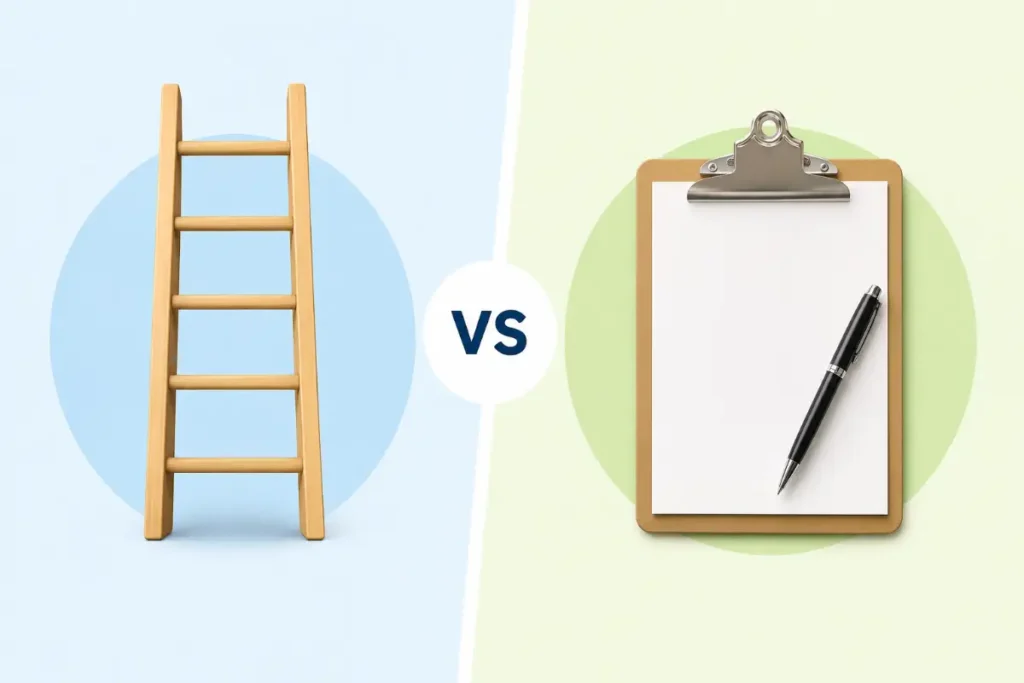
The Difference In One Simple Picture
Imagine three scenes.
In the first scene, someone is standing on a ladder while painting a ceiling. That is ladder.
In the second scene, someone is choosing between a red shirt and a blue shirt. They choose the blue shirt and call it the latter because it was mentioned second.
In the third scene, someone says they cannot meet now but can meet later. That is later because the sentence is about time.
These mental pictures give each word its own identity.
You don’t have to rely only on spelling. Connect the word to its meaning and the correct choice becomes much easier.
FAQs
What is the difference between ladder and latter?
Ladder is a climbing structure with steps or rungs. Latter refers to the second of two people or things mentioned earlier.
Is ladder or latter correct for the second choice?
Use latter when you mean the second choice in a pair. For example, if you mention tea and coffee and then say you prefer the latter, you mean coffee.
Is ladder or latter correct for something you climb?
Use ladder for something you climb. A ladder can help you reach a roof, ceiling, shelf, or other high place.
What is the difference between latter and later?
Latter means the second of two things. Later refers to a time after now or after another event.
Can latter refer to three things?
The clearest traditional use of latter is for the second of two things. If you have three or more items, naming the specific item is usually clearer.
What is the opposite of latter?
The usual opposite is former. Former refers to the first of two things while latter refers to the second.
Is latter used in everyday English?
Yes, but it is more common in formal writing than casual conversation. In everyday speech, people often say the second one instead.
How can I remember the difference quickly?
Think ladder means climb and latter means second. If you’re talking about time, use later.
Conclusion
The difference between ladder vs latter becomes simple once you focus on meaning instead of sound. A ladder is something you climb or a figurative series of levels. Latter points to the second of two people or things that have already been mentioned.
There is also a third word worth keeping in mind. Later refers to time. So you can remember the three words this way. Ladder means climb. Latter means second. Later means time.
When you’re unsure, stop and ask what you mean. If you could climb it, choose ladder. If you’re pointing to the second item in a pair, choose latter. If you’re talking about a future time, choose later.
That quick meaning check is all you need in most situations. Once you connect each spelling to its meaning, these three easily confused words stop being a guessing game.

Dr. Elena Vance holds a Ph.D. in Linguistics from Columbia University and has spent over 15 years analyzing the evolution of the English language. A former university professor turned full-time writer and editor, Elena specializes in breaking down high-level grammatical concepts, punctuation nuances, and style guides (APA, Chicago, MLA) into clear, actionable advice. When she isn’t hunting down dangling modifiers, she can be found collecting vintage dictionaries and reading classic literature.