
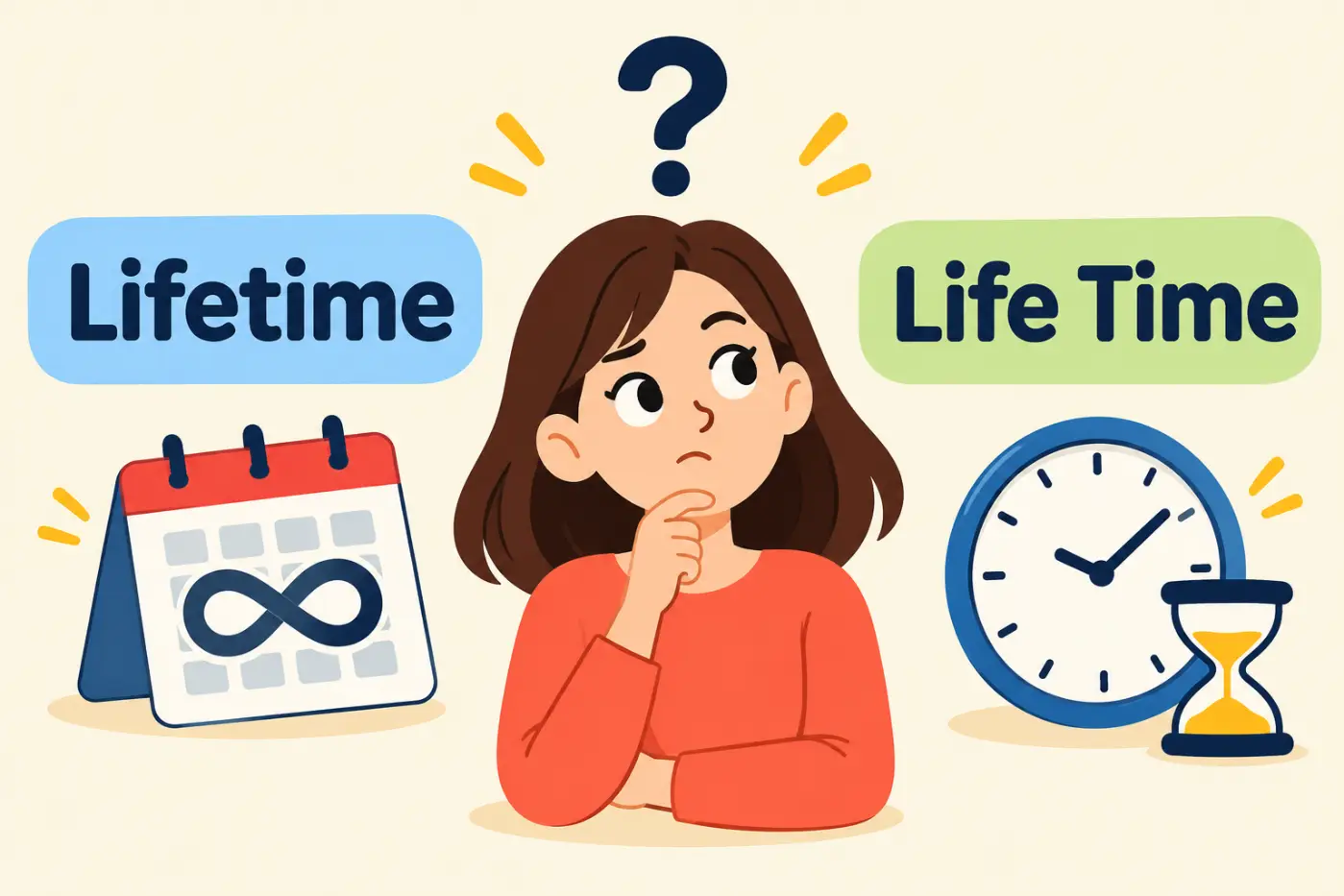
If you have ever paused mid-sentence to wonder whether to write lifetime or life time, you are not alone. Both words look completely normal on their own. When you put them side by side, your brain suddenly second-guesses whether they belong together or apart.
Here is the good news. Almost every time you use this phrase in modern English, it belongs together as one single word: lifetime. Splitting it into two words is almost always a typo, except in a handful of rare sentence structures.
In this guide, we will break down the exact rule in plain English. You will see dozens of real-life examples, learn why spellcheckers often miss this error, and pick up three fast memory tricks. By the end, you will also know how to handle related words like lifespan, lifelong, and once-in-a-lifetime without guessing.
Quick Definition
Lifetime (one word) is a noun that means the entire span of a person’s or thing’s existence, or simply a very long period of time. It also works as an adjective before a noun to describe something that lasts for your whole life, such as a lifetime warranty. Life time (two words) is not a standard phrase and only happens by accident when the noun “life” sits next to the word “time” in two separate parts of a sentence.
Direct Answer
Write lifetime as one word in almost every situation, whether you mean a whole life span, a very long time, or something that lasts forever. Only split it into life time when a verb takes “life” as its object and “time” begins a completely separate phrase, such as “give your life time to grow.”
Lifetime vs. Life Time Comparison
| Word/Phrase | Meaning | Example Sentence | When to Use It |
|---|---|---|---|
| Lifetime (noun) | The whole duration of a person’s, animal’s, or object’s existence. | She spent her entire lifetime teaching children how to read. | Use when referring to a complete life span from start to finish. |
| Lifetime (noun) | A very long stretch of time (often used for emphasis). | Waiting in that airport security line felt like a lifetime. | Use in casual speech or writing to exaggerate a long wait or era. |
| Lifetime (adjective) | Lasting for the whole duration of a life; permanent. | The backpack comes with a lifetime guarantee against broken zippers. | Use right before another noun (warranty, achievement, member, supply). |
| Life time (two words) | Two separate words meeting at a clause or phrase boundary. | You have to give your new life time to feel like home. | Use only when “life” is the object of a verb and “time” belongs to the next idea. |
Where the Confusion Comes From
English loves gluing two short words together to make a bigger word. Linguists call these combinations compound words. The tricky part is that English does not glue all compound words together at the exact same speed.
Most compound words go through three stages over hundreds of years. First, people write them as two separate words, like “base ball” or “web site.” Next, writers connect them with a hyphen, like “base-ball” or “web-site.” Finally, once everyone recognizes the pair as a single idea, the hyphen drops out and they become one closed word: “baseball” and “website.”
“Lifetime” finished this journey centuries ago. Writers were already joining “life” and “time” into a single word back in the 1600s. Still, because “life” and “time” are two of the most common standalone words in the English language, your eyes do not always flag “life time” as a spelling mistake.
Why Your Spellchecker Won’t Always Catch It
If you type “definately” in an email, a bright red squiggly line pops up right away. That happens because “definately” is not a real word in any dictionary. Your computer knows immediately that something is wrong.
When you type “life time” with a space in the middle, basic spellcheckers often stay completely silent. Both “life” and “time” are spelled right. Simple spellcheck tools check one word at a time rather than reading the grammar of your whole sentence.
Even smarter grammar tools can get tripped up if your sentence is long or casual. That is why human proofreading still matters so much for compound words. Once you know what to look for, your own eyes become much faster and more reliable than any software.
They Sound Identical Out Loud
Another reason people mix up the spelling is that both versions sound the exact same when spoken. In everyday conversation, nobody pauses between “life” and “time.” Both syllables blend smoothly together with the main stress on “life.”
When you hear someone say, “That is a once-in-a-lifetime trip,” your ears just hear the sounds. When you sit down later to write that sentence in a text message or a work report, your brain has to translate the sound back into letters. Without a clear rule in mind, it is easy to hit the spacebar by habit.
When to Use “Lifetime” as One Word
In roughly 99 percent of your writing, lifetime as a single closed word is the right choice. It does heavy lifting in English because it can act as both a noun and an adjective. Let’s look at the three main ways you will use it.
1. As a Noun Meaning a Whole Life Span
The core meaning of lifetime is the total stretch of time that someone is alive or something exists. Think of it as the full timeline from birth to death, or from creation to the end.
In these sentences, “lifetime” stands alone as a thing—a noun. You will often see words like “a,” “the,” “my,” “her,” “one,” or “entire” right before it.
- My grandfather lived in the same brick house for his entire lifetime.
- Over a lifetime, the average person spends roughly twenty-six years asleep.
- She accomplished more in one lifetime than most people could in three.
- The museum collected paintings created during the artist’s lifetime.
- No human lifetime is long enough to read every book in that library.
Notice that in every single example above, you could replace “lifetime” with “life” and the sentence would still make sense. Adding “-time” simply highlights the length or duration of that life.
2. As a Noun Meaning a Very Long Time
People also use lifetime in casual speech when something simply feels like it takes forever. You do not literally mean eighty or ninety years. You are using a bit of friendly exaggeration to show how slow or distant something feels.
This meaning is super common in everyday conversation, stories, and personal essays. Even though the meaning is figurative, the spelling stays the exact same: one closed word.
- High school graduation feels like a lifetime ago now.
- We stood in the rain waiting for that bus for what felt like a lifetime.
- It took a lifetime for the webpage to load on the slow hotel Wi-Fi.
- Since she moved across the country, we have not caught up in a lifetime.
If you split the word in any of these sentences, the rhythm breaks. “Felt like a life time” looks clunky and unfinished to a native reader.
3. As an Adjective Before Another Noun
Lifetime also works as a describing word (an adjective) when you place it directly in front of another noun. Here, it means “lasting for your whole life” or “never expiring.”
Companies, schools, and organizations love this form because it sounds permanent and valuable. Whenever you see “lifetime” describing a product, award, or promise, keep it together as one word.
- The company offers a lifetime warranty on all cast-iron skillets.
- He received a lifetime achievement award at the annual film festival.
- Winning the contest earned her a lifetime supply of free coffee.
- After retiring from the board, she was named a lifetime member of the club.
- A reckless driver can face a lifetime ban from operating commercial trucks.
Look at the word right after “lifetime” in each sentence: warranty, achievement, supply, member, ban. Those are all nouns. “Lifetime” sits right in front of them to tell you how long each one lasts.
When to Use “Life Time” as Two Words
You might wonder if there is any situation where life time with a space is actually correct. The answer is yes, though it happens rarely. You will almost never write “life time” on purpose as a single phrase. Instead, the two words only appear side by side when two different parts of a sentence happen to bump into each other.
When a Verb Needs “Life” as Its Object
Some verbs take two objects—a person or thing receiving something, and the thing being given. Verbs like “give,” “allow,” “grant,” or “buy” work this way. When the first object is “your life” and the second object is “time,” the two words land right next to each other.
Look closely at how these sentences work:
- Moving to a new city can be stressful, so give your life time to settle into a routine.
- After a major career change, you must allow your life time to adjust.
- Stepping back from social media gave my life time to breathe again.
Read that first example again slowly: “give [your life] [time] to settle into a routine.” Here, “your life” is what you are giving something to. What are you giving it? You are giving it “time.” They are two separate nouns doing two separate jobs. If you merged them into “give your lifetime to settle,” the sentence would fall apart.
When “Time” Starts a Separate Idiom or Phrase
Another rare overlap happens when a clause ends with the word “life” and the very next phrase begins with the word “time.” Certain English idioms start with “time,” such as “time and again,” “time after time,” or “time to time.”
- She risked her life time and again to rescue stranded hikers on the mountain.
- He rebuilt his life time after time whenever setbacks knocked him down.
- We reflect on our life time to time when old photos turn up in a drawer.
In these sentences, “time and again” is a fixed expression meaning “repeatedly.” A careful editor might add a comma after “life” (“risked her life, time and again”) to help the reader’s eye separate the two ideas. Without the comma, “life” and “time” sit right next to each other as two valid, separate words.
Hyphenated Compounds Starting With “Time”
Sometimes “time” is the first half of a hyphenated word that comes right after “life.” Examples include “time-consuming,” “time-tested,” or “time-sensitive.”
- Running a small bakery can make your life time-consuming during the holiday rush.
- Yoga gave her life time-tested tools for handling daily stress.
Once again, “life” and “time” are not forming the word “lifetime.” They just happen to be neighbors in the sentence.
Should You Ever Hyphenate “Life-Time”?
In modern American English, do not write “life-time” with a hyphen. Dictionaries like Merriam-Webster and style guides across the United States treat “lifetime” strictly as a closed compound word without a hyphen.
If you read older books from the 1800s or early 1900s, you might spot “life-time” printed with a hyphen. Back then, printers and editors still hyphenated many compound words that we write as single words today, such as “to-day,” “to-morrow,” and “week-end.” Over time, standard spelling dropped those hyphens.
The Exception: Multi-Word Modifiers
While “lifetime” itself never takes a hyphen, it can become part of a longer hyphenated phrase when three or more words team up before a noun. The most famous example is once-in-a-lifetime.
- Seeing a total solar eclipse from your own backyard is a once-in-a-lifetime event.
- They packed their bags for a once-in-a-lifetime trip across New Zealand.
Notice how “lifetime” is still spelled as one closed word inside that phrase. The hyphens simply link “once,” “in,” “a,” and “lifetime” together so the reader sees them as one big describing unit before the nouns “event” and “trip.”
If you place that same phrase after the verb instead of before a noun, most style guides drop the hyphens completely:
- An opportunity like this happens only once in a lifetime.
Other multi-word modifiers work the exact same way, such as “end-of-lifetime” (used in tech and manufacturing) or “full-lifetime” (used in insurance and finance). In every case, “lifetime” stays glued together as one word.
Choosing Between Lifetime or Life Time in Real Life
Seeing grammar rules in isolation is helpful, but seeing how they work in real writing makes the habit stick. Let’s look at four everyday areas where people frequently pause over this spelling.
1. Everyday Conversations and Personal Stories
When you are texting a friend, writing a birthday card, or posting a caption on social media, you want your writing to sound natural. Casual writing relies heavily on “lifetime” both as a literal timeline and as a playful exaggeration.
- “Thanks for being the best friend anyone could ask for in a lifetime.”
- “I have waited a lifetime for this band to go back on tour!”
- “Our family road trip to the Grand Canyon created memories that will last a lifetime.”
- “I swear I have eaten a lifetime supply of tacos this week.”
In casual writing, people often type quickly on phone keyboards. Predictive text sometimes splits “lifetime” into “life time” if you accidentally tap near the spacebar. Always give quick texts and social posts a fast glance before hitting send.
2. Warranties, Contracts, and Business Offers
In business writing, marketing copy, and customer service, spelling mistakes hurt trust. If a product box promises a “Life Time Warranty,” shoppers may subconsciously wonder if the company is careless with details.
Every major brand, retailer, and legal contract uses the single-word spelling:
- Lifetime warranty: Covers defects in materials or workmanship for as long as the original buyer owns the item.
- Lifetime guarantee: A promise to repair, replace, or refund a product with no expiration date.
- Lifetime membership: A subscription or club access paid once that never requires renewal.
- Lifetime value (LTV): A core business metric that estimates how much total revenue one customer will bring in over their entire relationship with a company.
If you are writing product descriptions, website banners, or sales emails, always keep lifetime as one word.
3. Science, Technology, and Product Specs
Scientists, engineers, and tech writers use lifetime constantly, and they never split it into two words. In technical fields, a “lifetime” does not require a living, breathing person. An object, machine part, star, or subatomic particle can have a lifetime too.
- Battery lifetime: The total amount of time a battery works before it can no longer hold a useful charge.
- Service lifetime: How long a bridge, roof, appliance, or machine part is expected to stay safe and functional.
- Stellar lifetime: The number of millions or billions of years a star shines before running out of fuel.
- Carrier lifetime: A physics term describing how long an electron stays active inside a semiconductor chip.
Even when talking about non-living things like lightbulbs or software versions, lifetime remains a single closed word.
4. Resumes, Cover Letters, and Career Writing
Job seekers often worry about small spelling slips on resumes and LinkedIn profiles—and for good reason. Hiring managers scan resumes in seconds, and an unnecessary space in a common word stands out right away.
Here is how to use lifetime cleanly in professional career materials:
- “Honored with the company’s Lifetime Sales Excellence Award in 2025.”
- “Built lifetime client relationships that generated 40 percent of branch repeat business.”
- “Committed to lifetime learning and continuous skill development in data analysis.”
Note that for that third bullet point, many career writers prefer lifelong (“lifelong learning”) over “lifetime learning,” because “lifelong” sounds slightly smoother when describing a personal habit. Both are spelled as one closed word without a space or hyphen.
Common Mistakes and How to Fix Them
Even strong writers make slips when typing fast. Here are the four most frequent mistakes people make with this word, along with quick before-and-after fixes.
Mistake 1: Splitting Fixed Phrases
People often know “lifetime” is one word when it stands alone, yet they accidentally break it apart inside longer expressions like “once in a lifetime” or “chance of a lifetime.”
- Incorrect: Landing that internship was the opportunity of a life time.
- Correct: Landing that internship was the opportunity of a lifetime.
- Incorrect: We took a once in a life time cruise through Alaska.
- Correct: We took a once-in-a-lifetime cruise through Alaska.
Mistake 2: Using Two Words on Business Materials
Small business owners frequently design their own flyers, menus, or website headers. Typing “Life Time” in big capital letters on a sign or brochure is one of the easiest traps to fall into, especially because capitalized words look visually separate.
- Incorrect: “All Roof Repairs Backed by Our Life Time Guarantee!”
- Correct: “All Roof Repairs Backed by Our Lifetime Guarantee!”
Mistake 3: Adding an Outdated Hyphen
Some writers try to play it safe when they are unsure between one word and two words by sticking a hyphen in the middle. For this word, a hyphen is just as incorrect as a space.
- Incorrect: She earned a life-time pension after thirty years with the state.
- Correct: She earned a lifetime pension after thirty years with the state.
Mistake 4: Mixing Up “Lifetime” With “Life Span”
People sometimes confuse the spelling rules for lifetime with those for life span (also written lifespan). While “lifetime” is strictly one word, “life span” can actually be written either as one word (“lifespan”) or two words (“life span”), depending on which dictionary or style guide you follow.
Because “life span” is allowed to have a space in some guides, writers wrongly assume “life time” is allowed to have a space too. It is not. Keep “lifetime” closed every single time.
Easy Memory Tricks That Work Every Time
If you ever catch yourself hovering over the spacebar, use one of these three fast mental checks. Each one takes less than three seconds.
1. The “Whole Life” Swap Test
Try replacing the phrase in your sentence with the words “whole life” or “entire life.”
- Test sentence: “That storm was the worst I have seen in my [lifetime / life time].”
- Swap check: “That storm was the worst I have seen in my whole life.”
- Result: It makes total sense! Whenever “whole life” fits smoothly, use lifetime as one word.
Now try that same swap on one of the rare two-word examples:
- Test sentence: “Give your new [lifetime / life time] to feel normal.”
- Swap check: “Give your new whole life to feel normal.”
- Result: That sounds strange and broken, because “time” is actually a separate noun being given to your “new life.” That tells you the words stay separate.
2. The “Warranty” Rule
Look at the word immediately following “lifetime” in your sentence. Is it a noun—something you can own, win, earn, or receive?
Think of the word warranty. Everyone knows “lifetime warranty” is a standard phrase. If your word fits the exact same pattern—lifetime membership, lifetime achievement, lifetime supply, lifetime customer—keep it glued together as one word.
3. The Comma Test
If you suspect you might have one of those rare sentences where “life” and “time” belong to two different clauses, try saying the sentence out loud with a tiny pause between “life” and “time.”
- “She changed her life [pause] time and again.” -> Sounds natural! Keep them as two words.
- “It was the trip of a life [pause] time.” -> Sounds completely unnatural! Keep it as one word: lifetime.
Lifetime vs. Lifespan vs. Lifelong vs. Lifestyle
Once you master lifetime, it helps to look at its closest cousins. English has several common words starting with “life” that look similar at a glance, yet each one carries a slightly different meaning. Picking the right one will make your writing much sharper.
Lifetime vs. Lifespan
Both words measure how long something lasts, so people often treat them as identical. In careful writing, however, they have a subtle difference in focus.
- Lifetime focuses on the personal experience, events, or duration within a life. We talk about things happening “during her lifetime” or “memories of a lifetime.”
- Lifespan (or life span) focuses on the biological or mechanical measurement—the average or maximum length of time an organism or product survives.
Look at how each word fits best in its own lane:
- Lifetime: “Advances in medicine have changed dramatically within a single lifetime.”
- Lifespan: “The average lifespan of an indoor house cat is twelve to eighteen years.”
- Lifespan: “Cleaning the filter regularly will extend the lifespan of your dishwasher.”
Notice that you would say “the lifespan of a sea turtle is eighty years,” rather than “the lifetime of a sea turtle is eighty years.” When you are talking about numbers, averages, or biology, lifespan is usually the stronger choice.
Lifetime vs. Lifelong
Both lifetime and lifelong can describe things that last from start to finish, yet they play different grammatical roles.
- Lifetime can be a noun or an adjective. When used as an adjective, it usually describes an external thing, status, or guarantee (a lifetime warranty, a lifetime ban, a lifetime contract).
- Lifelong is only an adjective. It almost always describes a personal trait, habit, bond, or feeling that stays with someone throughout their life.
Compare these natural pairs:
- Lifelong friend (a friendship that lasts your whole life) vs. Lifetime member (a formal membership status that never expires).
- Lifelong passion for music vs. Lifetime achievement in music.
- Lifelong learner vs. Lifetime subscription.
You would never say “a lifelong warranty,” and you would rarely say “a lifetime friend.” Keep lifelong for human relationships, habits, and passions, and save lifetime for statuses, awards, and guarantees.
Lifetime vs. Lifestyle
These two words are both closed one-word compounds, though their meanings do not overlap at all.
- Lifetime is all about how long something lasts.
- Lifestyle is all about how a person lives—their daily habits, routines, values, and choices.
For example: “Switching to a healthier lifestyle can add extra years to your lifetime.”
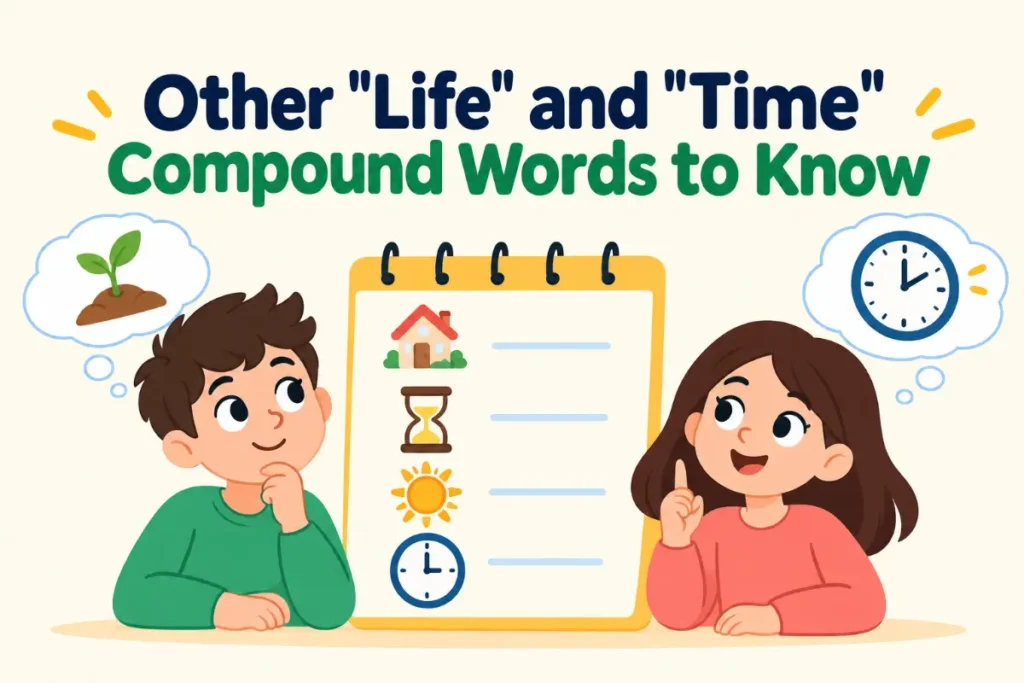
Other “Life” and “Time” Compound Words to Know
Seeing how other words behave around “life” and “time” helps reinforce why lifetime is spelled the way it is. English follows clear patterns once you group similar words together.
Common One-Word “Life” Compounds
Just like lifetime, all of these everyday words have fused completely into single closed words with no spaces and no hyphens:
- Lifelong: Lasting through a whole life (a lifelong dream).
- Lifestyle: A way of living (an active lifestyle).
- Lifelike: Looking very real (a lifelike portrait).
- Lifeline: A rope thrown to save someone, or a vital source of help (a financial lifeline).
- Lifeboat: A small rescue boat carried on a larger ship (board the lifeboat).
- Lifeguard: A trained swimmer who watches over beaches or pools (the lifeguard blew her whistle).
- Lifeblood: The essential force that keeps something alive or healthy (small businesses are the lifeblood of the town).
Two-Word and Hyphenated “Life” Phrases
Not every “life” combination has merged into one word. Many common phrases still keep their space or use a hyphen:
- Life jacket (two words): A vest that keeps you afloat in water.
- Life cycle (two words): The series of stages a living thing or product passes through.
- Life expectancy (two words): The average number of years a person is expected to live.
- Life-size or life-sized (hyphenated): Having the exact same size as the real person or object (a life-size statue).
- Life-saving or lifesaving (both accepted): Preventing death (lifesaving medical care).
- Life-threatening (hyphenated): Dangerous enough to cause death (a life-threatening allergy).
Common One-Word “Time” Compounds
The word “time” also forms dozens of closed one-word compounds when paired with another short noun. Notice how consistent the pattern is:
- Daytime: The hours when the sun is up.
- Nighttime: The dark hours between sunset and sunrise.
- Bedtime: The usual hour when someone goes to sleep.
- Lunchtime: The middle of the day when people eat lunch.
- Springtime: The season of spring.
- Downtime: Quiet time away from work, or hours when a computer system is offline.
- Overtime: Extra hours worked beyond a regular schedule.
- Meantime: The period between two events (in the meantime).
Just like “daytime” and “nighttime” describe a span of time, lifetime follows the exact same blueprint.
What US Style Guides Say About Lifetime or Life Time
If you write for school, journalism, marketing, or publishing in the United States, your editor will likely follow one of the major American reference guides. Fortunately, every single authority agrees completely on this word.
Merriam-Webster Dictionary
Merriam-Webster, the standard dictionary for American English, lists lifetime strictly as one closed word. It lists entries for both the noun (“the duration of the existence of a living being or thing”) and the adjective (“lasting for a lifetime”). There is no separate dictionary entry for “life time” as a two-word phrase.
The Associated Press (AP) Stylebook
The AP Stylebook—used by newspapers, magazines, and public relations teams across the country—follows Merriam-Webster on lifetime. AP style prefers clean, uncluttered text without unnecessary spaces or hyphens. In AP style, you always write “lifetime,” “lifetime achievement,” and “once-in-a-lifetime opportunity” (with hyphens when placed before a noun).
The Chicago Manual of Style
The Chicago Manual of Style, the standard guide for book publishers and academic writers, also mandates lifetime as a closed compound in all noun and adjective uses. Under Chicago’s compound-word rules, permanent closed compounds listed in the dictionary stay closed whether they appear before or after a noun.
FAQs
Is lifetime one word or two words?
Lifetime is one word in almost every context. You should write it as a single closed word whether you are using it as a noun (“in my lifetime”) or as an adjective (“a lifetime warranty”). Splitting it into two words is almost always a spelling mistake.
Is it spelled lifetime or life time on a resume?
Always spell it lifetime as one word on a resume or cover letter. For example, you might write “Lifetime Achievement Award” or “built lifetime client relationships.” Using two words on a resume looks like a careless typo to hiring managers.
Should there be a hyphen in lifetime?
No, modern American English never puts a hyphen inside lifetime. Older books from over a century ago occasionally printed “life-time,” but today that spelling is outdated. Only use hyphens when “lifetime” joins a longer phrase before a noun, such as “a once-in-a-lifetime trip.”
Can you ever write “life time” as two words?
The only time life time appears as two words is when the noun “life” and the noun “time” belong to two separate parts of a sentence. For example, in “give your new life time to grow,” you are giving “time” to your “new life.” Outside of rare grammatical overlaps like that, always keep the word together.
What is the difference between lifetime and lifespan?
Lifetime refers to the entire duration of someone’s life or the events experienced during it, such as “the trip of a lifetime.” Lifespan (also spelled life span) refers to the measured length of time an organism or object exists, such as “the average lifespan of a giant tortoise is over one hundred years.”
Is “once in a lifetime” hyphenated?
Hyphenate once-in-a-lifetime when it comes directly before a noun, as in “a once-in-a-lifetime chance.” Leave out the hyphens when the phrase comes after the verb, as in “an offer like this comes along only once in a lifetime.” In both cases, “lifetime” itself stays one closed word.
Does “lifetime” apply to objects, or only to people?
Lifetime applies to both people and non-living things. Engineers, scientists, and product makers regularly talk about the lifetime of a battery, a star, a software program, or a bridge. Even when describing a machine or an object, it is always spelled as one word.
Conclusion
The next time you pause over lifetime or life time, you will know the answer right away. In nearly every sentence you will ever write, lifetime is one closed word with no space and no hyphen. Whether you are describing a whole life span, exaggerating a long wait in traffic, or promising a lifetime guarantee to a customer, keep the two halves together.
Remember the quick “whole life” swap test whenever you feel unsure. If replacing the phrase with “whole life” still makes sense, write lifetime as one word. Only leave a space between “life” and “time” when a verb is handing “time” over to your “life,” or when a separate idiom like “time and again” happens to follow the word “life.”
Before you hit send on your next email, resume, or product page, do one fast scan for accidental spaces inside compound words. Catching that tiny gap takes two seconds and keeps your writing sharp, clear, and trustworthy.

Sienna Watson is a veteran copywriter and communications coach who has helped startup founders, marketers, and professionals polish their writing for over a decade. Realizing that most people don’t need a degree in linguistics—just clear, impactful communication—Sienna focuses on practical grammar, business writing etiquette, and eliminating wordiness. She advocates for plain language, strong verbs, and persuasive prose that gets results.