

If you’re stuck on planing or planning you’re dealing with two real English words that have very different meanings. The correct choice depends on what you want to say.
Planning means deciding what you intend to do and preparing for it. Planing is a much less common word that usually means smoothing wood with a plane. So if you’re talking about making arrangements for a trip meeting project or event then planning is the word you need.
The spelling gets confusing because the word plan changes when you add ing. You might wonder why the final consonant doubles in planning but not in planing. The answer comes from the difference between the two words and the spelling rule used when adding ing.
This guide explains both words in plain English. You’ll see how the spelling works why the extra n matters and how to use each form in real sentences. You’ll also learn a simple trick that can help you choose the right spelling without second guessing yourself.
Quick Definition
Planning means thinking ahead and deciding what you will do. It is the present participle of plan and can also be used as a gerund when the activity itself is treated as a noun.
Planing is usually the act of cutting or smoothing a surface with a tool called a plane. It can also describe the action of a boat or aircraft moving across a surface in certain technical contexts.
Direct Answer
Use planning when you mean preparing or deciding what to do. Use planing when you mean smoothing or shaping something with a plane.
Comparison Table
| Word | Meaning | Example Sentence | When To Use It |
|---|---|---|---|
| Planning | Preparing or deciding what to do. | We are planning a family vacation. | Use it for preparation or future arrangements. |
| Planing | Smoothing or shaping material with a plane. | He is planing the wooden board. | Use it for woodworking or specific technical meanings. |
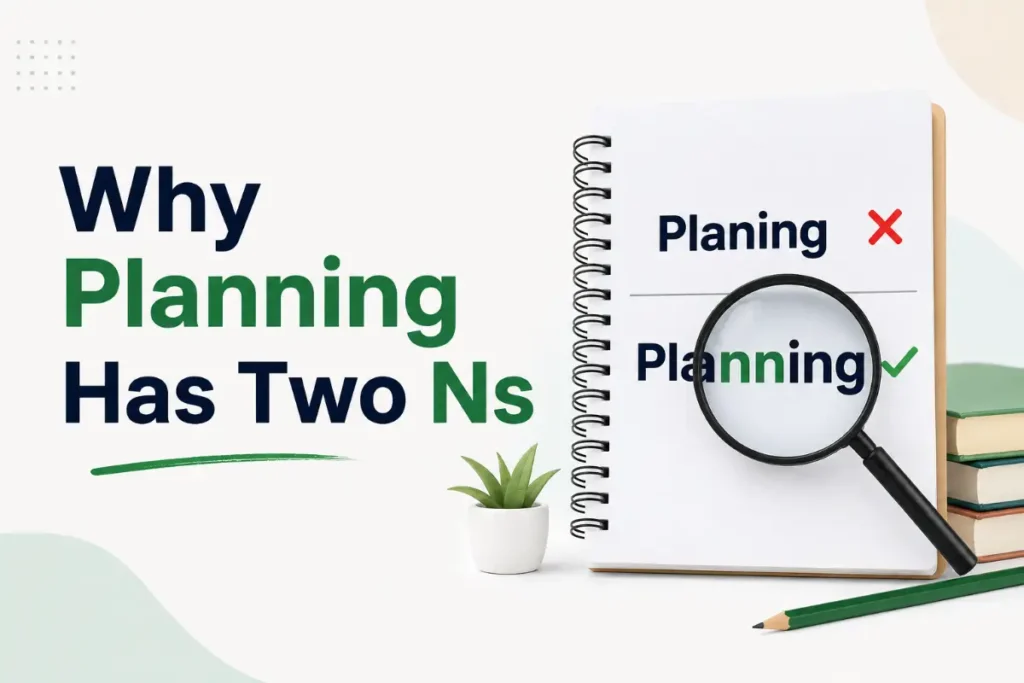
Why Planning Has Two Ns
The spelling becomes much easier once you understand what happens to the word plan when ing is added.
The base word is plan. When you turn it into planning the final n is doubled before ing. The result is planning rather than planing.
This happens because plan is a short one syllable word that ends in a single consonant after a single vowel. When you add a suffix that begins with a vowel such as ing the final consonant is doubled.
You can see the same pattern in other common words.
- Run becomes running.
- Sit becomes sitting.
- Stop becomes stopping.
- Begin becomes beginning.
The doubled consonant helps preserve the pronunciation of the original vowel sound. In planning the a keeps the short sound found in plan.
If you write planing when you mean making plans then you have created a different word. That small spelling change affects the meaning.
The Difference Between Planing And Planning
The simplest way to remember the difference is to focus on the action behind each word.
Planning involves ideas decisions schedules and preparation. You might plan a vacation plan a meeting plan a wedding or plan what you’ll do tomorrow.
Planing involves a plane or another specialized use of the word. In woodworking a plane is a tool used to remove thin layers from wood and create a smooth surface. The action is called planing.
Consider these two sentences.
- We are planning the kitchen renovation.
- He is planing the wooden cabinet door.
The first sentence is about making decisions and preparing for a project. The second describes physical work on wood.
The extra n isn’t just a spelling detail. It tells your reader which word you mean.
What Planning Means
Planning is the act of thinking ahead and deciding how something will happen. It often involves choosing goals setting steps arranging resources and deciding what needs to happen first.
You can plan something simple or something very complex.
You might plan what to cook for dinner. A company might spend months planning a new product launch.
The basic idea stays the same. You think ahead instead of simply reacting in the moment.
Planning A Trip
Travel often requires planning because several details need to work together.
You may need to choose your destination book a hotel check transportation and decide what you want to see.
For example.
- We are planning a trip to California this summer.
- She spent the weekend planning her vacation.
- They are planning to visit several national parks.
Here planning refers to preparation. There is no physical tool involved.
Planning A Meeting
People also use the word for work and school.
- I’m planning a meeting with the sales team.
- We spent an hour planning the next project.
- Sarah is planning the class presentation.
The word works naturally in both formal and casual writing.
Planning An Event
Events often require several decisions before they can happen.
- They are planning a birthday party for their daughter.
- The committee is planning a community fundraiser.
- We started planning the wedding six months ago.
Again the meaning is preparation. You are deciding what needs to happen and arranging the details.
How The Word Plan Changes With Ing
The spelling rule becomes clearer when you start with the base word.
The base form is plan.
Add ing.
The final consonant doubles.
The result is planning.
This is part of a broader English spelling pattern. A short word that ends in a single vowel followed by a single consonant often doubles that final consonant before a suffix beginning with a vowel.
The pattern can look like this.
- Plan → planning
- Run → running
- Sit → sitting
- Hop → hopping
- Cut → cutting
The pattern isn’t something you need to apply blindly to every English word. Longer words and words with different stress patterns can follow different rules. Still it gives you a useful guide for common words like plan.
Why Planing Is A Real Word
This is where the spelling question gets interesting.
It would be easy to say that planing is simply wrong. That isn’t accurate. Planing is a legitimate English word. It just doesn’t usually mean making plans.
The word comes from plane. A plane is a woodworking tool used to shave thin layers from a material such as wood. When someone uses that tool to smooth or shape a surface they are planing it.
For example.
- The carpenter is planing the rough board.
- She spent the afternoon planing the wooden surface.
- He is planing the door so it will fit the frame.
In these sentences planing is correct.
The word can therefore cause a special kind of spelling confusion. You aren’t choosing between one correct word and one completely made up word. You’re choosing between two correctly spelled words with different meanings.
What Planing Means In Woodworking
In woodworking planing means removing small amounts of material from a surface to make it smoother flatter or more accurately shaped.
A woodworking plane has a sharp blade that cuts across the surface of the wood. Each pass can remove a thin shaving. A skilled woodworker can use the tool to create a flat smooth surface or adjust the size of a piece.
For example a door might be slightly too large for its frame. A woodworker could plane a small amount from the edge so the door fits properly.
The word also appears in woodworking instructions and discussions about tools.
- Plane the edge until it fits the opening.
- The board needs planing before it can be finished.
- He carefully planed the rough surface.
This meaning is much less common in everyday writing than planning. That’s why most people who are unsure about the spelling probably need planning.
More Examples Of Planning In Real Life
Once you know the basic difference between the two spellings the choice becomes much easier. Planning is the form you’ll use most often because people regularly talk about preparing for events projects trips goals and daily tasks.
The word can describe something as simple as deciding what to eat or as large as preparing for a major business project. The meaning stays connected to thinking ahead and deciding what should happen.
Planning Your Day
Daily life involves small decisions that often count as planning. You might decide what time to wake up what errands to run or when to finish your work.
For example.
- I’m planning my day before I leave for work.
- She spent Sunday planning her schedule for the week.
- We’re planning what to cook for dinner tonight.
These sentences all describe preparation. Nothing is being shaped or smoothed with a tool so planning is the natural choice.
Planning A Vacation
Travel gives us another common use.
- We’re planning a trip to Florida in July.
- She is planning a weekend getaway with her friends.
- They spent several weeks planning their road trip.
Vacation planning can include booking flights choosing hotels making a budget and deciding which places to visit.
Planning A Project
At work or school you may need to think about several steps before starting a project.
- Our team is planning the next phase of the project.
- The students are planning their science presentation.
- I’m planning a new content strategy for the website.
Here the word describes preparation and organization. It has nothing to do with the woodworking meaning of planing.
Planning A Future Goal
You can also use the word when talking about long term goals.
- She’s planning to attend college next year.
- I’m planning to save more money this year.
- They are planning to move to another state.
Notice the common structure planning to. This is one of the most useful patterns to remember.
When planning comes before to and the next word is a verb it often means someone intends to do something.
For example.
- We are planning to leave early.
- He is planning to start a business.
- She is planning to study abroad.
Planning To Do Something
The phrase planning to appears constantly in everyday English. It connects a current intention with a future action.
The basic pattern is simple.
Subject + am is or are + planning to + verb.
For example.
- I am planning to visit my parents.
- She is planning to buy a new car.
- We are planning to move next year.
- They are planning to open a restaurant.
You can also use it in questions.
- Are you planning to travel this summer.
- Is she planning to apply for the job.
- What are you planning to do this weekend.
This pattern is useful because it clearly separates planning from the less common planing. If you are talking about an intention or future action then you almost certainly need the version with two n letters.
Planning For Something
Another common structure is planning for.
It means preparing for a future situation or event.
- We’re planning for the holidays.
- The company is planning for higher demand.
- She is planning for retirement.
- Parents should plan for unexpected expenses.
The word for changes the structure but not the basic idea. You are still preparing for something that may happen later.
You can also use planning ahead.
- We started planning ahead for the busy season.
- Planning ahead can save you time.
- She’s good at planning ahead for family events.
The phrase planning ahead is especially common because planning by nature involves looking at what comes next.
Planning With A Gerund
The word can also function as a gerund. A gerund is a verb ending in ing that acts like a noun.
You don’t need to memorize the grammar term to use it correctly. Just look at how the word works in a sentence.
- Planning takes time.
- Good planning can prevent mistakes.
- I enjoy planning trips.
- Careful planning helped us stay within budget.
In good planning can prevent mistakes the word names an activity. It isn’t describing what someone is doing at that exact moment.
This is one reason the form appears so often in writing. It can work as both part of a verb phrase and as a noun like activity.
Planning And Plan
The base word plan can take several forms. Knowing these forms helps you understand why the spelling changes.
Here are some common examples.
| Form | Use | Example |
|---|---|---|
| Plan | Present tense or noun. | I plan to call tomorrow. |
| Plans | Present tense with he she or it. | She plans to move soon. |
| Planned | Past tense or past participle. | We planned the event carefully. |
| Planning | Present participle or gerund. | They are planning a trip. |
The important spelling point is that plan becomes planned and planning with a doubled n.
That same pattern helps explain why planing has a different meaning. Removing one n doesn’t simply create another form of the verb plan. Instead it gives you a separate word connected to plane.
Why The Final N Doubles
The spelling rule can seem strange until you compare a few short words.
When a one syllable word ends in a single vowel followed by a single consonant the final consonant often doubles before a suffix such as ing is added.
Consider these examples.
- Plan → planning
- Run → running
- Sit → sitting
- Shop → shopping
- Swim → swimming
- Get → getting
The final consonant doubles because of the spelling pattern used to keep the original short vowel sound.
This is why you shouldn’t write planing when you mean the action of making a plan. That spelling doesn’t represent the normal ing form of plan.
When The Final Consonant Does Not Double
English spelling rules always need some care. You shouldn’t double the final consonant simply because a word ends in a consonant.
For example.
- Help → helping
- Walk → walking
- Clean → cleaning
- Read → reading
These words don’t double their final consonants.
The difference comes from the spelling pattern of the base word. The simple consonant doubling rule applies to certain words with a short vowel and a single final consonant. It doesn’t apply to every word ending in a consonant.
That distinction becomes useful when you’re learning other ing forms.
What About Longer Words
The same basic idea can appear in longer words when the final syllable carries the main stress.
For example.
- Begin → beginning
- Prefer → preferring
- Admit → admitting
The final consonant doubles in these forms because of the stress and spelling pattern.
But compare that with a word like visit.
Visit → visiting
The final t doesn’t double because the stress pattern is different.
You don’t need to master every spelling rule before you can spell planning correctly. The key point is much simpler. The base word plan takes ing with a doubled n.
Common Mistakes With Planning
The most common mistake is writing planing when you mean preparing or making arrangements.
For example.
- Incorrect: We are planing our vacation.
- Correct: We are planning our vacation.
- Incorrect: She is planing a birthday party.
- Correct: She is planning a birthday party.
- Incorrect: They spent weeks planing the event.
- Correct: They spent weeks planning the event.
In each example the writer is talking about preparation. That requires the spelling with two n letters.
Another mistake is assuming that planing is simply an alternative spelling. It isn’t. The two forms have different meanings.
When Planing Is The Correct Choice
There are times when planing is exactly right. The trick is to look at the word that comes before it mentally.
If the action involves a plane as a tool then planing can be correct.
For example.
- The carpenter is planing the rough board.
- Planing the edge made the door fit properly.
- He finished planing the wooden surface before sanding it.
Here the spelling has one n after the a. That’s because the word comes from plane, not plan.
The relationship looks like this.
- Plane → planing
- Plan → planning
This is one of the easiest ways to remember the difference. The extra n belongs to the word plan when you add ing.
Planing In Technical Contexts
The woodworking meaning is the one most people encounter. However planing can appear in other technical contexts too.
For example a boat can move across water in a way called planing. In this use the hull rises partly out of the water and moves at speed across the surface.
You may see this word in boating articles manuals or discussions about boat performance.
For example.
- The boat began planing as it gained speed.
- The hull is designed to reach planing speed quickly.
This meaning has nothing to do with making plans. It is another reason planing is a real word rather than simply a spelling mistake.
The context tells you which meaning the writer intends.
A Useful Memory Trick
Try this simple connection.
Plan has two ns when you add ing.
Think of the extra n as staying with the original word.
Plan + ning = planning.
For the other word think about a plane.
Plane + ing = planing.
The silent e disappears before ing is added to plane. That gives you planing.
This creates a useful pair.
- Plan → planning
- Plane → planing
Once you connect each spelling to its base word the difference becomes much easier to remember.
A Quick Spelling Test
When you’re writing and suddenly wonder which form you need stop for a second and ask what you mean.
If you could replace the word with preparing then use planning.
- We are planning the event.
- We are preparing the event.
If you could replace it with smoothing with a plane then use planing.
- He is planing the board.
- He is smoothing the board with a plane.
The replacement test works because meaning matters more than appearance. Instead of staring at the letters and guessing use the sentence itself to guide you.
More Common Confusions With Planning
The spelling of planning becomes easier when you compare it with words that follow similar patterns. English often changes the final letter of a short word before adding ing. Once you notice these patterns you can make better spelling choices without stopping every few seconds.
Plan And Planned
The same doubling rule appears when you add ed to the word plan.
Plan becomes planned.
For example:
- We planned the trip months ago.
- She planned everything carefully.
- They planned a surprise for their parents.
The second n appears before ed for the same basic reason it appears before ing. The base word ends with a short vowel sound followed by one consonant.
This gives you a useful word family.
- Plan
- Plans
- Planned
- Planning
Learning the whole family makes the spelling much easier than memorizing one form by itself.
Plan And Plane
The words plan and plane look almost identical but they have different meanings.
A plan can be an idea or a set of steps for reaching a goal.
- We made a plan for the weekend.
A plane can be an aircraft or a woodworking tool.
- The plane was ready for takeoff.
- The carpenter used a plane on the rough board.
The spelling changes again when ing is added.
- Plan → planning
- Plane → planing
That small e makes a big difference.
Planning And Preparing
Planning and preparing often appear in the same sentence because they describe closely related ideas. Still they aren’t exact synonyms.
Planning usually means deciding what you intend to do and figuring out the steps.
Preparing often means getting something ready for action.
For example:
- I’m planning a party.
- I’m preparing the food for the party.
You can plan an event weeks before it happens. You can prepare the room food and supplies shortly before guests arrive.
The distinction is useful because it shows why planning is connected with decisions and organization while preparing often focuses on getting things ready.

How Planning Works In Different Contexts
The word appears in many areas of everyday life. Its meaning stays fairly stable but the details change depending on the situation.
Financial Planning
Financial planning means deciding how to manage money now and in the future.
Someone might create a budget decide how much to save or prepare for a major purchase.
For example:
- We’re planning our budget for next year.
- She’s planning for retirement.
- Good financial planning can help reduce stress.
In these sentences the focus is on future needs and smart decisions.
Meal Planning
Meal planning means deciding what you’ll eat before the meals happen. People often use it to save time reduce food waste or make grocery shopping easier.
For example:
- I’m planning our meals for the week.
- Meal planning helps me avoid last minute takeout.
- She spends Sunday planning dinners for the family.
The activity can be simple. You might only decide on five dinners and make a grocery list.
Lesson Planning
Teachers use planning to decide what students will learn and how they will learn it.
For example:
- The teacher is planning tomorrow’s lesson.
- Lesson planning takes time before a new school term.
- She spent the evening planning activities for her students.
The word works the same way here. The person thinks ahead and organizes what needs to happen.
Business Planning
Businesses often create plans for sales growth hiring budgets products and future goals.
For example:
- The owners are planning to open another location.
- The team is planning its next marketing campaign.
- Careful planning helped the company avoid major delays.
Business writing may use more formal language but the basic meaning remains simple. Someone is deciding what to do and preparing for it.
Wedding Planning
Wedding planning is another common phrase. It can include choosing a venue arranging food sending invitations and deciding on other details.
For example:
- They started planning their wedding last year.
- She’s planning a small wedding with close family.
- Wedding planning can take months.
Again the spelling needs two n letters because the base word is plan.
Planning As A Verb
The most common grammatical use appears in a phrase such as am planning is planning or are planning.
This form is called the present participle. It usually appears with a form of be when you describe an action happening now.
For example:
- I am planning a trip.
- She is planning a meeting.
- We are planning a family dinner.
- They are planning a move.
The action may not be happening every second. The sentence simply presents the planning as an activity in progress.
You can also use the word when talking about a future intention.
- I’m planning to call him tonight.
- She’s planning to apply for the position.
- We’re planning to visit our friends next month.
These sentences are especially common in spoken American English.
Planning As A Noun
The same form can act as a noun.
Consider this sentence:
Planning takes time.
Here the word isn’t telling us that someone is currently planning something. It names the activity itself.
You can use it in many similar sentences.
- Careful planning saved us money.
- Good planning made the project easier.
- We need better planning before we begin.
- Her planning helped the team stay organized.
This use is common in both casual and professional writing.
Why Context Matters
A word can have different grammatical jobs while keeping the same spelling. That can feel confusing at first but context usually makes the meaning clear.
Compare these sentences.
We are planning a trip.
Here planning is part of the verb phrase.
Planning a trip takes time.
Here planning names the activity.
In both sentences the spelling stays the same because both uses come from the verb plan.
Is Planning Always About The Future
Usually the idea involves something that has not happened yet. However the word can also describe organizing something that is already underway.
For example:
- We are planning how to finish the project.
- The team is planning its response to the problem.
- She is planning the final steps of the event.
The event or project may already exist. The planning simply involves deciding what should happen next.
So don’t think of the word as meaning only future events. Its core meaning is thinking ahead and organizing actions.
Common Sentences You Can Use
If you’re unsure about the spelling it can help to see the word in natural sentences. These examples cover situations you might encounter in everyday American English.
- I’m planning a trip for next month.
- We’re planning to leave early tomorrow.
- She is planning her next career move.
- They are planning a family reunion.
- He spent the morning planning his schedule.
- The students are planning their presentation.
- We’re planning a small dinner at home.
- The company is planning a new product launch.
- She enjoys planning parties for her friends.
- Good planning can save a lot of time.
All of these examples need the form with two n letters.
Common Sentences With Planing
The single n form is much less common. Still it is useful to see it in context so you can recognize it when you encounter it.
- The carpenter is planing the wooden board.
- He spent an hour planing the edge of the door.
- The table needs planing before it can be painted.
- The boat started planing across the water.
- The technician checked the boat’s planing performance.
These examples make the difference clear. The word refers to smoothing material with a plane or to a technical type of movement across water.
If your sentence is about schedules goals events decisions or preparation then this is almost certainly not the word you need.
How To Avoid The Mistake While Typing
A useful habit is to stop thinking about the two spellings as simple letter choices. Instead identify the base word first.
Ask yourself what the word comes from.
- If the base word is plan then the ing form is planning.
- If the base word is plane then the ing form is planing.
That one distinction removes most of the confusion.
You can also check the meaning of the sentence. If someone is deciding what to do then you need planning. If someone is using a woodworking plane or describing a boat moving across water then planing may be correct.
This approach is more reliable than trying to remember which version looks right. Meaning gives you a reason for the spelling.
A Better Way To Remember The Difference
Picture two simple scenes in your mind.
In the first scene someone sits at a desk with a calendar. They are choosing dates making a list and organizing tasks. That person is planning.
In the second scene a carpenter holds a wooden plane against a board. Thin pieces of wood curl away as the tool moves across the surface. That person is planing.
The mental pictures are completely different. That makes the spellings easier to separate.
You can also remember this pair:
- Plan has two ns when you add ing.
- Plane loses the e when you add ing.
So you get:
- Plan → planning
- Plane → planing
Once these two base words are clear the spelling stops feeling like a guessing game.
A Note About American English
The spelling rules discussed here work in standard American English. The meanings are also standard English meanings used across many English speaking regions.
American readers will encounter planning constantly in everyday writing. It appears in work emails school assignments travel guides schedules personal messages and conversations.
The word planing is far less common outside technical contexts. You may see it in woodworking material boating discussions or specialized writing.
That difference in frequency matters when you’re writing for a general audience. If you’re talking about making arrangements or deciding what you’ll do next then the spelling with two n letters is almost certainly the one your reader expects.
Why The Extra N Matters
It might seem like one extra letter shouldn’t matter much. In this case it does because the two spellings point to different base words.
Compare:
- Planning a vacation.
- Planing a board.
The first sentence describes preparation. The second describes physical work.
A reader who sees the wrong form may understand your meaning from context but the spelling still looks incorrect. In professional writing schoolwork applications and published content small errors can distract from an otherwise strong message.
The good news is that this is an easy mistake to prevent. Remember the base word and the spelling takes care of itself.
A Quick Editing Check
Before you finish writing a sentence with this word stop for one second and ask what action you’re describing.
- If someone is making arrangements setting goals choosing dates organizing tasks or thinking ahead use planning.
- If someone is smoothing wood with a plane or describing a specialized boating action use planing.
Then check the base word.
- Plan gives planning.
- Plane gives planing.
That quick check takes almost no time and can prevent an easy spelling error from slipping into your work.
When To Use Each Spelling
The two words are easier to remember when you connect each one with a short list of ideas.
Use planning for:
- Trips.
- Meetings.
- Parties.
- Weddings.
- Projects.
- Budgets.
- Schedules.
- Lessons.
- Goals.
- Events.
- Future decisions.
- Preparation.
Use planing for:
- Woodworking.
- Smoothing wood.
- Shaping a wooden surface.
- Using a woodworking plane.
- Certain boating descriptions.
The first list covers situations most readers deal with regularly. The second is more specialized.
A Final Practice Exercise
Try choosing the correct form in these sentences before looking at the answers.
1. We are ___ a trip to New York.
The correct answer is planning because the sentence describes arranging a trip.
2. The carpenter is ___ the rough board.
The correct answer is planing because the sentence describes smoothing wood with a plane.
3. She is ___ to start college next fall.
The correct answer is planning because she has an intention for the future.
4. They spent weeks ___ the wedding.
The correct answer is planning because they were organizing the event.
5. He is ___ the door so it fits the frame.
The correct answer is planing because he is removing material from the door with a plane.
6. We’re ___ what to cook tonight.
The correct answer is planning because the person is deciding what to do.
If you got these right then you’ve already mastered the main difference.
The Rule In One Simple Idea
Don’t try to memorize dozens of complicated spelling rules. For this word pair you only need one useful connection.
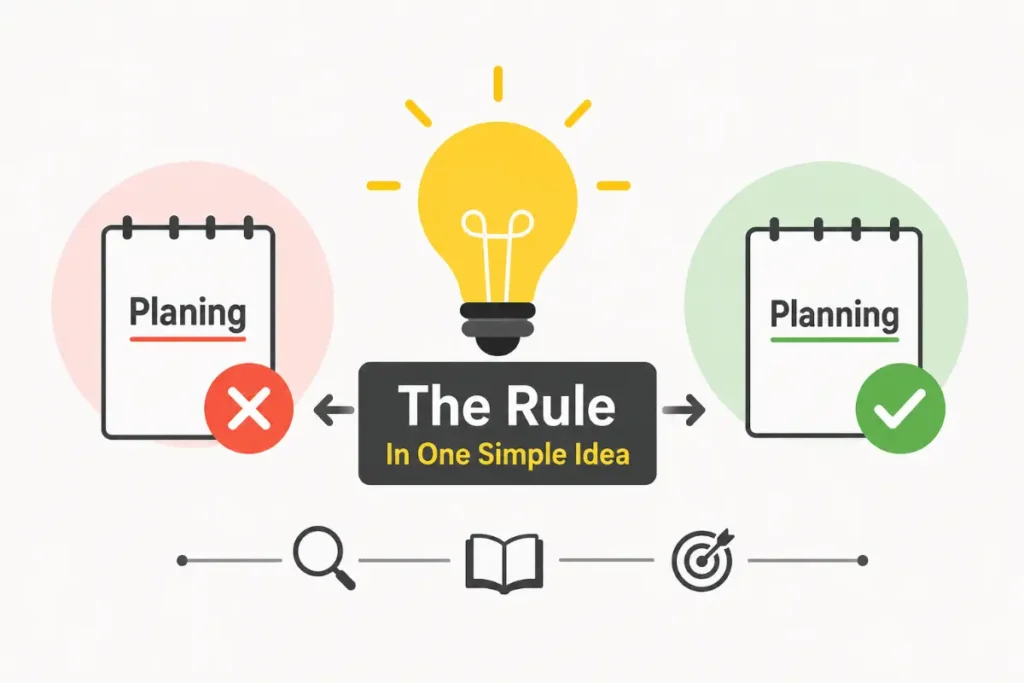
Plan becomes planning.
The final n doubles when ing is added.
Plane becomes planing.
The final e disappears before ing is added.
That gives you a clear distinction between the two forms. The spelling follows the base word and the meaning follows the context.
When you mean making arrangements or deciding what to do next use the form with two n letters. When you mean smoothing something with a plane use the form with one n.
FAQs
Is planing or planning correct?
Both spellings are correct but they have different meanings. Use planning when you mean making arrangements or deciding what to do. Use planing when you mean smoothing or shaping something with a woodworking plane or describing a specialized boating action.
Why does planning have two ns?
The word planning comes from the base word plan. When you add ing to a short word that ends in a single vowel followed by a single consonant the final consonant is often doubled. That gives us plan plus ning and produces the spelling planning.
Is planing a real word?
Yes. Planing is a real English word. It usually refers to using a plane to smooth or shape wood. In boating it can also describe a boat moving quickly across the surface of the water.
How do you spell planning correctly?
The correct spelling is planning with two n letters. Think of the base word plan and remember that the final n doubles before ing is added. This gives you plan plus ning.
What is the difference between plan and planning?
Plan can be a noun or a verb. A plan is an idea or set of steps while the verb plan means to decide what you intend to do. Planning describes the activity of making those decisions or preparing for something.
Is planing the same as planning?
No. The words have different meanings. Planning relates to preparation and future actions while planing usually relates to smoothing a surface with a plane.
How do you remember the difference between planing and planning?
Connect each spelling to its base word. Plan becomes planning while plane becomes planing. If you’re talking about a trip meeting project or future goal you need the spelling with two n letters.
Can I use planning for a future intention?
Yes. The phrase planning to is very common when talking about something you intend to do. For example you can say I’m planning to visit my family next month or She’s planning to apply for the job.
Conclusion
The choice between planing or planning becomes simple once you focus on meaning. Planning is the spelling you need when you’re making arrangements setting goals organizing an event or deciding what to do. Planing has a much narrower meaning and usually refers to smoothing or shaping a surface with a plane.
The spelling difference comes from two different base words. Plan becomes planning when you add ing and the final n doubles. Plane becomes planing because the final e drops before ing is added.
For most everyday writing you’ll want planning. You might write about planning a vacation planning a meeting planning a budget or planning your next move. These are all examples of thinking ahead and organizing what needs to happen.
When you aren’t sure which spelling to choose use the base word test. If the word comes from plan write planning. If it comes from plane write planing. That quick check can help you choose the right word without having to memorize a long list of spelling rules.

Sienna Watson is a veteran copywriter and communications coach who has helped startup founders, marketers, and professionals polish their writing for over a decade. Realizing that most people don’t need a degree in linguistics—just clear, impactful communication—Sienna focuses on practical grammar, business writing etiquette, and eliminating wordiness. She advocates for plain language, strong verbs, and persuasive prose that gets results.