
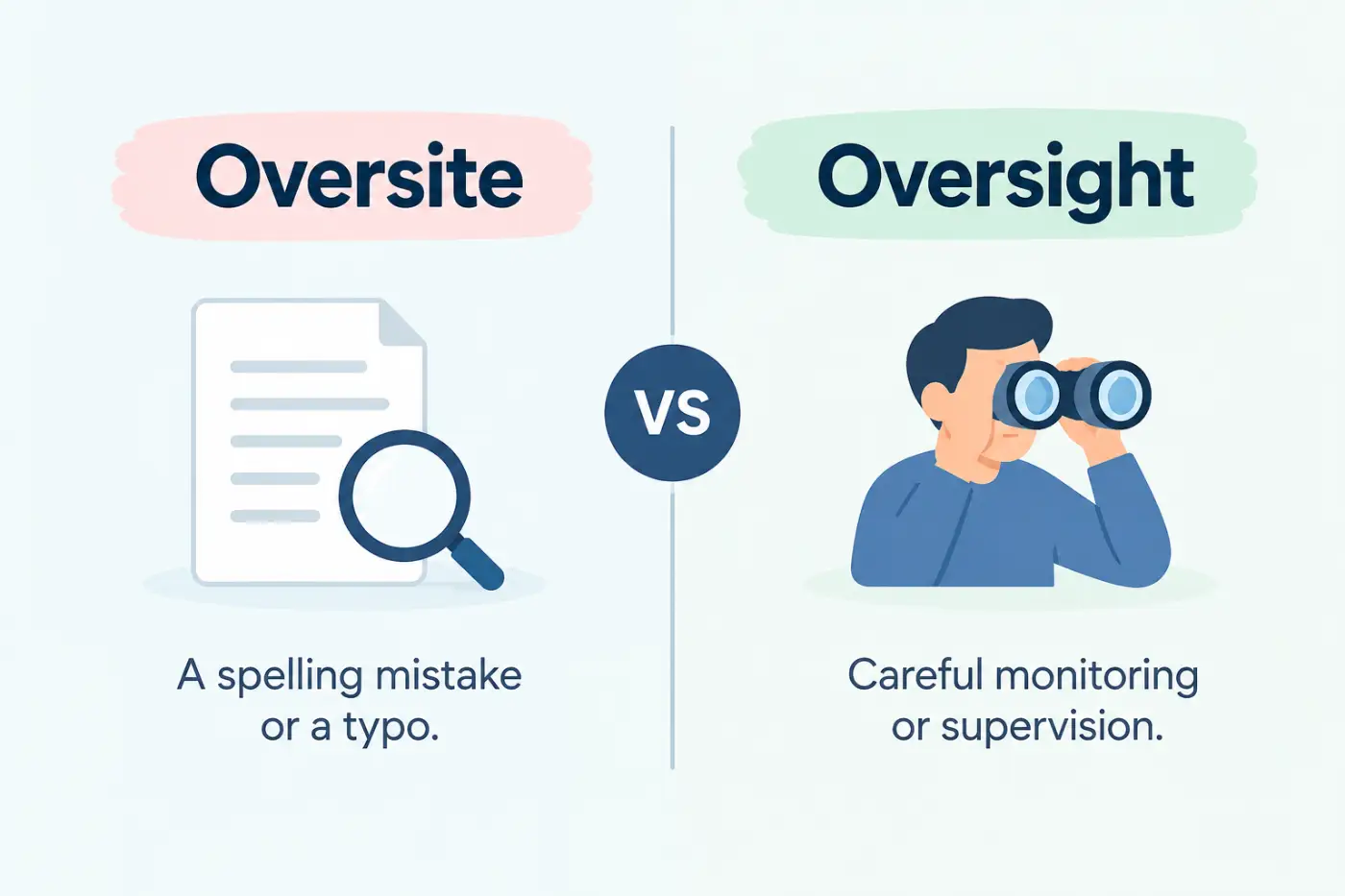
If you’re searching for oversite vs oversight you’re probably trying to figure out which spelling fits your sentence. The two words look almost identical but they don’t mean the same thing. In most everyday writing the word you need is oversight.
Oversite is a real word too. However it has a much narrower use and usually appears in construction. Oversight is the common word used when you mean a mistake caused by failing to notice something or the act of supervising something.
That small difference can change the meaning of a sentence. This guide explains both words in plain English. You’ll see clear examples of each one learn why people confuse them and get simple tips for choosing the right spelling.
Quick Definition
Oversight can mean an accidental failure to notice or do something. It can also mean supervision or the act of watching over a person or process.
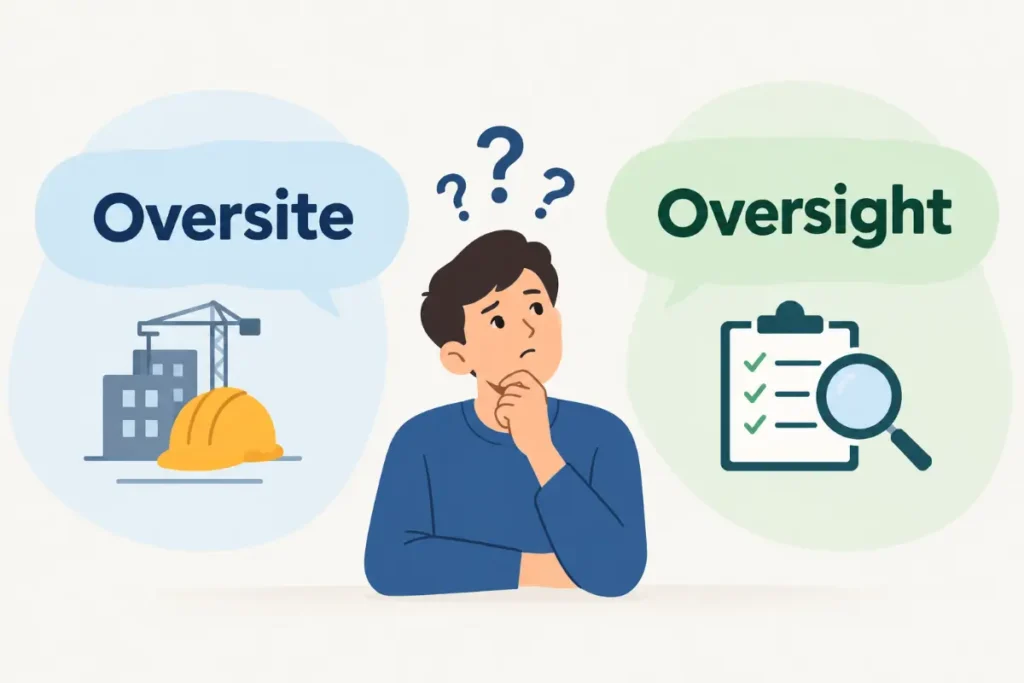
Oversite is a specialized construction term. It refers to a layer of concrete or another material placed over the ground inside a building.
Direct Answer
Oversight is the correct word for a mistake caused by missing something or for supervision. Oversite is a separate construction term and isn’t a general spelling of the same word.
Comparison Table
| Word | Meaning | Example Sentence | When To Use It |
|---|---|---|---|
| Oversight | A missed detail or an act of supervision. | Leaving his name off the list was an oversight. | Use it for mistakes or supervision. |
| Oversite | A construction layer placed over the ground. | The workers poured the oversite before continuing the floor work. | Use it only in the relevant construction context. |
Why These Words Cause Confusion
The confusion comes from more than spelling. Both words contain the same basic sounds and letters. When people hear them in conversation they may not know which spelling the writer intends.
There is also a useful clue hidden in the word oversight. The word combines the idea of something being over another thing with the word sight. In one sense an oversight happens when you fail to see or notice something. That connection can help you remember the spelling.
The other word has a different history and meaning. Oversite appears mainly in building and construction language. It isn’t the word you want when you’re talking about a missed deadline a forgotten detail or supervision.
Consider these two sentences.
- Forgetting to attach the file was an oversight.
- The builders prepared the oversite before laying the floor.
Both sentences are grammatically correct. They simply talk about completely different things.
That distinction is worth remembering because replacing one word with the other can make an otherwise clear sentence confusing.
What Does Oversight Mean
Oversight has two main meanings in American English. The first describes an accidental mistake. The second describes supervision or control.
The first meaning is very common in everyday writing. If you fail to notice something or forget to do something you can call it an oversight.
For example.
- Leaving her name off the invitation was an oversight.
- I apologize for the oversight in the report.
- The missing attachment was a simple oversight.
- His failure to lock the door was an oversight.
In each case someone failed to notice or complete something. The mistake wasn’t necessarily intentional. That’s a key part of the meaning.
The second meaning relates to supervision. A manager may provide oversight of a project. A government agency may have oversight of a program. A board may provide oversight of an organization.
For example.
- The committee provides oversight of the program.
- The manager has oversight of the new project.
- The agency is responsible for regulatory oversight.
- Strong oversight can help prevent costly mistakes.
Here the word doesn’t describe a mistake. It describes the act of watching managing or supervising something.
Oversight As A Mistake
The mistake meaning is probably the one you’re looking for if you’re writing an email article school assignment or everyday message.
An oversight happens when something gets missed.
Maybe you forgot to include an important name on a list. Maybe you missed a deadline because you didn’t check your calendar. Perhaps a small error slipped into a report because you didn’t notice it during proofreading.
All of these situations can involve an oversight.
Common Examples
Imagine that you’re sending invitations to a birthday party. You invite everyone except one close friend. You didn’t leave the person out on purpose. You simply forgot.
You could say.
- Leaving Sam off the guest list was an oversight.
Now imagine that you’re preparing a work report. You include every sales figure except one. Later you discover the missing number.
You could write.
- The missing sales figure was an oversight.
The word works well because it shows that the problem happened because someone failed to notice something.
Oversight And Mistake
An oversight is a type of mistake but the words don’t always carry the same feeling.
Mistake is a broad word. It can describe many kinds of errors.
Oversight usually points to something that was missed or forgotten.
For example.
- I made a mistake on the math problem.
- Forgetting to submit the form was an oversight.
The first sentence could describe an incorrect calculation. The second suggests that the person simply failed to remember or notice the submission requirement.
That difference gives oversight a more specific meaning.
Oversight As Supervision
The second meaning can confuse readers because it sounds almost opposite to the first one.
How can oversight mean both missing something and supervising something?
English sometimes gives one word more than one related meaning. In this case the supervision meaning developed around the idea of watching over something.
When a person has oversight of a project they monitor it and help make sure it stays on track.
For example.
- The director has oversight of the entire department.
- The board provides oversight of the company’s finances.
- The committee has oversight of the program.
- The manager is responsible for oversight of the process.
Here oversight doesn’t mean an error. It means supervision.
Oversight In The Workplace
You’ll often see this meaning in business writing.
A manager may oversee a team. A director may oversee several departments. A board may provide oversight of company decisions.
For example.
- The director oversees the marketing team.
- The board provides oversight of financial decisions.
Notice the relationship between oversee and oversight. The verb oversee means to supervise or manage. The noun oversight can describe that supervisory role.
This is useful because it gives you another memory clue. If you’re talking about supervision you can connect the word with oversee.
Oversite In Construction
Now we come to the less common word.
Oversite is a construction term. It generally refers to a layer of concrete or similar material laid over the ground inside a building. This layer can form part of the base for a floor.
You’ll mainly encounter the word in technical construction documents building guides or discussions about foundations and floors.
For example.
- The contractor poured the oversite before installing the floor structure.
- The construction plan called for a concrete oversite.
- Workers prepared the ground before placing the oversite.
The exact construction method can vary by building type and local practice. That’s why general readers don’t often need this word.
If you’re writing about a forgotten task or a missed detail oversite isn’t the spelling you want.
When To Use Oversite
Use oversite only when you’re talking about its construction meaning.
A builder architect contractor or construction professional might use the term when discussing the ground layer beneath a floor.
For example.
- The oversite was inspected before the next stage of construction.
- The crew repaired the damaged oversite.
- The plans show an oversite beneath the floor.
If your sentence has nothing to do with building work then oversite probably isn’t the word you need.
That simple test can save you a lot of confusion. Ask yourself what you’re talking about. If you’re describing a forgotten detail or supervision use oversight. If you’re discussing a construction layer use oversite.
The Difference In Real Sentences
The easiest way to understand the difference is to put the words side by side.
- Missing the deadline was an oversight.
- The workers completed the oversite before moving on.
The first sentence describes a missed action. The second describes a construction material or stage.
Here are a few more examples.
Examples With Oversight
- Forgetting to call the client was an oversight.
- The error happened because of an oversight during the review.
- I apologize for the oversight.
- The committee provides oversight of the project.
- Her oversight helped keep the team on schedule.
Examples With Oversite
- The builders installed the oversite as part of the floor construction.
- The oversite needed repairs before the next stage could begin.
- The contractor checked the oversite before laying the floor.
- The plans included a concrete oversite.
- Workers prepared the ground for the oversite.
The context tells you which word belongs in the sentence.
A Simple Memory Trick
If you’re talking about something that was missed think of sight.
An oversight can happen when you fail to see something that you should have noticed.
Think.
Oversight means something was missed from sight.
This isn’t a formal spelling rule. It’s simply a memory aid. It gives you a useful mental connection between the meaning and the spelling.
For supervision you can connect oversight with oversee. Both words relate to watching or supervising something.
Oversite is easier to remember as the construction word. Think about a building site. The word appears in construction language and refers to a layer used in building work.
These three connections make the difference easier to recall.
Oversight means a missed detail or supervision.
Oversee means supervise.
Oversite relates to construction.
Once you separate the meanings the spelling becomes much easier.
Common Mistakes With Oversight
People make several mistakes when using these words. Most happen because the writer knows what they want to say but hasn’t connected the meaning with the spelling.
Using Oversite For A Missed Detail
This is the most common problem.
You might see a sentence such as.
- Forgetting the meeting was an oversite.
That spelling is wrong in this context.
The correct sentence is.
- Forgetting the meeting was an oversight.
The writer means that the meeting was forgotten. There is no construction meaning involved.
Using Oversight For Construction
The reverse mistake can also happen.
If you’re writing a construction document and mean a concrete layer beneath a floor you may need oversite instead.
For example.
- The concrete oversite was completed before the floor was installed.
Using oversight there would change the meaning completely. It would make the reader think you’re talking about supervision or a missed detail.
Treating The Words As Variants
These words aren’t simply two accepted spellings of one word.
That’s the key point.
Oversight and oversite have different meanings. You can’t freely switch them based on personal spelling preference.
The context decides which word belongs.
Oversight In Everyday English
The mistake meaning appears in many ordinary situations. You don’t need formal writing to use it.
You might forget someone’s birthday. You might miss a small detail in a form. You might leave an item off a shopping list.
All of these can be described as oversights.
For example.
- I forgot to add milk to the shopping list. That was an oversight.
- I didn’t see the typo in the first draft. It was an oversight.
- We missed one name on the list because of an oversight.
The word often sounds polite when someone admits a small mistake. Saying something was an oversight can explain what happened without making the error sound intentional.
That doesn’t mean you should use the word to hide a serious problem. Context still matters. A major failure caused by carelessness may need a more direct explanation.
Oversight In Formal Writing
You’ll also find the word often used in reports policies government documents and business communication.
In these settings oversight can describe supervision.
For example.
- The board has oversight of the organization’s financial activities.
- The agency provides oversight of public programs.
- The committee was created to provide independent oversight.
It can also describe a missed detail.
- The omission was an oversight during the editing process.
- The incorrect figure resulted from an oversight.
The surrounding words usually make the intended meaning clear.
How Oversight Works In Different Situations
The meaning of oversight depends on the situation around it. In one sentence it can describe something that someone forgot to notice. In another it can describe careful supervision. The same spelling works for both meanings.
Context usually makes the difference clear. If someone says that a missing signature was an oversight they mean the signature was accidentally missed. If a board provides oversight of a company they mean the board monitors the company and its decisions.
Oversight As A Missed Detail
When you use the word for a missed detail you are usually talking about an error that happened because someone failed to notice something.
Imagine that an employee sends an important report but forgets to attach the file. The employee didn’t mean to leave it out. The missing file was simply overlooked.
You could say:
- Forgetting the attachment was an oversight.
- The missing page was an oversight during the final review.
- Leaving her name off the list was an unfortunate oversight.
- The typo was a small oversight that we fixed later.
This use often appears when someone admits responsibility for a minor mistake. The word can sound less harsh than mistake because it suggests that the person missed something rather than made a deliberate choice.
Oversight As Supervision
The other meaning focuses on watching and managing something.
A supervisor provides oversight when they monitor a task or group and make sure the work follows the right process. A board can provide oversight of an organization. A government agency can have oversight of a particular program.
For example:
- The manager provides oversight of the hiring process.
- The board has oversight of the company’s finances.
- The committee provides oversight of the research program.
- The director is responsible for oversight of several departments.
In these sentences no one has made a mistake. The word refers to responsibility and supervision.
The verb oversee has a closely related meaning. If you oversee a project you supervise it. If you have oversight of that project you have responsibility for monitoring it.
How To Tell Which Meaning Oversight Has
When you see the word in a sentence ask what role it plays.
If it describes something that someone forgot missed or failed to notice then it means an error caused by inattention.
If it describes a person group board or agency watching and managing something then it means supervision.
Compare these examples:
- The missing signature was an oversight.
- The board has oversight of the new policy.
The first sentence talks about a mistake. The second talks about supervision. The spelling stays the same even though the meaning changes.
This is a good example of why you should look at the whole sentence instead of trying to understand a word in isolation.
Oversight And Overlook
The words oversight and overlook are closely connected when you are talking about a missed detail.
To overlook something means to fail to notice it.
For example:
- I overlooked the missing page.
- She overlooked a small error in the report.
- We overlooked one name on the list.
The noun oversight can describe the result of that mistake.
- Missing the page was an oversight.
- Leaving out the name was an oversight.
This connection gives you another useful way to understand the word. If you can replace the idea with overlooked then oversight may fit naturally.
However you still need to check the sentence. Oversight can also mean supervision so the surrounding context matters.
Oversight And Supervision
When the word means supervision it can often be replaced with words such as supervision monitoring or management.
For example:
- The committee provides oversight of the program.
- The committee provides supervision of the program.
The two sentences are close in meaning although the first sounds more natural in many formal settings.
Another example is:
- The director has oversight of the department.
- The director supervises the department.
The second sentence uses the verb supervises while the first uses the noun oversight.
These connections help you understand how the word works instead of simply memorizing a definition.
Common Phrases With Oversight
Some combinations appear often enough that they are worth learning as complete phrases.
Provide Oversight
Provide oversight means to supervise or monitor something.
- The committee provides oversight of the project.
- The board provides oversight of financial operations.
This phrase is common in business government education and nonprofit writing.
Government Oversight
Government oversight refers to supervision by a government body or official group.
- The program operates under government oversight.
- The agency came under greater government oversight after the review.
The phrase does not mean a government mistake. It refers to monitoring and control.
Regulatory Oversight
Regulatory oversight means supervision by an organization that makes sure rules and standards are followed.
- The industry operates under strict regulatory oversight.
- The agency provides regulatory oversight of financial institutions.
The phrase can sound formal but its basic meaning is simple. Someone has the job of checking that rules are being followed.
An Oversight In The Report
Here the word means a missed detail.
- The missing figure was an oversight in the report.
- The editor found an oversight during the final review.
This phrase is useful when you need to acknowledge a small error without suggesting that someone made it on purpose.
An Unfortunate Oversight
This phrase describes a mistake that caused a problem.
- Failing to notify the customer was an unfortunate oversight.
- The missing information was an unfortunate oversight.
It often appears in apologies or formal explanations.
Oversite In Construction Writing
The word oversite belongs to a much more specialized area. You may encounter it in construction documents that describe floors foundations and ground preparation.
An oversite can refer to a layer of concrete or another suitable material placed over prepared ground within a building. It can form part of the base used before later floor work takes place.
For example:
- The contractor inspected the oversite before continuing the floor work.
- The concrete oversite was ready for the next stage.
- The workers prepared the ground before installing the oversite.
The exact construction method can depend on the building design materials and local construction practices. That means the word may appear more often in technical documents than in general American English.
For most readers this distinction is enough. If your sentence has nothing to do with construction then oversite probably isn’t the word you need.
Why Oversite Is Rare In Everyday Writing
Most people don’t discuss concrete floor bases in ordinary conversation. They talk about missed appointments forgotten details supervision and mistakes much more often.
That explains why oversight is far more familiar to general readers.
You might write:
- I apologize for the oversight.
You probably won’t write:
- I apologize for the oversite.
The first sentence makes sense because you are apologizing for a mistake. The second changes the word into a construction term and doesn’t fit the situation.
This difference is especially useful when proofreading. Don’t choose the spelling based only on how the word sounds. First identify what you mean.
A Quick Context Test
When you’re unsure about oversite vs oversight use a simple context test.
Ask yourself what happened.
- If someone forgot something or failed to notice a detail use oversight.
- If someone is supervising or monitoring a project use oversight.
- If you’re talking about a construction layer placed over prepared ground use oversite.
That gives you a quick three part check.
Missed detail means oversight.
Supervision means oversight.
Construction layer means oversite.
Once you attach each spelling to its meaning the difference becomes much easier to remember.
Examples That Show The Difference
Reading examples side by side can make the distinction stick.
When Oversight Means A Mistake
- Forgetting to include the invoice was an oversight.
- The missing signature was an oversight.
- I apologize for the oversight in the report.
- The error happened because of an oversight during editing.
- Leaving one customer off the list was an oversight.
Each sentence describes something that was missed.
When Oversight Means Supervision
- The board provides oversight of the organization.
- The manager has oversight of the department.
- The committee is responsible for oversight of the program.
- The agency provides regulatory oversight.
- Strong oversight helps keep the project on track.
Each sentence describes monitoring or supervision.
When Oversite Is Correct
- The contractor inspected the oversite before laying the floor.
- The workers completed the concrete oversite.
- The construction plan included an oversite beneath the floor.
- The damaged oversite needed repair before the next stage.
- The builder checked the oversite as part of the floor preparation.
Each example uses the specialized construction meaning.
How To Avoid The Mistake In Your Own Writing
The easiest way to avoid confusion is to decide on the meaning before thinking about the spelling.
- If you mean a missed detail think of something being overlooked.
- If you mean supervision think of someone overseeing a task.
- If you mean construction work think of the building site and the material placed over prepared ground.
This approach works better than trying to memorize two spellings without knowing why they differ. Meaning gives spelling a purpose.
It also helps to read the sentence after you write it. Ask yourself if the word matches the idea you want to express. A ten second check can catch a surprising number of errors.
What To Use In An Email
For everyday emails you will almost always need oversight.
Suppose you forgot to include an attachment. You could write:
- Sorry about the oversight. I’ve attached the file now.
If you missed a name in a document you could say:
- I apologize for the oversight. I’ve corrected the list.
If you’re talking about management you might write:
- The project will remain under the oversight of the department manager.
In normal workplace communication oversite will almost never be appropriate unless your work involves construction.
That makes the choice easier than it first appears. You don’t need to worry about both words every time you write. In ordinary communication the standard word is oversight.
What To Use In School Writing
Students commonly encounter the word when writing essays reports or explanations.
If you want to describe a forgotten detail you can use oversight.
For example:
- The missing source was an oversight during the research process.
- The student apologized for the oversight and corrected the mistake.
If you’re writing about construction then oversite may appear in a technical source. Use it only when the subject requires that specialized term.
When writing for a general audience always choose the word that matches your intended meaning. Don’t use a technical term simply because it looks similar to a familiar word.
A Useful Difference Between Oversight And Error
The word error is broader than oversight.
An error can happen because of a wrong calculation incorrect information poor judgment or a simple typing mistake.
An oversight specifically points toward something being missed or not noticed.
Compare these sentences:
- The calculation contained an error.
- The missing calculation was an oversight.
The first sentence says the calculation itself was wrong. The second says something was left out or forgotten.
This distinction can help you choose stronger words in your writing. If you know exactly what went wrong you can describe it more accurately.
When Oversight Is The Better Word
Use oversight when you want to make it clear that something was missed.
For example:
- The missing attachment was an oversight.
- Forgetting the appointment was an oversight.
- The typo was an oversight during proofreading.
- Leaving out the final paragraph was an oversight.
Use it for supervision when you are describing someone who monitors a person project process or organization.
For example:
- The manager provides oversight of the team.
- The board has oversight of the company’s finances.
- The committee provides oversight of the program.
In both meanings the spelling stays oversight.
When Oversite Is The Better Word
Use oversite only when your subject is construction and you are referring to the relevant layer or stage of building work.
For example:
- The builder prepared the oversite before the floor was installed.
You would not use this spelling for an overlooked detail.
That one rule covers most situations. If the sentence could naturally include words such as forgotten missed overlooked supervised or monitored then oversight is likely the right choice. If the sentence discusses a concrete layer beneath a floor then oversite may be the specialized term you need.
Related Words That Can Help You Remember Oversight
Understanding related words can make the spelling easier to remember. Instead of treating oversight as a word you must memorize by itself you can connect it to words with similar meanings and forms.
One useful connection is overlook. To overlook something means to fail to notice it. An oversight can describe the thing that was missed.
For example:
- I overlooked the missing page.
- The missing page was an oversight.
The first sentence uses a verb. The second uses a noun. Both sentences describe the same basic situation.
Another useful connection is oversee. To oversee something means to supervise it. The noun oversight can describe that responsibility.
For example:
- Maria oversees the project.
- Maria has oversight of the project.
These connections give you two simple memory paths. Think of overlook when you mean a missed detail. Think of oversee when you mean supervision.
Oversight And Oversaw
The word oversaw can also cause confusion because it looks closely related to oversight.
Oversaw is the past tense of oversee. It means that someone supervised or managed something in the past.
For example:
- The manager oversaw the renovation.
- The director oversaw the hiring process.
- She oversaw the project for three years.
Oversight is a noun. It can describe supervision itself.
- The manager provided oversight during the renovation.
- The director had oversight of the hiring process.
The relationship is simple once you see it. Someone oversees a project. That person provides oversight of the project.
Oversight And Oversight Meaning
A common search question asks what oversight means. The answer depends on the sentence.
When the word refers to a mistake it means that someone failed to notice or remember something.
When it refers to management it means supervision or monitoring.
Consider these examples:
- The missing signature was an oversight.
- The committee has oversight of the program.
The first example involves a mistake. The second involves responsibility and supervision.
This is a good example of a word having more than one meaning without changing its spelling. You can usually identify the intended meaning by looking at the words around it.
Is Oversight Always A Mistake
No. This is one of the most useful points to remember.
Many people know oversight only as a synonym for a missed detail. However the word also means supervision.
For example:
- The error was an oversight.
Here it means a mistake.
But:
- The board provides oversight of the company.
Here it means supervision.
You should not assume that the word always has a negative meaning. The sentence decides what it means.
This matters in professional writing. If you read that a government agency has oversight of a program the writer isn’t saying the agency made a mistake. The writer is saying that the agency monitors or supervises the program.
Can Oversight Mean Supervision
Yes. This is a standard meaning of the word.
If a person or group has oversight of something they are responsible for watching it or checking how it operates.
For example:
- The committee has oversight of the research program.
- The board provides oversight of the company’s finances.
- The director has oversight of several departments.
In simple terms you can think of this meaning as watching over something.
That connection also helps explain why oversight and oversee are related. Both words involve the idea of watching or supervising.
Can Oversight Mean A Small Mistake
Yes. This is another standard use.
An oversight is often a mistake that happens because someone failed to notice something.
For example:
- Forgetting to include the address was an oversight.
- The missing page was an oversight.
- I apologize for the oversight.
The word often works well when the mistake was accidental. It doesn’t automatically mean the mistake was harmless. The seriousness depends on what was missed and what happened as a result.
For a minor problem the word can sound natural and polite.
For a serious problem you may need to explain the situation more directly instead of hiding behind a softer word.
Oversight In An Apology
You may hear oversight often in apologies.
For example:
- I apologize for the oversight.
- Sorry for the oversight in the report.
- We apologize for this oversight and have corrected the issue.
The word works well because it tells the reader that something was missed. It doesn’t always explain exactly what happened though. If the reader needs more information you should name the problem.
For example:
- I apologize for the oversight. I left your name off the final list.
This version is clearer than simply saying:
- I apologize for the oversight.
The second sentence tells the reader exactly what went wrong.
Oversight And Omission
Omission is another related word.
An omission happens when something has been left out. An oversight can cause an omission.
For example:
- The omission of the final paragraph was an oversight.
The sentence tells us both what happened and why it happened. The paragraph was left out and the writer missed it during the process.
However the words aren’t exact substitutes in every situation.
You can say:
- The report contains an omission.
But that doesn’t tell us why the information was missing. It could have been forgotten or intentionally left out.
You can say:
- The missing information was an oversight.
Now the sentence suggests that someone failed to notice or include it.
That small difference can make your writing more precise.
Oversight And Neglect
Neglect is stronger than oversight.
Neglect suggests that someone failed to give something the care or attention it needed. It can involve repeated or serious failure to act.
An oversight often describes a single missed detail.
Compare these examples:
- Forgetting one signature was an oversight.
- Failing to maintain the building for years was neglect.
The first sounds like a mistake. The second suggests a longer or more serious failure.
Choosing the right word helps you communicate the seriousness of a situation without exaggerating it.

Oversight And Supervision In Business
The supervision meaning appears often in workplace writing.
A company may assign one person responsibility for oversight of a project. A manager may provide oversight during a major change. A board may have oversight of financial decisions.
For example:
- The director provides oversight of the department.
- The finance team has oversight of the annual budget.
- The board maintains oversight of major company decisions.
In everyday speech you might use manage supervise or monitor instead.
For example:
- The director supervises the department.
- The finance team monitors the budget.
- The board monitors major company decisions.
The noun oversight can sound more formal. That makes it common in reports policies and official documents.
Oversite And Construction Terms
The less common spelling can be confusing because construction has many specialized terms that aren’t familiar to everyone.
Oversite can refer to a layer of concrete or another material placed over prepared ground as part of a building floor system. The term appears mainly in construction contexts.
You might see it in technical specifications or building discussions.
For example:
- The contractor completed the oversite before the floor installation.
- The oversite was inspected before the next stage began.
A general reader may never need this word. If you’re writing an email about a missed task or a report about supervision this construction term doesn’t belong.
How To Spot The Construction Meaning
Look at the words around the term.
Words such as concrete floor foundation ground building construction and contractor can point toward the specialized construction meaning.
For example:
- The contractor poured the concrete oversite before installing the floor.
The surrounding words make the meaning clear.
Now compare that with:
- Forgetting to send the invoice was an oversight.
Words such as forgetting send and invoice clearly point toward the missed detail meaning.
Context acts like a signpost. It tells you which word belongs.
A Memory Trick For The Spelling
If you mean a mistake caused by failing to notice something remember the word sight.
The spelling contains sight.
That gives you a simple mental picture. Something was missed because it wasn’t seen or noticed.
You can also connect the spelling to oversee. The two words share the same beginning and both relate to watching over something.
For the construction term think about a site. A building site is where construction happens. That gives you a useful way to separate the two spellings.
So you can remember:
- Sight connects with oversight.
- Site connects with oversite.
This is a memory trick rather than a formal spelling rule. It works because it connects each spelling with a different meaning.
A Quick Proofreading Method
When proofreading your work search for the word and check its meaning.
If you wrote oversight ask yourself if you mean a missed detail or supervision. If you do then the spelling is right.
If you wrote oversite ask yourself if you’re talking about construction. If you aren’t then you probably need the other spelling.
This takes only a few seconds. It also works well when you’re proofreading articles emails reports or school assignments.
Don’t rely only on how the word looks. Ask what the sentence means.
Examples To Test Yourself
Try to choose the correct word before reading the answers.
Sentence one.
Leaving the customer’s address out of the letter was an ______.
The answer is oversight because the address was accidentally missed.
Sentence two.
The contractor checked the ______ before continuing with the floor.
The answer is oversite because the sentence describes construction work.
Sentence three.
The board has ______ of the company’s financial activities.
The answer is oversight because the board is responsible for supervision.
Sentence four.
The missing page was an ______ during the final review.
The answer is oversight because a detail was missed.
Sentence five.
The workers prepared the ground for the concrete ______.
The answer is oversite because the sentence describes a construction layer.
These examples show why meaning matters more than sound. The two words may look similar but their uses are very different.
A Simple Rule For Everyday Writing
Most readers will need oversight far more often than oversite.
If you’re writing about an error use oversight. If you’re writing about supervision use oversight. If you’re writing about a specialized construction layer use oversite.
That gives you a simple rule you can remember without studying a long list of exceptions.
Think about the meaning first. Then choose the spelling.
- If you mean something was missed choose oversight.
- If you mean someone is supervising something choose oversight.
- If you mean a construction layer choose oversite.
Once these meanings become familiar the spelling choice becomes almost automatic.
Oversite Vs Oversight In Plain English
If you remember only one thing from this guide, remember that oversight is the word you will use in normal English. It can describe a mistake caused by failing to notice something, or it can describe supervision and careful monitoring. The meaning depends on the sentence.
Oversite has a much narrower use. It belongs mainly to construction writing and describes a layer of concrete or similar material used as part of a floor construction system. You are unlikely to need this word in an email, school assignment, business report, or everyday conversation.
A simple context check can save you from the spelling mistake. If you are talking about a missed detail or supervision, use oversight. If you are talking about a construction layer placed over prepared ground, oversite may be the word you need.
How Context Gives You The Answer
Context is your best guide because the two spellings do not have the same everyday meaning. The surrounding words usually make the intended meaning clear.
Consider the sentence “The missing signature was an oversight.” The writer is talking about something that was accidentally missed. The correct spelling is oversight.
Now consider “The contractor prepared the oversite before the next stage of construction.” The sentence is about building work rather than a mistake or supervision. In that setting, oversite can be appropriate.
This difference becomes easier to spot when you focus on the subject of the sentence. If the subject involves people noticing, managing, checking, or missing something, oversight is usually the right choice. If the subject involves concrete, floors, foundations, or prepared ground, oversite may fit.
Oversight In Professional Communication
The word oversight appears often in professional communication because businesses need to discuss both mistakes and supervision. It can sound neutral and professional when you need to explain that something was missed.
For example, you might write, “The incorrect date was included due to an oversight.” This explains the problem without making the statement sound unnecessarily harsh.
You can also use the word when discussing responsibility and supervision. A sentence such as “The finance team operates under the oversight of senior management” describes monitoring rather than an error.
This makes oversight useful in emails, reports, policies, meeting notes, and business documents. The surrounding context tells readers which meaning you intend.
Oversight In School Writing
Students often use oversight when explaining an error in an assignment or project. For example, “Leaving out the final source was an oversight.” This sounds natural and clearly shows that the omission was accidental.
You can also use the word when discussing institutions or organizations. A sentence such as “The committee provides oversight of the research process” uses the supervision meaning.
If your assignment is not about construction, oversite will almost never be the word you need. Using it to mean a mistake can make an otherwise good sentence look like a spelling error.
Oversight And Other Similar Words
Several words are closely related to oversight, but they are not perfect replacements. Understanding these differences can make your writing more precise.
Omission usually refers to something that has been left out. For example, “The omission of the final paragraph weakened the report.” An omission can be deliberate or accidental, depending on the context.
Neglect suggests a failure to give something the proper care or attention. It often carries a stronger sense of responsibility than oversight.
Error is a broad word for a mistake. It can refer to an incorrect fact, calculation, decision, action, or result.
Supervision focuses on watching or managing people and activities. It does not normally carry the accidental mistake meaning that oversight can have.
These distinctions matter because the best word depends on what you want the reader to understand. A small missed detail may be an oversight. Repeated failure to care for something may be neglect. Monitoring a process is supervision.
Oversight And Overlook
Overlook is one of the most useful words to connect with oversight. As a verb, overlook can mean to fail to notice something.
For example, “I overlooked the typo in the final report.” This means I failed to notice the typo.
The related noun is oversight. You could say, “The typo was an oversight.” Both sentences describe the same basic idea from different grammatical angles.
There is another meaning of overlook that can cause confusion. It can also mean to have a view from a higher position. For example, “The balcony overlooks the garden.” That meaning has nothing to do with an accidental omission.
Oversight And Oversee
Oversee is another useful related word. It means to supervise or manage something.
For example, “Maria oversees the training program.” This means Maria supervises the program.
The noun form is oversight. You could write, “Maria provides oversight of the training program.”
This connection is a useful memory aid. If you are talking about supervision, think of oversee and oversight together.
The past tense of oversee is oversaw. For example, “The manager oversaw the project during its final stage.” These words share the supervision idea, but their grammatical roles are different.
When Oversight Refers To A Mistake
When oversight means a mistake, it usually describes something that was missed rather than something intentionally done wrong. That makes it a useful word for polite explanations.
For example, “The wrong attachment was sent due to an oversight.” The sentence tells the reader what happened without suggesting that the person deliberately made the mistake.
You could also say, “It was an oversight on my part.” This is a natural way to accept responsibility for a small missed detail.
Another example is “The deadline was left off the calendar by oversight.” Again, the idea is that someone failed to notice or include something.
The word often works well when you want to acknowledge an error without making it sound dramatic. Still, it should not be used to hide serious wrongdoing. Clear writing should accurately describe the situation.
When Oversight Refers To Supervision
The supervision meaning appears often in government, business, education, healthcare, finance, and other formal settings.
For example, “The board has oversight of the organization’s financial policies.” Here, oversight means monitoring and supervision.
You might also read sentences such as “The agency provides oversight of public spending.” This means the agency monitors how money is used.
In this sense, oversight is not a mistake at all. It is an active responsibility. People or organizations provide oversight to make sure a process follows rules, standards, or expectations.
How To Choose The Right Word Quickly
When you see these two spellings, ask yourself what the sentence is really about.
- If something was missed, forgotten, or accidentally left undone, choose oversight.
- If someone is supervising, monitoring, or reviewing an activity, choose oversight.
- If the sentence describes a construction layer or building process involving prepared ground and flooring, consider oversite.
This quick test works because the two words belong to very different areas of language. One is common English. The other is a specialized construction term.
Examples You Can Use In Your Writing
Here are some natural examples that show the difference.
- “The missing page was an oversight.”
- “Leaving his name off the list was an oversight.”
- “The manager provides oversight of the department.”
- “The committee has oversight of the new policy.”
- “The government agency is responsible for regulatory oversight.”
- “The contractor prepared the oversite before continuing the floor construction.”
- “The construction team checked the oversite before moving to the next stage.”
- “The report contained a small oversight that was corrected before publication.”
These examples show why context matters more than simply memorizing the spelling. The sentence itself usually gives you the clue.
FAQs
Is oversite or oversight correct?
Oversight is the correct word in ordinary English when you mean a missed detail, accidental mistake, supervision, or monitoring. Oversite is a specialized construction term and is rarely needed in everyday writing.
What does oversight mean?
Oversight has two main meanings. It can describe an accidental failure to notice or do something, or it can mean supervision and monitoring.
Is oversite a real word?
Yes. Oversite is a specialized construction term used for a layer of concrete or similar material placed over prepared ground as part of floor construction. It is much less common than oversight.
Is oversight the same as overlook?
Not exactly. Overlook is usually a verb meaning to fail to notice something, while oversight is a noun that can describe the resulting mistake.
Can oversight mean supervision?
Yes. Oversight can mean supervision or monitoring, especially in business, government, finance, education, and other formal settings. For example, a board can provide oversight of a company.
Can oversight mean a mistake?
Yes. Oversight can describe an accidental failure to notice, remember, include, or do something. For example, forgetting to attach a document can be called an oversight.
How can I remember the spelling?
Think of sight when you mean noticing or supervising. Think of site when you are dealing with a physical construction site. This is only a memory trick, but it can help you choose the spelling faster.
What is the easiest way to remember oversite vs oversight?
Think about the subject of the sentence. Everyday mistakes and supervision normally call for oversight, while construction language may call for oversite.
Conclusion
The main lesson from oversite vs oversight is simple. Oversight is the normal word for an accidental missed detail and for supervision or monitoring. Oversite is a specialized construction word that you will mainly encounter in technical building contexts.
If you are writing an email and want to explain that you missed something, use oversight. If you are describing a board that monitors an organization, use oversight again. You only need oversite when your sentence belongs to the specific construction context where that term applies.
A good memory trick is to connect sight with seeing or noticing and site with a physical place. It is not a formal spelling rule, but it gives you a quick mental picture when you are proofreading.
Once you understand the two meanings, the choice becomes much easier. In most everyday writing, oversight will be the spelling you need.

Dr. Elena Vance holds a Ph.D. in Linguistics from Columbia University and has spent over 15 years analyzing the evolution of the English language. A former university professor turned full-time writer and editor, Elena specializes in breaking down high-level grammatical concepts, punctuation nuances, and style guides (APA, Chicago, MLA) into clear, actionable advice. When she isn’t hunting down dangling modifiers, she can be found collecting vintage dictionaries and reading classic literature.