
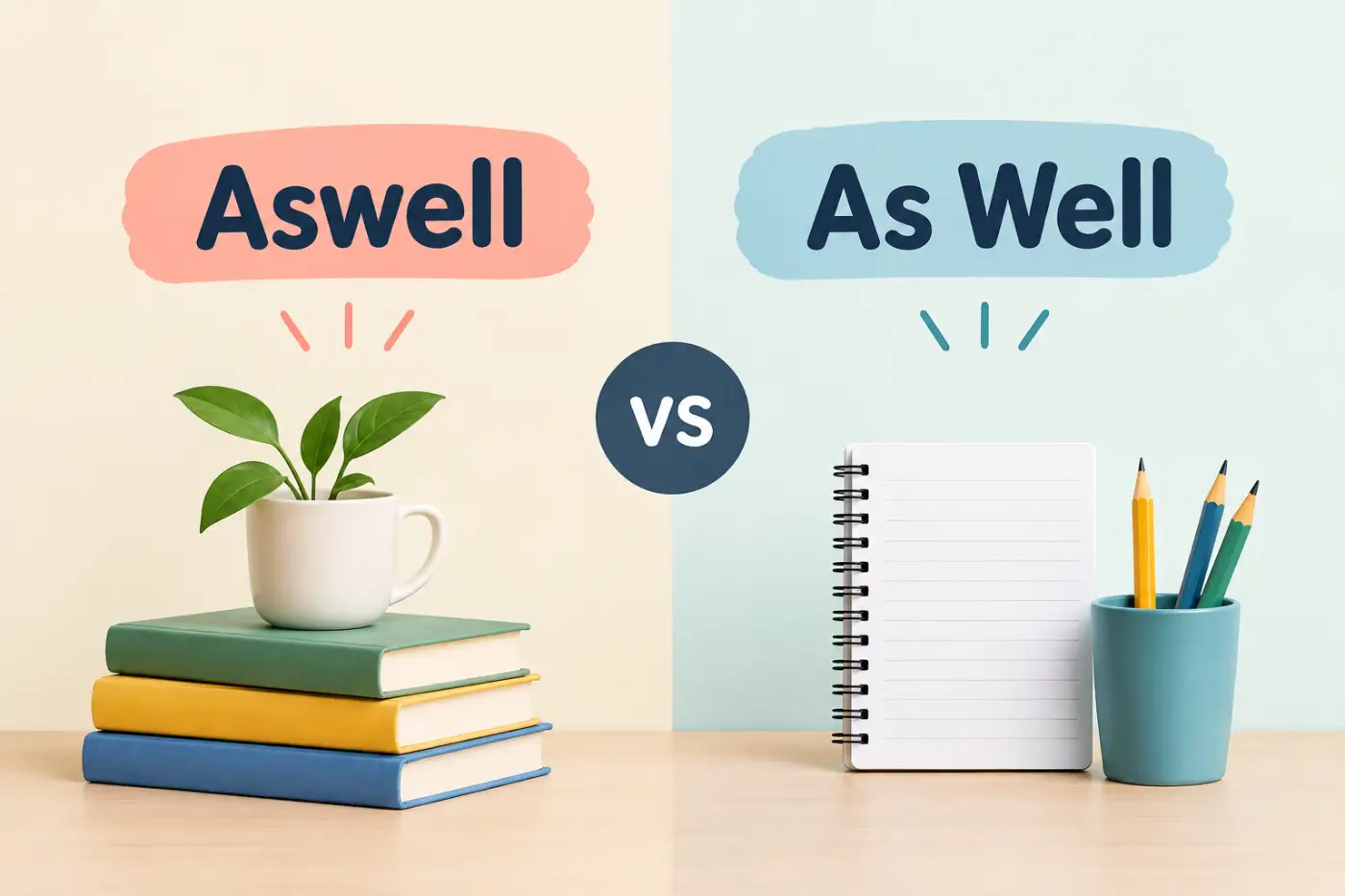
If you are unsure about aswell vs as well you only need to remember one thing. The correct spelling is as well with two separate words. The form aswell is not standard English.
This small spelling mistake is easy to make because the phrase sounds like one word when people say it quickly. It also appears often in casual writing online. That can make the incorrect form look familiar even though standard English keeps the two words separate.
The phrase usually means also or too. You can use it to add another person thing idea or action to a sentence. This guide explains the correct spelling the meaning the grammar rules and the most common mistakes so you can use the phrase naturally.
Quick Definition
As well is a two word phrase that usually means also or too. It often appears near the end of a sentence but it can appear in other positions depending on the sentence structure. Aswell is not the standard spelling and should not be used in normal English writing.
Direct Answer
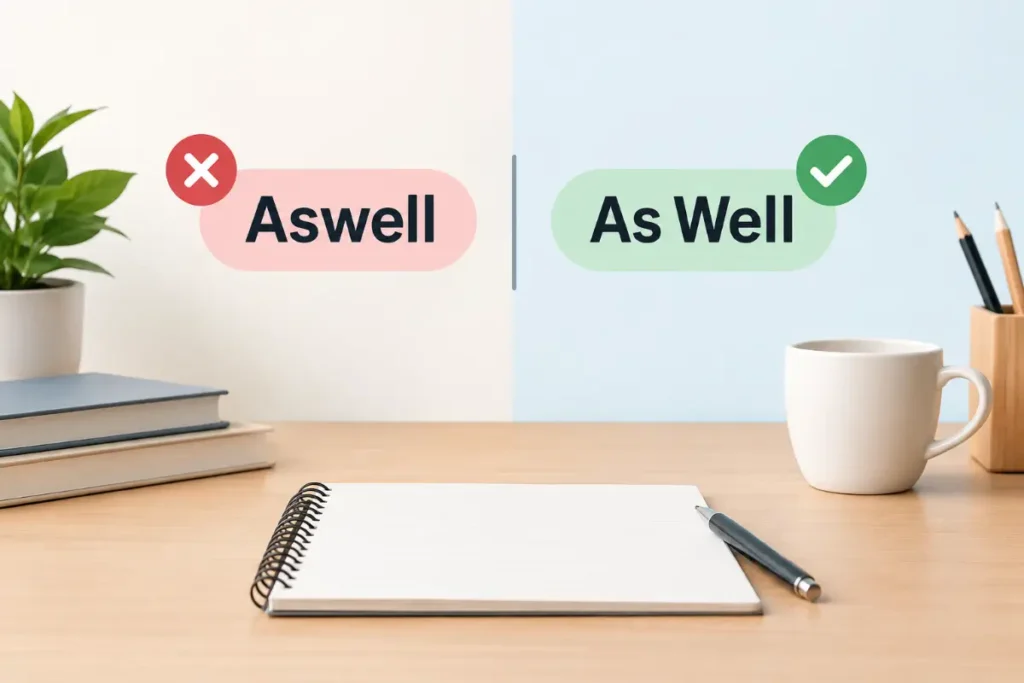
The correct form is as well with a space. Aswell is incorrect in standard English.
Comparison Table
| Word or Phrase | Meaning | Example Sentence | When to Use It |
|---|---|---|---|
| As well | Also or too | I want to come as well. | Use this form in standard English. |
| Aswell | Incorrect spelling | I want to come aswell. | Do not use this form. |
What Does As Well Mean
The phrase as well usually means also or too. It adds another fact to a sentence that already contains a related idea.
For example you might say that Sarah is coming and that Mark is coming too. You could write the sentence this way.
Sarah is coming as well.
The phrase tells the reader that Sarah is included in something already mentioned. It adds information without changing the main idea of the sentence.
You can also use it after a verb phrase.
I want to watch the movie as well.
This means I also want to watch the movie.
The meaning is simple but the phrase has a few different uses. Understanding those uses can help you sound more natural and avoid awkward sentences.
Why People Write Aswell
The main reason people write aswell is simple. The phrase often sounds like one unit when spoken.
When people say as well in normal conversation they usually do not pause between the two words. The sound flows together. That can make the phrase feel like it should be written as one word.
English has many expressions that sound different from the way they look on the page. Some phrases contain two words even though speakers say them quickly as one smooth unit.
Typing habits can add to the problem. People often write messages quickly and may not stop to check small spelling details. Once an incorrect form becomes familiar it can start to look right.
The same thing happens with other common word pairs and phrases. A person may see an incorrect spelling many times online and begin to remember it as the correct form.
That does not change the standard spelling. In edited English the phrase remains two words.
The Correct Rule For As Well
The basic rule is easy. Write as well as two separate words when you mean also or too.
Consider these examples.
- I ordered dessert as well.
- She plays tennis as well.
- We invited our neighbors as well.
- He wants to join us as well.
In each sentence the phrase adds another person action or thing to an existing idea.
You do not need to combine the words to make the phrase work. The space between them is part of the standard spelling.
How To Use As Well In A Sentence
The most common position is near the end of a sentence. This is especially natural when the phrase means too.
For example.
- I enjoyed the concert as well.
- She wants to come with us as well.
- We bought some snacks as well.
- He knows the answer as well.
- The phrase can also follow an object.
- I brought my sister as well.
- They invited our teacher as well.
- We need a larger table as well.
This placement makes the added information clear and easy to understand.
In everyday American English the phrase often feels slightly more polished than simply using too. Both are correct in many situations.
Compare these sentences.
- I want to go too.
- I want to go as well.
Both mean that the speaker wants to go in addition to someone else. The choice often depends on tone and sentence rhythm.
As Well And Too
As well and too often have the same meaning. Both can mean also.
For example.
- I like pizza too.
- I like pizza as well.
The meaning is almost identical. The difference is mostly about style and position.
Too commonly appears at the end of a sentence.
She wants to come too.
As well also commonly appears at the end.
She wants to come as well.
In casual American conversation too may sound more natural and direct. As well can sound a little more polished but it is still common in everyday speech.
Neither choice changes the basic meaning.
When Too Sounds More Natural
Use too when you want a short casual sentence.
I need one too.
Me too.
She wants some too.
These sentences sound natural in conversation and informal messages.
When As Well Works Better
As well can fit nicely into longer sentences and formal writing.
- The company provides health insurance as well.
- The report includes sales figures as well.
- Students can submit the form online as well.
The phrase adds information without making the sentence sound overly formal.
As Well And Also
Also is another common word that means the same basic thing. It can replace as well in many sentences.
Compare these examples.
I also want to visit New York.
I want to visit New York as well.
Both sentences say that the speaker wants to visit New York in addition to something already discussed.
The main difference is position. Also often appears before the main verb.
She also likes jazz.
As well often appears near the end.
She likes jazz as well.
This is a useful pattern to remember. If you are unsure where to put the phrase you can often use also instead.
More Examples With Also
- I also need some help.
- He also works on weekends.
- They also invited my parents.
- We also watched the second movie.
- She also speaks Spanish.
Each sentence adds information to something that came before.
Is As Well Formal Or Informal
As well works in both formal and informal English. You can use it in a text message a school assignment an email a report or a conversation.
The tone depends more on the sentence around it than on the phrase itself.
For example this sounds casual.
- I want one as well.
- This sounds more formal.
- The program offers financial assistance as well.
- Both are grammatically correct.
You do not need to avoid the phrase in professional writing. It is a normal part of standard English.
At the same time you should avoid forcing it into every sentence just because you want to sound formal. Simple writing is often stronger.
Common Mistakes With As Well
Spelling the phrase as one word is the most obvious mistake. There are also a few grammar mistakes that can make the sentence sound unnatural.
Writing Aswell As One Word
This is the main spelling error.
Incorrect.
I would like to attend aswell.
Correct.
I would like to attend as well.
The fix is simple. Keep a space between as and well.
Using As Well Too Often
The phrase is useful but repetition can make your writing sound dull.
For example.
I like coffee as well. I like tea as well. I like juice as well. I like soda as well.
The grammar is not wrong but the repeated phrase makes the paragraph feel mechanical.
You can vary the wording.
I like coffee too. I also enjoy tea. Juice is another favorite.
Good writing gives readers some variety.
Confusing As Well With As Well As
These expressions are related but they do different jobs.
As well usually means also or too.
As well as usually means in addition to.
For example.
- I want to go as well.
- This means I also want to go.
- Now compare it with this sentence.
- I want to bring my sister as well as my brother.
- Here as well as connects two people. It means in addition to.
Knowing the difference helps you avoid sentences that sound confusing.
How As Well As Works
The phrase as well as deserves special attention because people sometimes treat it as the same thing as as well. It is not.
Consider this example.
Maria speaks English as well as Spanish.
Here as well as connects English and Spanish. It tells us that Maria speaks both languages.
Now look at this example.
Maria speaks Spanish as well.
Here as well means that Spanish is an additional language she speaks.
The extra word as changes the structure and meaning of the expression.
Examples With As Well As
- The store sells shoes as well as clothing.
- He brought his laptop as well as his notebook.
- We visited the museum as well as the park.
- She is kind as well as hardworking.
- These sentences connect two related ideas.
Can As Well Start A Sentence
Yes but this use is less common when the phrase means also or too.
In most everyday sentences you will naturally place it near the end.
I enjoyed the meal as well.
Starting a sentence with as well can sound unusual if you are simply trying to say also. A different structure may be clearer.
For example instead of writing this.
As well I wanted to call you.
Write this.
I wanted to call you as well.
Or use also.
I also wanted to call you.
This produces a smoother sentence.
Can As Well Go In The Middle Of A Sentence
Yes. Its position can change when the phrase has a different grammatical role.
For example.
- She as well as her brother attended the meeting.
- Here the structure is actually as well as. It connects two subjects.
- When you mean also or too the phrase usually works better at the end.
- She attended the meeting as well.
This distinction matters because moving the phrase around can change the meaning or make the sentence sound unnatural.
As Well At The End Of A Sentence
Ending a sentence with as well is extremely common.
Here are some natural examples.
- I need a copy as well.
- We saw the new restaurant as well.
- She wants to learn French as well.
- They ordered dessert as well.
- He plans to attend the meeting as well.
This position is easy for readers to understand because the phrase clearly adds something to the statement.
If you are learning English you can use this structure with confidence. It is simple and natural.
As Well In Questions
You can also use the phrase in questions.
- Are you coming as well?
- Do you want some as well?
- Did Sarah receive an invitation as well?
- Will your brother be there as well?
- In each question the phrase asks about an additional person or thing.
- The structure is especially common when the speaker already knows about one person or item and wants to know about another.
- For example someone might say that John is going to the party. You could ask.
- Is Mike coming as well?
- The question means Is Mike coming too?
As Well In Negative Sentences
The phrase can appear in negative sentences but the structure needs care.
For example.
- I do not want to go as well.
- This sentence can be confusing because the position of as well may make the reader wonder exactly what is being added.
- In many cases another structure is clearer.
- I do not want to go either.
When agreeing with a negative statement English usually uses either rather than too or as well.
For example.
- I do not like spinach either.
- This means the speaker also does not like spinach.
- Compare it with a positive sentence.
- I like spinach as well.
The positive sentence uses as well. The negative sentence naturally uses either.
As Well And Either
This distinction is useful because learners sometimes use as well in places where either sounds more natural.
For positive statements use as well or too.
- I like this song as well.
- I like this song too.
- For negative statements use either.
- I do not like this song either.
- This pattern is common in everyday English.
- Consider another example.
- She does not want coffee either.
The phrase either adds agreement with the negative idea. Using as well in that position would not sound natural to most American English speakers.
Memory Tricks For The Correct Spelling
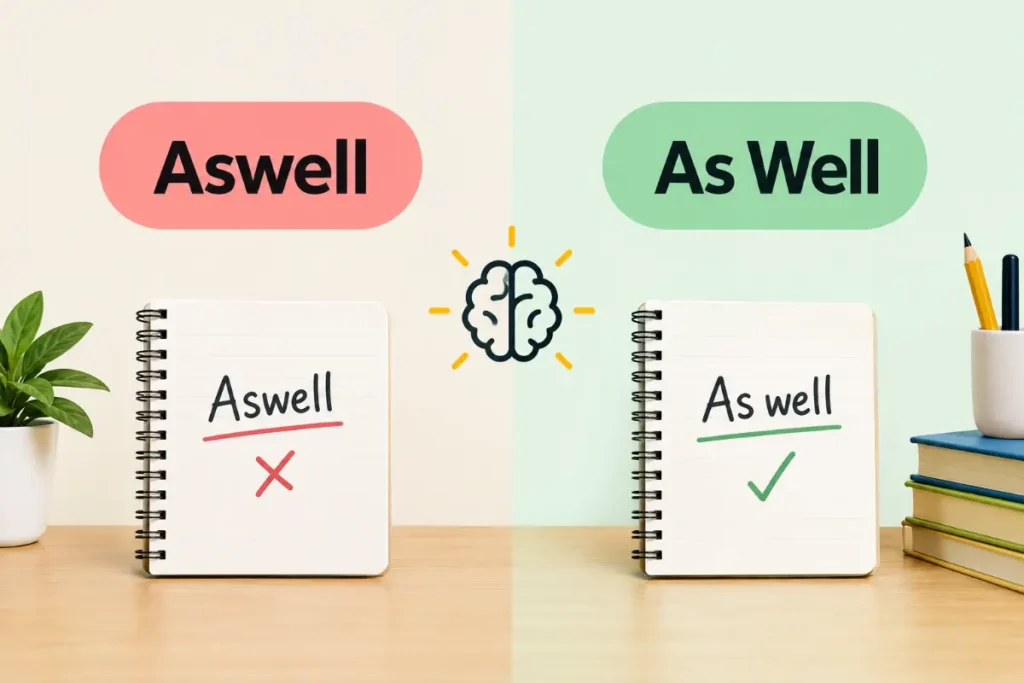
The easiest memory trick is to think of the phrase as two simple words.
As + well = as well.
You can also connect the phrase with the word too.
If you can replace the phrase with too and the sentence still makes sense you probably have the right expression.
For example.
- I want to come as well.
- I want to come too.
Both sentences work. That tells you as well is being used to mean also.
Another useful trick is visual. Picture the phrase with a small space between the words.
as well
That space is easy to remember once you have seen the correct form often enough.
A Simple Test You Can Use
When you are unsure about the spelling ask yourself one question.
Can I replace the phrase with also or too.
If the answer is yes you probably mean as well.
For example.
- She wants to join us as well.
- Replace it with too.
- She wants to join us too.
- The meaning stays almost the same.
- Now try the incorrect spelling.
- She wants to join us aswell.
The meaning may still be clear but the spelling is not standard. The fact that a reader can understand a mistake does not make the spelling correct.
Why Spacing Matters In English
A space can change the form of an expression. English contains many phrases that look like one unit when spoken but remain separate words in writing.
As well is one of them.
The same idea appears in many common expressions.
- A lot is written as two words.
- At least is written as two words.
- Of course is written as two words.
- For now is written as two words.
Knowing how words and phrases are normally written is part of good spelling. It helps readers process your writing quickly without having to stop and interpret unusual forms.
As Well In Email Writing
You can use the phrase naturally in emails.
For example.
I wanted to share the updated schedule as well.
Please send the final report as well.
Could you include the receipt as well?
We would like to invite your manager as well.
These sentences sound natural and professional without being stiff.
If you are writing a formal email the phrase can help you add information without repeating the same sentence pattern.
For example.
Please send the signed form. We also need a copy of your identification.
You could also write.
Please send the signed form as well as a copy of your identification.
The second sentence uses as well as because it connects two items.
As Well In School Writing
Students can use as well in essays reports assignments and other academic writing. It is a normal English expression and does not make writing too casual.
For example.
- The author uses humor as well.
- The study examines cost as well as quality.
- The character shows courage as well.
The second sentence uses as well as because it connects two ideas. The other examples use as well to add information.
When writing for school focus on clear meaning. You do not need to replace simple phrases with complicated words just to sound academic.
As Well In Professional Writing
The phrase also works well in workplace communication.
For example.
- Please review the attached document as well.
- The new policy applies to contractors as well.
- The team will receive training as well.
- The report includes customer feedback as well.
- These sentences are direct and easy to understand. That is usually what workplace writing needs.
- You can also use too when the tone is casual.
- I will attend too.
- In a formal message as well may sometimes fit the rhythm better.
- I will attend as well.
- Both are correct.
Examples To Help You Remember
- I want some ice cream as well.
- She brought her camera as well.
- We invited Tom as well.
- He speaks French as well.
- They are coming with us as well.
- I need a ticket as well.
- Did you order dessert as well?
- Can you send me the file as well?
- My sister wants to join as well.
- The hotel offers free breakfast as well.
- The store sells furniture as well as electronics.
- She studies biology as well as chemistry.
- The program supports students as well as teachers.
The fastest way to make a spelling rule stick is to see it in context. Read these examples aloud and pay attention to the space between the two words.
These examples show two different structures. The first group uses as well to mean also or too. The final three examples use as well as to connect two things.
A Quick Guide To Choosing The Right Form
- If you mean also use as well.
- If you mean too use as well.
- If you want to connect two nouns or ideas you may need as well as.
- If the sentence is negative and you mean also not use either in many common situations.
- If you are writing the phrase that means also do not combine the words into one.
That simple guide covers most everyday uses.
FAQs
Is aswell ever correct
No. Aswell is not the standard spelling of the phrase. Use as well with a space in standard English writing.
Is as well one word or two words
As well is two words. The space between as and well is part of the standard spelling.
Does as well mean also
Yes. As well often means also or too. For example I want to come as well means I also want to come.
Can I use as well at the end of a sentence
Yes. This is one of the most common positions for the phrase. For example you can say She wants to come as well.
Is as well the same as too
In many sentences yes. Both phrases can mean also. As well often appears at the end of a sentence just like too.
What is the difference between as well and as well as
As well usually means also or too. As well as connects two things and usually means in addition to.
Should I use either instead of as well in negative sentences
Usually yes when you are agreeing with a negative statement. For example I do not like coffee either sounds natural when you mean that you also do not like coffee.
Is as well correct in formal writing
Yes. As well is standard English and works in formal and informal writing. You can use it in emails reports essays and everyday messages.
Conclusion
The correct choice in aswell vs as well is simple. Use as well with two separate words. The one word form is not standard English.
The phrase usually means also or too. It often appears at the end of a sentence but it can take other positions depending on how the sentence is built. You can use it in casual conversation school writing emails reports and professional communication.
Remember the phrase as two separate words. If you can replace it with also or too and the meaning stays clear you are probably using it correctly. For negative statements remember that either often works better.
The next time you type this phrase take one quick look at the space. Write as well and move on with confidence.

Sienna Watson is a veteran copywriter and communications coach who has helped startup founders, marketers, and professionals polish their writing for over a decade. Realizing that most people don’t need a degree in linguistics—just clear, impactful communication—Sienna focuses on practical grammar, business writing etiquette, and eliminating wordiness. She advocates for plain language, strong verbs, and persuasive prose that gets results.