
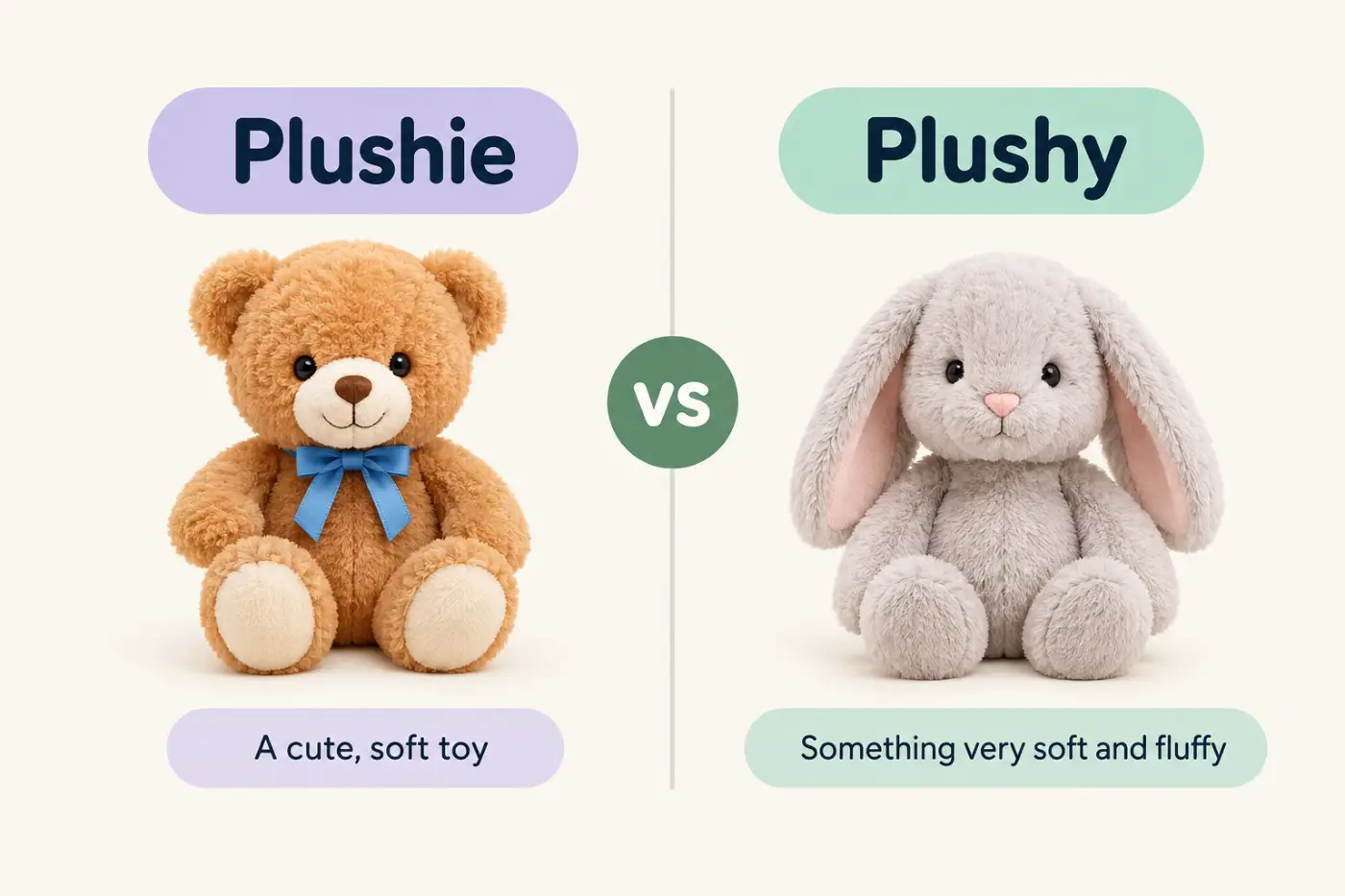
If you’re wondering about plushie vs plushy you’ve probably seen both forms online and wondered if one is wrong. They look almost identical and people often use them when talking about soft stuffed toys. The short answer is that both forms can be used, but they don’t work in exactly the same way.
Plushie is usually a noun for a soft stuffed toy. Plushy is usually an adjective that describes something soft and cushiony. The difference is small but useful once you see how each word works in a sentence.
This guide explains the meaning of both words, how they developed, when to use each one, and why people sometimes treat them as interchangeable. You’ll also see plenty of natural examples so you can choose the right word without second guessing yourself.
Quick Definition
Plushie is an informal noun that usually means a soft stuffed toy such as a stuffed animal or character toy. Plushy is an adjective that describes something soft, thick, padded, or luxurious. Both words are common in casual English, especially in conversations about stuffed animals and cute toys.
Direct Answer
Both plushie and plushy can be correct. Use plushie when you mean a stuffed toy and plushy when you’re describing something as soft or cushiony.
Comparison Table
| Word | Meaning | Example Sentence | When to Use It |
|---|---|---|---|
| Plushie | A soft stuffed toy | My sister bought a cat plushie. | Use it as a noun for a stuffed toy. |
| Plushy | Soft thick padded or cushiony | This blanket feels plushy. | Use it mainly as an adjective to describe texture or comfort. |
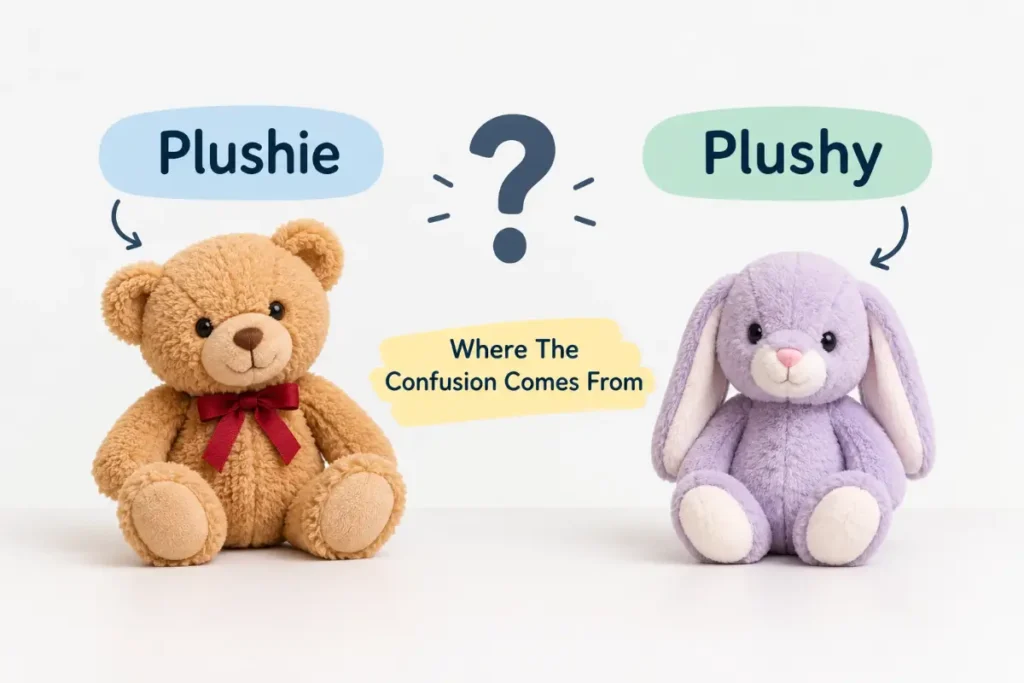
Where The Confusion Comes From
The confusion exists because both words come from the same basic idea. They are connected to plush which describes a soft fabric or something that feels rich and comfortable.
The ending changes the role of the word. Plushie commonly names an object. Plushy commonly describes an object or material. That small change can make the words look like spelling variations even though they often serve different purposes.
There’s another reason the distinction gets blurry. Online communities often use plushie as a casual name for stuffed toys. People may also use plushy as a noun when talking informally about the same type of toy. You may see sentences like I bought a new plushy or Look at this cute plushy.
That use is common in casual online writing. It doesn’t mean that the two words have identical standard functions. It simply shows how flexible informal English can be.
Think of the difference this way. Plushie points to the toy itself. Plushy points to the soft quality.
If someone says I bought a plushie they’re telling you what they bought. If they say I bought a plushy toy they’re using the word to describe the toy.
What Does Plushie Mean
A plushie is a soft stuffed toy. It can look like an animal a person a fantasy creature a food item or a character from a movie game or cartoon.
The word is informal and friendly. It often appears in conversations among people who enjoy stuffed animals and cute collectibles. You’ll also see it in product descriptions social media posts messages and online communities.
For example you might say:
- I got a new plushie for my birthday.
- My dog keeps trying to steal my plushie.
- She has a shelf full of plushies.
- This little bear plushie is adorable.
- I bought a plushie of my favorite game character.
In each example plushie refers to the physical stuffed item.
The word can describe something small and cute but size isn’t required. A plushie can be tiny enough to fit in your hand or large enough to sit on like a pillow.
The word also doesn’t require the toy to be shaped like an animal. A stuffed strawberry a cartoon character or a fantasy creature can all be called plushies.
What Does Plushy Mean
Plushy is generally an adjective. It describes something that feels soft thick padded or comfortable.
For example:
- This couch is really plushy.
- I love the plushy texture of this blanket.
- The hotel bed felt warm and plushy.
- These pillows are soft and plushy.
- The carpet feels plushy under my feet.
Here the word describes a quality. It doesn’t name the object itself.
That distinction helps make the choice easier. If you can replace the word with soft cushy or comfortable the adjective plushy may fit.
Still there is an important point to remember. Informal English often turns descriptive words into nouns. That’s why you may see people use plushy to mean a stuffed toy. The usage is understandable and common online but it’s more casual than the traditional adjective use.
Plushie As A Noun
The clearest use of plushie is as a noun.
A noun names a person place thing or idea. In this case the thing is a stuffed toy.
Consider these examples:
- My daughter wants a bunny plushie.
- I found a cute plushie at the store.
- He keeps his favorite plushie beside his bed.
- We gave the children a plushie after the show.
You can also make the noun plural.
The plural form is plushies.
For example:
- She collects plushies.
- The store has hundreds of plushies.
- My nieces brought their plushies on the trip.
Notice the spelling change. When a word ending in y becomes plural the y often changes to ies when the word behaves like a regular noun of this type.
That gives you:
plushie
plushies
This form is very common when people talk about collections of stuffed toys.
Plushy As An Adjective
Adjectives describe nouns. That’s the main job of plushy.
You can use it to describe furniture bedding fabric toys and other objects that have a soft or cushioned feel.
For example:
- We bought a plushy blanket for winter.
- The chair has a plushy seat.
- These slippers have a plushy lining.
- I want a plushy rug for the bedroom.
- The toy has a soft plushy body.
In these sentences the word gives you information about texture or comfort.
You can often test the word by asking yourself a simple question.
Am I naming the thing or describing how it feels?
If you’re naming the stuffed toy then plushie is usually the better choice. If you’re describing its texture then plushy may work.
The Role Of Plush
Understanding plush makes the difference even clearer.
Plush is an established English word. As a noun it can refer to a soft fabric with a raised surface. As an adjective it can describe something soft comfortable rich or luxurious.
For example:
- The chair has a plush fabric covering.
- We stayed in a plush hotel room.
- The blanket has a plush texture.
- The seats are soft and plush.
The newer casual forms plushie and plushy build on this idea of softness.
The connection is easy to see. A plushie is a stuffed object made to feel soft. Plushy describes something that has that soft quality.
You don’t need to know the history of every suffix to use these words correctly. Just remember the basic relationship between the words.
Plush describes softness or luxury.
Plushie usually names a soft stuffed toy.
Plushy usually describes something soft or cushiony.
When To Use Plushie
Use plushie when the stuffed toy itself is the subject of your sentence.
For example:
- My new plushie is sitting on the shelf.
- I gave my friend a plushie for her birthday.
- That plushie looks just like my cat.
- I’m taking my favorite plushie on the trip.
- The child hugged her plushie during the movie.
The word works especially well in casual conversation. It has a warm and playful feeling that fits the subject.
You could use stuffed animal in many of the same situations. The difference is that stuffed animal usually suggests an animal shaped toy while plushie can refer to almost any soft character or object.
For example a stuffed rabbit is a stuffed animal and a plushie. A stuffed version of a hamburger is usually a plushie but not a stuffed animal.
That makes plushie a broader casual term.
When To Use Plushy
Use plushy when you want to describe softness texture or comfort.
For example:
- The blanket is soft and plushy.
- I love the plushy material inside these slippers.
- The new sofa has a plushy feel.
- This pillow is much more plushy than the old one.
- The stuffed toy has a plushy surface.
In each sentence the word describes a feature rather than naming the item.
You can also use plush instead of plushy in many situations. In fact plush is often more natural and established.
For example:
- The blanket has a plush texture.
- The sofa feels plush.
- We bought a plush rug.
Plushy has a more casual and playful sound. That makes it a natural choice in relaxed conversations and online writing.
Is Plushy A Word
Yes. Plushy is a real English word and is used as an adjective for something soft thick or cushiony.
The word is related to plush and carries a similar meaning. It appears in casual descriptions of bedding furniture clothing toys and other soft items.
However the exact use can depend on context. In everyday online speech some people also use plushy as a noun for a stuffed toy. That use is easy to understand but plushie is usually clearer when you specifically mean the toy.
For formal writing you may want to choose more established words such as plush soft cushiony or stuffed toy based on what you mean.
Is Plushie A Word
Yes. Plushie is widely used as an informal noun for a stuffed toy.
It’s especially common in casual speech and online communities. The word has become familiar to many English speakers who talk about stuffed animals toys collectibles and character merchandise.
You might see it used in phrases such as:
- plushie collection
- plushie shelf
- plushie toy
- cute plushie
- giant plushie
- animal plushie
The word is informal but that doesn’t make it incorrect. English has many everyday words that started as casual forms and became widely understood.
If you’re writing a formal report you may prefer stuffed toy or stuffed animal. If you’re chatting with friends or writing a casual article about toys plushie sounds natural.
Plushie And Stuffed Animal
These terms overlap but they aren’t perfect substitutes.
A stuffed animal is a toy designed to look like an animal. A plushie can represent an animal but it can also represent almost anything else.
For example:
- stuffed dog
- stuffed bear
- stuffed rabbit
- plushie dog
- plushie bear
- plushie rabbit
All of these can describe animal toys.
Now consider these:
- plushie mushroom
- plushie burger
- plushie star
- plushie robot
- plushie game character
These are plushies but they aren’t stuffed animals.
That makes plushie a useful broad term when you don’t want to limit the toy to an animal shape.
Plushie And Stuffed Toy
Stuffed toy is another broad term. It can cover many of the same objects as plushie.
The main difference is tone.
Stuffed toy sounds neutral and standard. It works well in formal writing product information and general descriptions.
Plushie sounds more casual cute and personal.
Compare these sentences:
- The store sells stuffed toys for children.
- I bought a tiny plushie for my desk.
Both sentences can refer to a soft toy. The second one has a more personal and playful tone.
If you’re writing product information for a broad audience stuffed toy may be the safer term. If you’re talking about your own collection plushie often feels more natural.
Can Plushy Be Used As A Noun
Yes but this is where context matters.
In casual online English plushy is sometimes used as a noun to mean a stuffed toy. You may see sentences such as:
- I bought a new plushy.
- Look at this cute plushy.
- My favorite plushy is a little fox.
People understand what the writer means because the context makes the meaning clear.
Still plushie is generally the clearer choice when you want to name the toy. Plushy has a stronger history as an adjective describing softness.
Think of it like this. If you want the least confusing wording use plushie for the toy and plushy for the texture.
That simple habit will work in most everyday situations.
Why Online English Blurs The Difference
Internet language changes quickly. People shorten words create playful forms and turn adjectives into nouns all the time.
The world of stuffed toys is especially friendly to this kind of language. Fans often create cute names for objects they collect and care about. A word doesn’t have to follow a strict dictionary pattern to be understood in a casual community.
That’s why you might see several forms used for similar things.
Someone may write:
- I love my plushie.
- I love my plushy.
- I love my stuffed toy.
- I love my plush toy.
The first two are informal. The last two are more neutral.
None of this means every form has exactly the same status in every setting. Context and audience matter.
For everyday conversation there’s plenty of room for casual language. For professional or academic writing choose the clearest standard term.
Common Mistakes With These Words
The most common mistake is treating plushie and plushy as simple spelling alternatives.
They can overlap in casual use but they often have different grammatical jobs.
Consider this example:
- I bought a plushie blanket.
The phrase sounds odd if the writer means the blanket is soft. A better choice would be:
- I bought a plush blanket.
- I bought a soft blanket.
- I bought a plushy blanket.
Now consider:
- I bought a new plushie.
This clearly means the person bought a stuffed toy.
Another common mistake is assuming that plushies and plushys are equally standard plural forms. When plushie is used as a noun the usual plural is plushies.
For example:
- She owns three plushies.
- My collection has twenty plushies.
If someone uses plushy as an informal noun then you may see plushies or plushys in casual online writing. Usage varies because the noun form is informal. If you want the clearest standard looking form for a collection of stuffed toys use plushies.
How To Choose The Right Word
You can make the decision in seconds by looking at the job the word needs to do.
Ask yourself what you are talking about.
If you mean the stuffed toy itself use plushie.
If you mean a soft luxurious material or a rich comfortable quality use plush.
For example:
- I bought a plushie.
- The plushie has a plushy texture.
- The blanket feels plush.
- She collects plushies.
- The chair has a plushy seat.
These examples show how the three words can work together without causing confusion.
A Simple Memory Trick
Think of the ending as a clue.
The ending ie in plushie can remind you of a thing you can hold.
The ending y in plushy can remind you of a quality.
This isn’t a formal spelling rule. It’s simply a memory trick.
Picture a stuffed bear sitting on your desk. That bear is your plushie.
Now imagine touching its soft surface. The surface feels plushy.
One word names the object. The other describes the feeling.
That mental picture can make the distinction stick much faster than memorizing a definition.
Examples In Real Conversations
Natural examples are useful because these words are mostly casual. Here are some situations you might actually hear or read.
Talking About A New Toy
Someone might say:
I finally bought the plushie I wanted.
The speaker is talking about the toy.
Describing Its Texture
Someone might say:
It’s so plushy and soft.
Now the speaker is describing how the toy feels.
Talking About A Collection
Someone might say:
My room is full of plushies.
The plural noun refers to several stuffed toys.
Talking About Furniture
Someone might say:
This chair is really plushy.
The word describes the chair’s soft comfortable feel.
Talking About A Blanket
Someone might say:
I bought a plush blanket for the winter.
Here plush works naturally as an adjective. You could also use plushy in a casual description.
These examples show why context matters more than the visual similarity between the words.
Is Plushie More Common Than Plushy
For the specific meaning of a stuffed toy plushie is generally the clearer and more recognizable informal term.
That doesn’t mean everyone uses it. Different online communities and groups may favor different forms. Some people naturally say plushy when they mean a stuffed toy.
The safest choice depends on your audience.
If you’re talking casually with people who enjoy stuffed toys both terms may be understood.
If you’re describing softness use plushy or plush.
That distinction avoids most confusion.
Which Word Works Better In Formal Writing
Formal writing calls for clarity. In that setting stuffed toy is often the safest term when you mean the object.
For example:
- The study examined how children interact with stuffed toys.
This sounds neutral and professional.
You could use plushie in a formal piece if the word itself is relevant to your topic. For example a study about online toy communities might discuss the term directly.
The key is to match the word to the audience.
Casual writing gives you more freedom. Formal writing benefits from familiar standard terms.
How Brands Use These Words
Toy brands and online sellers may use plush plushie plush toy and stuffed animal in different ways.
A product listing might call something a plush toy because that term is widely understood. A social media post might call the same item a plushie because it sounds warmer and more personal.
You may also see plushy used in descriptions of materials.
For example:
- plushy fabric
- plushy filling
- plushy texture
- plushy surface
These phrases focus on how the product feels.
Product language often mixes formal and casual words because sellers want descriptions to sound both clear and appealing. That’s another reason you may encounter these terms side by side.
Does Plushie Mean Cute
Not necessarily.
Many plushies are designed to look cute but plushie itself simply refers to a soft stuffed toy. A plushie can be cute scary funny realistic strange or simple.
For example a stuffed toy shaped like a friendly puppy may be cute. A stuffed toy designed to look like a monster can also be a plushie.
The word describes the type of object rather than its emotional effect.
That distinction matters because people sometimes assume that every plushie must have a cute design. The term is broader than that.
Does Plushy Mean Soft
Usually yes.
When plushy is used as an adjective it suggests softness thickness or a cushioned feel. It can describe fabric furniture bedding toys and similar things.
Still soft is a broader word.
A silk scarf can be soft without being plushy. A thin cotton shirt can be soft without having a thick cushioned texture. Plushy usually suggests more body and thickness than the simple word soft.
That makes the word useful when you want to describe something that feels especially cushioned or cozy.
Other Words Similar To Plushy
Several words can describe a similar quality.
Soft
This is the broadest choice. It simply means something isn’t hard or rough.
- The blanket is soft.
Cushiony
This suggests a soft padded feeling.
- The chair has a cushiony seat.
Fuzzy
This describes a surface with fine soft fibers.
- The blanket has a fuzzy surface.
Fluffy
This suggests something light soft and full.
- The pillow is fluffy.
Plush
This suggests softness and often a rich or luxurious feel.
- The hotel has plush chairs.
These words overlap but they aren’t identical. Choose the one that best matches the texture you want to describe.
Other Words Similar To Plushie
If you’re talking about the toy itself you have several options.
Stuffed Animal
Use this for a stuffed toy shaped like an animal.
Stuffed Toy
Use this as a broad neutral term for soft filled toys.
Plush Toy
This is another broad term and often appears in retail and product descriptions.
Plush
In casual speech some people use plush as a noun to refer to a plush toy.
For example:
- I bought a new plush.
This use is common in some communities but may sound less familiar to people outside them.
Plushie
This is a friendly informal term for the toy and works well in casual conversation.
Knowing these alternatives helps you choose a word that matches your audience instead of forcing one term into every situation.
Final Examples To Keep In Mind
When you’re unsure which form to choose think about these sentence pairs.
- I bought a plushie for my niece.
- The plushie has a plushy surface.
The first sentence names the toy. The second describes its texture.
Here’s another pair.
- She keeps several plushies on her bed.
- Her bed has a plushy blanket.
Again the noun names the objects while the adjective describes a quality.
You can also use plush when it sounds more natural.
- The blanket has a plush texture.
- The sofa feels plush.
- The store sells plush toys.
Once you see the three forms working together the distinction becomes much easier to remember.
FAQs
What is the difference between plushie and plushy?
Plushie usually refers to a soft stuffed toy and works as a noun. Plushy usually describes something soft thick padded or cushiony and works as an adjective. In casual online English people sometimes use plushy as a noun for a stuffed toy too.
Is plushie or plushy correct?
Both can be correct depending on what you mean. Use plushie when you’re naming a stuffed toy and plushy when you’re describing softness or texture. For a casual noun meaning stuffed toy plushie is usually the clearer choice.
Is plushie a real word?
Yes. Plushie is a widely used informal word for a stuffed toy. It is especially common in casual conversations and online communities centered around toys collectibles and cute characters.
Can plushy mean a stuffed animal?
Yes. Some people use plushy as an informal noun for a stuffed toy or stuffed animal. However plushy is more commonly understood as an adjective so plushie or stuffed animal may make your meaning clearer.
What is the plural of plushie?
The usual plural is plushies. For example you can say I collect plushies or The store sells many plushies.
Is plushy an adjective?
Yes. Plushy is mainly used as an adjective. It describes something that feels soft thick padded or cushiony.
Is plush the same as plushie?
No. Plush is a broader word that can describe a soft material or something rich and comfortable. Plushie usually refers specifically to a stuffed toy.
Can I use plushie in formal writing?
You can use it when the topic calls for the word but it has an informal tone. In formal writing stuffed toy or plush toy may be a clearer choice for a general audience.
Conclusion
The easiest way to remember plushie vs plushy is to focus on the job each word does. Plushie usually names a soft stuffed toy. Plushy usually describes something that feels soft thick padded or cushiony.
The words are closely related because they both connect to plush. That shared root explains why people sometimes use them interchangeably. Casual online English also gives people more freedom to turn descriptive words into nouns.
For everyday writing you can keep the choice simple. If you can point to the stuffed toy and name it use plushie. If you want a neutral term that works in almost any setting use stuffed toy or plush toy.
Once you make that small distinction the choice becomes much easier. Think plushie for the thing and plushy for the feel. That quick test will help you choose the right word without having to stop and think about it every time.
Meta Description: Learn the difference between plushie and plushy. See clear meanings, examples, common uses, and simple tips for choosing the right word.

Dr. Elena Vance holds a Ph.D. in Linguistics from Columbia University and has spent over 15 years analyzing the evolution of the English language. A former university professor turned full-time writer and editor, Elena specializes in breaking down high-level grammatical concepts, punctuation nuances, and style guides (APA, Chicago, MLA) into clear, actionable advice. When she isn’t hunting down dangling modifiers, she can be found collecting vintage dictionaries and reading classic literature.