
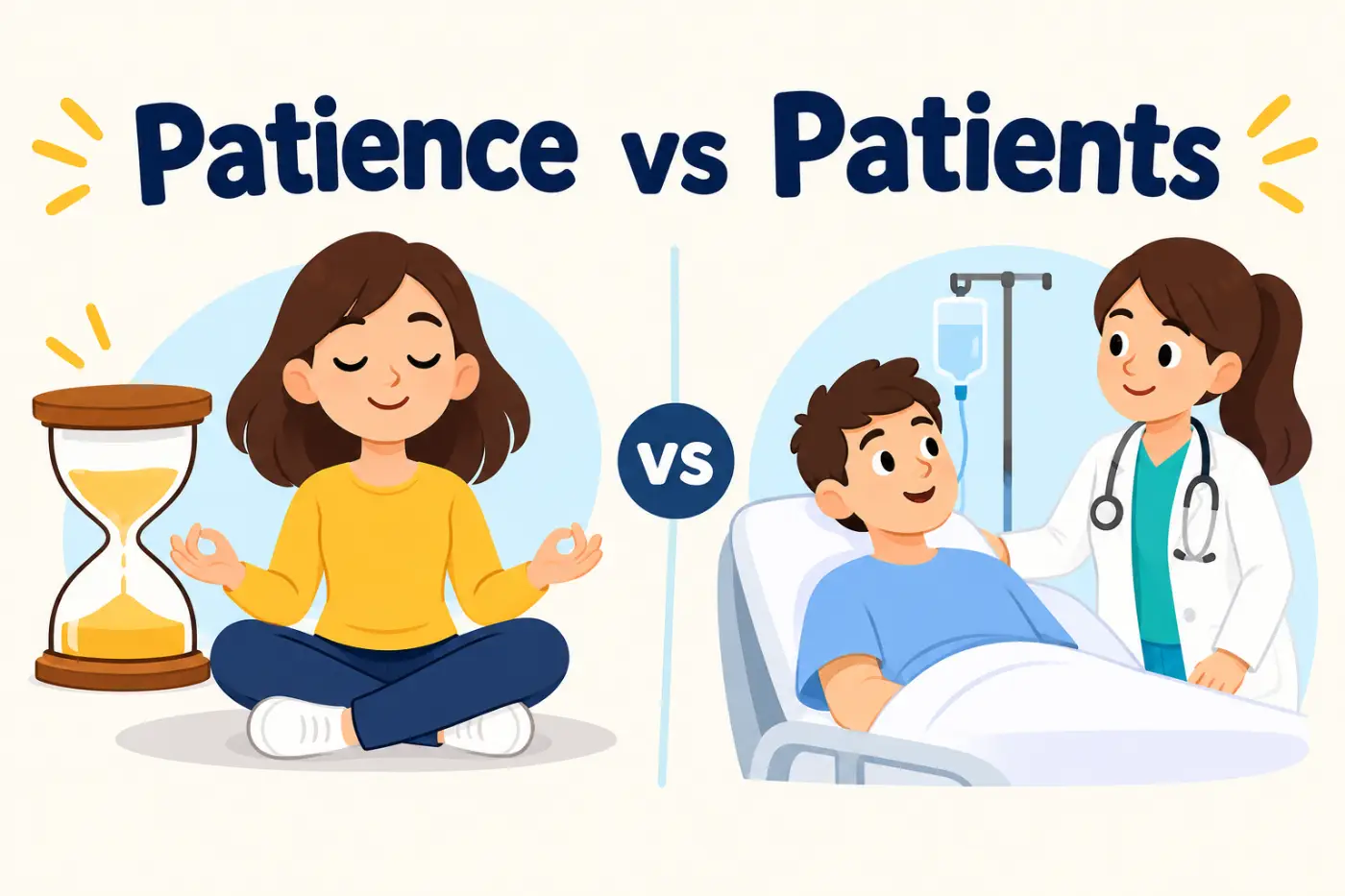
The words patience vs patients sound exactly the same. However, they have very different meanings. One describes the ability to stay calm and wait. The other refers to people who receive medical care. Mixing them up can change the meaning of a sentence completely.
The confusion between patience vs patients often comes from their pronunciation. Both words sound like PAY shunts when spoken aloud. However, their spelling and meaning depend on the situation. If you’re talking about staying calm during a long wait then you need patience. If you’re talking about people visiting a doctor or receiving treatment then you need patients.
For example, you might say that a teacher needs patience when working with young children. You might also say that a doctor sees many patients every day. Both sentences are correct because each word has a different job.
The good news is that the difference is easy to remember once you understand how each word works. In this guide you’ll learn their meanings, spelling rules, grammar differences, and common uses. You’ll also find plenty of everyday examples to help you choose the right word without second guessing yourself.
Quick Definition
Patience is a noun that means the ability to stay calm and wait without getting upset or frustrated. It can also describe the ability to handle delays or difficult situations calmly.
Patients is the plural form of patient. It refers to people who receive medical care from doctors, nurses, dentists, or other health professionals.
Direct Answer
Patience means the ability to wait calmly or deal with something difficult without getting upset. Patients means people who receive medical treatment. Use patience when talking about a person’s behavior and patients when talking about people receiving health care.
Patience vs Patients Comparison Table
| Word | Meaning | Example Sentence | When to Use It |
|---|---|---|---|
| Patience | The ability to wait calmly or stay calm during a difficult situation. | Learning a new skill takes patience. | When discussing calmness or self control. |
| Patients | People who receive medical care. | The doctor treated five patients today. | When discussing people at a medical facility. |
| Patient | A person receiving medical care or someone who can wait calmly. | The patient waited for the doctor. | When referring to one person or describing someone as calm. |

What Is the Difference Between Patience and Patients?
The main difference comes down to meaning and grammar. Although these words sound alike, they don’t serve the same purpose in a sentence.
Patience describes a quality or personal ability. Patients refers to people who receive medical treatment. One is an abstract noun. The other is a plural noun that names people.
Let’s look at each word more closely.
Understanding the Meaning of Patience
Patience is the ability to remain calm when something takes time or doesn’t go as planned. It helps people handle delays, problems, and difficult situations without losing their temper.
For example, imagine you’re waiting in a long line at the grocery store. The line moves slowly and the person ahead of you takes several minutes to finish paying. You might feel annoyed, but you decide to wait quietly. That is patience.
People use this word in many parts of daily life. Parents need patience when teaching children. Students need patience when learning a difficult subject. Drivers need patience when traffic gets heavy.
Patience doesn’t mean that you never feel frustrated. It means you can manage your feelings instead of reacting immediately.
Here are some natural examples.
- My mother has the patience to teach young children.
- Learning to play the piano takes time and patience.
- Please have patience while I finish this task.
- He lost his patience after waiting for two hours.
- Building a strong friendship requires patience and understanding.
- You need patience when dealing with difficult customers.
- Her patience helped her handle a stressful situation.
- I don’t have much patience for people who constantly interrupt me.
Notice that patience often appears with words such as have, show, need, lose, and require. These combinations are common in everyday English.
Understanding the Meaning of Patients
Patients is the plural form of patient. It describes people who receive medical attention or treatment from health professionals.
A patient might visit a doctor because of an illness. Someone might also become a patient after an accident or during a hospital stay. The word applies to people receiving medical care in different settings.
For example, a dentist may see several patients in one afternoon. A nurse may care for ten patients during a shift. A hospital may admit new patients every day.
Here are some examples.
- The doctor examined three patients this morning.
- The hospital admitted several new patients overnight.
- Nurses checked on their patients before the evening shift.
- The clinic treats patients with different health problems.
- All patients must check in at the front desk.
- The dentist asked his patients to arrive early.
- The medical team helped patients recover after surgery.
- The hospital needs more rooms for its patients.
In each sentence, patients refers to people receiving health care. It has nothing to do with waiting calmly or controlling emotions.
Why Do These Words Sound the Same?
Patience and patients are homophones. Homophones are words that sound the same but have different meanings. They may also have different spellings.
English has many homophones. For example, right and write sound alike but have different meanings. Their and there also sound alike but work differently in sentences.
The same thing happens with patience and patients. Their pronunciation is nearly identical in standard American English. The ending sounds the same even though the spelling changes.
This creates a problem when people write quickly. Someone might know exactly what they want to say but still choose the wrong spelling because they rely on sound instead of meaning.
The easiest solution is to understand the context. Ask yourself what you’re describing. If you’re talking about staying calm then write patience. If you’re talking about people receiving medical care then write patients.
How to Use Patience in a Sentence
Patience is an uncountable noun. It describes an ability or quality rather than a person or object that you can count.
You can have patience, show patience, develop patience, or lose patience. However, you generally don’t use a number directly before it.
For example, you can say I need more patience. You wouldn’t normally say I need three patiences.
Let’s look at its common uses.
Use Patience When Talking About Waiting
People often use patience when something takes longer than expected. Waiting can test your ability to stay calm, especially when you have somewhere to go or something important to finish.
Consider these examples.
- Please have patience while the computer updates.
- We need patience because the repair may take several hours.
- She showed great patience while waiting for her flight.
- I tried to keep my patience during the long delay.
- You need patience when dealing with slow internet connections.
In these sentences, patience describes how someone handles waiting.
Use Patience When Learning Something New
Learning takes time. You won’t understand every lesson or master every skill on your first attempt. Patience helps you keep going when progress feels slow.
For example, a child learning to ride a bicycle may fall several times before getting it right. A beginner learning English may struggle with pronunciation or grammar. Both need patience to improve.
Consider these examples.
- Learning English requires patience and regular practice.
- You need patience when learning how to drive.
- My coach showed patience while teaching me to swim.
- Developing good writing skills takes patience.
- She had the patience to practice the song until she got it right.
Here, patience refers to the ability to keep trying without giving up too quickly.
Use Patience When Dealing With People
Some situations require you to understand other people and give them time. This is especially true when someone is upset, confused, or learning something new.
For instance, a parent may need patience when explaining a rule to a child. A manager may need patience when training a new employee. A friend may need patience when listening to someone going through a difficult time.
Examples include the following.
- You should show patience when someone makes an honest mistake.
- My father has always had patience with me.
- Good teachers need patience with their students.
- She handled the disagreement with patience.
- Working with young children takes a lot of patience.
Patience can make relationships stronger because it gives people room to learn and communicate.
Use Patience in Negative Sentences
You can also use patience to explain that someone doesn’t tolerate delays or difficult behavior well.
For example.
- I have no patience for rude behavior.
- He doesn’t have enough patience to teach beginners.
- She is running out of patience with the noisy neighbors.
- We had little patience left after the long meeting.
- My brother has never had much patience for traffic.
These examples show that patience can describe a quality someone has in large or small amounts.
How to Use Patients in a Sentence
Patients is a plural countable noun. It refers to two or more people who receive medical care. You can use it when talking about doctors, nurses, hospitals, clinics, dentists, and other health services.
Unlike patience, patients refers to actual people. You can count them. For example, a doctor might treat five patients in the morning and eight more in the afternoon.
Here are the most common ways to use this word.
Use Patients When Talking About Medical Care
Doctors and other health professionals use the word patients to describe the people under their care. These people may visit a clinic for a checkup or stay in a hospital for treatment.
Examples include.
- The doctor saw twelve patients before lunch.
- The clinic accepts new patients every week.
- The nurse gave medicine to her patients.
- Several patients arrived at the emergency room.
- The hospital provides free care to low income patients.
- The medical team helped patients with serious injuries.
- The dentist explained the treatment plan to his patients.
- All patients should follow their doctor’s instructions.
In each example, patients means people receiving health care.
Use Patients When Talking About Hospitals
Hospitals care for people with many different health needs. Some patients stay for several days. Others visit for a few hours and return home.
You can use patients when discussing hospital rooms, medical records, treatment plans, recovery, and hospital services.
For example.
- The hospital moved its patients to safer rooms.
- Nurses checked the condition of their patients throughout the night.
- Some patients needed extra care after surgery.
- The hospital has separate rooms for children and adult patients.
- Doctors discussed the patients’ progress during the morning meeting.
- The medical staff helped patients prepare for discharge.
The word can describe people receiving care for a short time or a longer period.
Use Patients When Talking About Doctors and Nurses
Medical professionals often work with many patients during a single shift. The word fits naturally when describing their duties and responsibilities.
Consider these examples.
- Doctors must listen carefully to their patients.
- Nurses help patients understand their treatment plans.
- The surgeon spoke with his patients before the operation.
- The pediatrician treats young patients.
- The clinic trains its staff to communicate clearly with patients.
- Nurses comforted patients who felt nervous about their procedures.
These examples show how patients appears in common medical conversations.
Use Patients When Talking About Dental Care
The word isn’t limited to hospitals or general medical treatment. Dentists, orthodontists, and other dental professionals also have patients.
For example.
- The dentist examined two patients before noon.
- Her patients trust her advice about dental care.
- The orthodontist treats patients with braces.
- The dental clinic welcomes patients of all ages.
- The dentist explained the procedure to his patients.
Remember that a person receiving dental care is also a patient.
Patience vs Patient vs Patients
The words patience, patient, and patients are closely related. However, each one has a different meaning and grammatical role.
Understanding all three will help you avoid common spelling mistakes.
What Does Patient Mean?
Patient has two main uses in English. It can work as an adjective or a noun.
As an adjective, patient describes someone who can wait calmly or deal with problems without becoming upset.
For example.
- My sister is very patient with children.
- Please be patient while we solve this problem.
- He remained patient during the long meeting.
- A good teacher should be patient with beginners.
- She was patient while her son learned to read.
In these sentences, patient describes a person’s behavior.
As a noun, patient refers to one person who receives medical care.
For example.
- The patient is waiting outside the doctor’s office.
- The doctor examined a young patient.
- Every patient needs a clear treatment plan.
- The nurse helped the patient get out of bed.
- The patient asked the doctor about the medicine.
The context tells you which meaning applies.
What Does Patients Mean?
Patients is the plural form of the noun patient. It refers to more than one person receiving medical care.
For example.
- The doctor treated several patients today.
- The patients waited quietly in the clinic.
- Nurses checked on their patients every hour.
- The hospital admitted twenty new patients.
- All patients must bring their medical records.
Notice that patients doesn’t describe someone’s ability to wait calmly. It only refers to people receiving medical care.
A Simple Comparison
| Word | Part of Speech | Meaning | Example |
|---|---|---|---|
| Patience | Noun | The ability to stay calm while waiting or facing difficulty. | Patience helps you learn new skills. |
| Patient | Adjective | Able to wait calmly without getting upset. | She is patient with her students. |
| Patient | Noun | One person receiving medical care. | The patient needs more rest. |
| Patients | Plural noun | Two or more people receiving medical care. | The doctor treated several patients. |
Why Patient and Patience Are Different
Patient and patience share a similar meaning when they describe someone’s ability to wait calmly. However, they have different grammatical forms.
Patient is an adjective. Patience is a noun.
Compare these sentences.
- She is patient with her younger brother.
- She has patience with her younger brother.
Both sentences express a similar idea. The first describes her personality. The second describes a quality she possesses.
You can also compare these examples.
- Be patient while the doctor finishes the examination.
- Have patience while the doctor finishes the examination.
Both are correct. The first uses an adjective. The second uses a noun.
This difference becomes easier to recognize when you pay attention to the words around them.
Common Mistakes People Make With Patience and Patients
Even people who speak English every day sometimes confuse these words. Their similar pronunciation makes spelling mistakes easy to miss.
However, a few simple checks can help you choose the correct word.
Using Patients When You Mean Calmness
This is one of the most common mistakes. Someone may write patients when they actually want to describe the ability to wait calmly.
Incorrect: You need patients when learning a new language.
Correct: You need patience when learning a new language.
The sentence discusses a personal quality. It doesn’t refer to people receiving medical care.
Another example.
Incorrect: I have no patients for noisy children.
Correct: I have no patience for noisy children.
The correct word is patience because the speaker is talking about tolerance.
Using Patience When You Mean People Receiving Care
The opposite mistake happens when someone uses patience to refer to people in a medical setting.
Incorrect: The doctor treated ten patience today.
Correct: The doctor treated ten patients today.
The sentence describes ten people receiving medical treatment. Therefore, patients is the correct spelling.
Here is another example.
Incorrect: The hospital needs more beds for its patience.
Correct: The hospital needs more beds for its patients.
A hospital provides beds for people receiving medical care. It doesn’t provide beds for the quality of staying calm.
Confusing Patient With Patients
Another common error involves the singular and plural forms of the medical noun.
Use patient when you mean one person. Use patients when you mean two or more people.
Compare these examples.
- The patient is waiting for the doctor.
- The patients are waiting for the doctor.
The first sentence refers to one person. The second refers to several people.
Pay attention to the verb too. A singular subject usually takes a singular verb. A plural subject usually takes a plural verb.
For example.
- The patient needs medical attention.
- The patients need medical attention.
This small grammar detail can help you spot mistakes in your writing.
Writing Patients When You Mean Patient
Sometimes people add an unnecessary s to patient.
Incorrect: Please be patients while we prepare your order.
Correct: Please be patient while we prepare your order.
Here, patient is an adjective that describes how someone should behave. It doesn’t need a plural ending.
You can also say Please have patience while we prepare your order.
Both correct sentences express the same general idea.
Confusing Patience With Other Similar Words
Some writers confuse patience with words such as tolerance, endurance, and persistence. These words are related but don’t always mean the same thing.
- Patience means staying calm while waiting or dealing with difficulty.
- Tolerance means accepting something you dislike or find difficult.
- Endurance means having the strength to continue through hardship.
- Persistence means continuing to work toward a goal despite problems.
For example, a runner needs endurance to finish a long race. A student needs persistence to keep studying after a poor test result. A person waiting for a delayed flight needs patience.
These words can overlap in certain situations. However, each one focuses on a different quality.
Easy Ways to Remember the Difference
You don’t need to memorize complicated grammar rules to choose between these words. A few simple memory tricks can make the difference stick.
Remember That Patience Is a Personal Quality
Think of patience as something a person has or shows. You can’t count patience like you count people.
You can have patience with a child. You can lose patience during a long wait. You can also develop more patience through practice.
A useful memory sentence is.
Patience helps you stay calm.
Whenever your sentence discusses calmness, waiting, or self control, patience is usually the word you need.
Remember That Patients Are People
Think of a hospital or doctor’s office. The people receiving treatment are patients.
You can count them.
- One patient.
- Two patients.
- Five patients.
- Twenty patients.
The word refers to people rather than a personal quality.
A useful memory sentence is.
Patients visit doctors.
If your sentence talks about doctors, nurses, hospitals, clinics, or medical treatment, patients is likely the correct choice.
Look for Clues in the Sentence
The words around the confusing term can tell you which spelling to use.
For example, words such as have, lose, show, develop, and need often appear with patience.
- She needs more patience.
- He lost his patience.
- They showed patience during the delay.
Words such as doctor, nurse, hospital, clinic, treatment, and medical care often appear with patients.
- The doctor examined his patients.
- The clinic welcomed new patients.
- Nurses helped the patients recover.
These clues aren’t strict grammar rules. However, they make choosing the correct word much easier.
Replace the Word to Check Your Sentence
Another useful trick is to replace the confusing word with a simpler phrase.
If you mean patience, try replacing it with the ability to wait calmly.
For example.
You need patience when learning to cook.
You need the ability to wait calmly when learning to cook.
The sentence still makes sense. That tells you patience is correct.
If you mean patients, try replacing it with people receiving medical care.
For example.
The doctor treated several patients.
The doctor treated several people receiving medical care.
The meaning stays the same. Therefore, patients is correct.
This replacement trick works well when you’re unsure about spelling during writing or editing.
Patience and Patients in Everyday Situations
These words appear in different parts of daily life. Looking at real situations can help you understand how naturally they fit into ordinary conversations.
At Home
Families often need patience because people have different habits, needs, and personalities.
For example, parents may need patience when helping children with homework. Brothers and sisters may need patience when sharing a room. Couples may need patience when working through disagreements.
Consider these sentences.
- My parents taught me the value of patience.
- She needs patience when helping her toddler get dressed.
- We should have patience with one another.
- My brother has little patience for loud music.
- Raising children takes patience and love.
You can also use patients in a home setting when discussing medical care.
For example, a person receiving home nursing care is still a patient. A nurse may visit several patients at their homes during the day.
At School
Students and teachers use the idea of patience in many situations. Learning a difficult topic takes time. Some students understand a lesson quickly while others need more practice.
Examples include.
- Teachers need patience when explaining difficult lessons.
- Learning mathematics takes patience and regular effort.
- She showed patience while helping her classmate.
- The students learned to have patience during group activities.
- My teacher was patient when I made mistakes.
The word patients can also appear in school lessons about health care.
For example.
- Medical students learn how to communicate with patients.
- The nursing class studied the needs of older patients.
- The school invited doctors to talk about patient care.
At Work
Patience is useful in almost every workplace. Employees may deal with tight deadlines, demanding customers, technical problems, and unexpected delays.
For example.
- Good customer service requires patience.
- I need patience when training new employees.
- She handled the difficult customer with patience.
- The manager remained patient during the meeting.
- Our team showed patience while waiting for the new system.
Patients is common in workplaces connected to health care.
- The hospital employs nurses who care for patients.
- The clinic treats patients with different medical needs.
- Doctors discuss difficult cases with other health professionals.
During Travel
Travel often tests a person’s patience. Flights get delayed. Roads become crowded. Long lines can make even a short trip feel exhausting.
Examples include.
- You need patience when airport security lines are long.
- We lost our patience after waiting three hours.
- She remained patient during the flight delay.
- Driving through heavy traffic requires patience.
- Please be patient while we find your luggage.
Patients can also appear in travel related medical situations.
For example, a doctor may arrange transportation for patients who need treatment at another hospital.
During Difficult Times
Patience can help people deal with stressful situations. It gives them time to think before reacting.
For example, someone recovering from an injury may need patience because healing can take time. A person searching for a job may need patience while waiting for interview results.
Consider these sentences.
- Recovery takes time and patience.
- You need patience when things don’t go as planned.
- She showed patience during a difficult period.
- He learned to be patient with himself.
- Building a better future requires patience and effort.
Patients also appears when talking about people receiving care during difficult times.
- The hospital provided support to patients after the accident.
- Doctors monitored patients during their recovery.
- The medical team helped patients cope with their injuries.

Patience vs Patients in American English
American English uses both words in the same way as standard English. Their meanings and grammar don’t change based on the country or region.
However, their pronunciation can make them tricky for English learners. Both words sound alike in everyday American speech. This means you usually can’t identify the correct spelling by listening alone.
The context of the sentence matters most.
Are There Any Differences in British and American English?
No. Both American and British English use patience to describe the ability to wait calmly. They also use patients as the plural form of patient when talking about people receiving medical care.
For example.
- American English: The doctor treated several patients.
- British English: The doctor treated several patients.
- American English: You need patience when learning a new skill.
- British English: You need patience when learning a new skill.
The spelling stays the same in both varieties of English.
Does Pronunciation Change the Meaning?
No. Both words have the same pronunciation in standard American English. Their meanings come from their spelling and the context in which they appear.
For example, if someone says PAY shunts while talking about a hospital, they probably mean patients. If they’re discussing the ability to wait calmly, they mean patience.
This is why context matters when you write these words. Sound alone can’t help you choose the right spelling.
Related Words and Commonly Confused Terms
Patience and patients aren’t the only words that cause spelling confusion. English has several word pairs that sound alike or look similar but have different meanings.
Learning these pairs can help you become a more confident writer.
Patient vs Impatient
Patient describes someone who can wait calmly. Impatient describes someone who becomes annoyed or frustrated when things take too long.
For example.
- My teacher is patient with new students.
- I become impatient when people arrive late.
- She remained patient during the long wait.
- He grew impatient after waiting for an hour.
The prefix im changes the meaning to its opposite.
Patience vs Tolerance
Patience and tolerance are related, but they don’t mean exactly the same thing.
Patience focuses on staying calm while waiting or dealing with a difficult situation. Tolerance means accepting something that you may dislike or disagree with.
For example.
- You need patience when teaching a young child.
- People should show tolerance toward different opinions.
- She showed patience while waiting for her friend.
- He has little tolerance for dishonest behavior.
Both qualities can help people build better relationships.
Patience vs Persistence
Persistence means continuing to work toward something despite problems or setbacks. Patience means staying calm while waiting or dealing with difficulties.
A person may need both qualities to achieve a goal.
For example.
- Learning a language requires patience and persistence.
- Her persistence helped her finish the project.
- You need patience when progress is slow.
- He showed persistence by trying again after failing.
Persistence keeps you moving forward. Patience helps you handle the time and effort involved.
Patient vs Patience in Grammar
The words patient and patience are related, but they fit into sentences differently.
Patient is an adjective when it describes a person. Patience is a noun when it names the quality of staying calm.
Compare these examples.
- Be patient with your younger brother.
- Show patience with your younger brother.
- She is patient when teaching children.
- She has patience when teaching children.
Both forms can express a similar idea. However, the grammar changes depending on the word you choose.
Practice Examples to Test Your Understanding
The best way to remember the difference is to use both words in real sentences. Try these examples and see if you can choose the correct spelling.
Fill in the Blanks
Choose patience or patients to complete each sentence.
- The doctor treated several new ______ yesterday.
- Learning a musical instrument takes ______.
- Nurses should listen carefully to their ______.
- Please have ______ while I finish this report.
- The hospital admitted five new ______.
- My father has always had great ______.
- The dentist examined all his ______.
- You need ______ when dealing with difficult customers.
- The clinic welcomes new ______ every month.
- She lost her ______ after waiting for two hours.
Correct Answers With Explanations
- Patients. The sentence refers to people who received medical treatment.
- Patience. Learning an instrument takes time and calm effort.
- Patients. Nurses care for people receiving medical attention.
- Patience. The sentence asks someone to wait calmly.
- Patients. Five refers to people admitted to the hospital.
- Patience. The sentence describes a personal quality.
- Patients. The dentist examined people receiving dental care.
- Patience. Dealing with difficult customers requires calm behavior.
- Patients. The clinic welcomes people who need medical services.
- Patience. The sentence describes someone becoming frustrated after waiting.
More Examples for Better Practice
Here are additional sentences that show how the words work in different situations.
Examples with patience.
- Patience is a valuable quality in a good teacher.
- I need more patience when working under pressure.
- His patience helped him solve the problem.
- She showed patience while teaching her grandmother to use a smartphone.
- You should have patience with yourself when learning something new.
- It takes patience to grow a garden from seeds.
- The children waited with patience for their turn.
- He finally ran out of patience after several delays.
Examples with patients.
- The doctor spoke with his patients before starting treatment.
- Several patients were waiting outside the examination room.
- The hospital provides special care for older patients.
- The nurse prepared the rooms for new patients.
- Some patients need regular checkups.
- The clinic treats patients with common illnesses.
- The medical team answered questions from worried patients.
- All patients received instructions before leaving the hospital.
Notice how the meaning stays clear in every example. Patience describes an ability or quality. Patients identifies people receiving medical care.
FAQs
What Is the Main Difference Between Patience and Patients?
Patience means the ability to stay calm while waiting or dealing with something difficult. Patients refers to people who receive medical care. The two words sound alike but have different meanings.
Is Patience Singular or Plural?
Patience is an uncountable noun. It doesn’t normally have a plural form. You can say I need more patience or She has a lot of patience.
Is Patients the Plural of Patient?
Yes. Patients is the plural form of the noun patient when it refers to someone receiving medical care. One person is a patient while two or more people are patients.
How Do You Spell Patience When Talking About Waiting?
The correct spelling is patience. Use it when discussing calmness, self control, or the ability to wait without becoming frustrated. For example, Learning a new skill requires patience.
How Do You Use Patients in a Medical Sentence?
Use patients when referring to two or more people receiving medical treatment. For example, The doctor examined six patients today. You can use it when discussing hospitals, clinics, dentists, nurses, and other health professionals.
Are Patience and Patients Homophones?
Yes. They are homophones because they have the same pronunciation but different spellings and meanings. You need to understand the sentence to choose the correct word.
Can I Use Patient Instead of Patience?
No. They have different grammatical roles. Patient can describe someone who waits calmly or refer to one person receiving medical care. Patience is the noun that describes the ability to wait calmly.
What Is a Good Trick to Remember Patience and Patients?
Remember that patience is something you need when waiting. Patients are people who visit doctors for medical care. If your sentence discusses calmness, use patience. If it discusses people receiving treatment, use patients.
Conclusion
The difference between patience and patients is simple once you understand their meanings. Patience describes the ability to stay calm during delays or difficult situations. Patients refers to people who receive medical care.
Remember that patience is an uncountable noun. You can have patience, show patience, or lose patience. Patients is the plural form of patient and refers to more than one person receiving treatment.
The easiest way to avoid mistakes with patience vs patients is to check the meaning of your sentence. If you’re talking about waiting calmly, choose patience. If you’re talking about doctors and people receiving medical care, choose patients.
Keep this simple rule in mind and you’ll have no trouble choosing the right spelling in your everyday writing.

Dr. Elena Vance holds a Ph.D. in Linguistics from Columbia University and has spent over 15 years analyzing the evolution of the English language. A former university professor turned full-time writer and editor, Elena specializes in breaking down high-level grammatical concepts, punctuation nuances, and style guides (APA, Chicago, MLA) into clear, actionable advice. When she isn’t hunting down dangling modifiers, she can be found collecting vintage dictionaries and reading classic literature.